

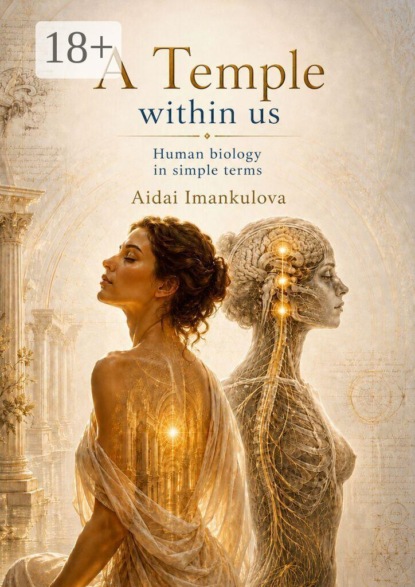
A Temple within us. Human biolo

- -
- 100%
- +

Proofreader Aidai Imankulova
Cover designer Aidai Imankulova
Cover designer DALL-E
© Aidai Imankulova, 2026
© Aidai Imankulova, cover design, 2026
© DALL-E, cover design, 2026
ISBN 978-5-0071-1095-2
Created with Ridero smart publishing system
The Threshold of Metaphor
Disclaimer: “All analogies presented in this book are of an exclusively metaphorical, artistic, and philosophical nature. The author does not claim to establish a new religious doctrine or revise academic neurobiology.”
Scientific Essence: This project is strictly popular science, grounded in evidence-based medicine, fundamental neurobiology, and endocrinology. The integration of socio-cultural, religious, and architectural concepts is purely metaphorical (SciArt).
Metaphorical Narrative: This book is not a theological commentary. Instead, it utilizes the biblical architecture of the Temple and its sacred hierarchy as a universal cultural code to visually elucidate the most complex principles of homeostasis. Remarkably, the anatomy of the brain mirrors the concept of a sacred space where a higher order is perpetually maintained.
Introduction
A Single Source: The Boundless Temple
Welcome, dear reader! My name is Aidai. A chemist by training and a science communicator by calling, I am not a professional theologian. My true passion lies in biochemistry and the intricate design of the human body. I love to imagine complex scientific concepts as vivid, living images, translating them into the simplest, most accessible language. My ultimate goal is to show that science is not made of dry formulas, but of a breathtakingly beautiful, deeply logical, and captivating architecture.
This book is not a religious treatise, nor is it an attempt to rewrite sacred texts or offer a new paradigm in rigid academic endocrinology. It is my personal invitation to a fascinating thought experiment. It is a sincere quest for a fresh, living language to explain the incredibly complex processes occurring within us every single second.
Today, virtually everyone is familiar with the Bible and its pivotal stories in one way or another. We absorb these images from early childhood through cinema, classical painting, literature, and even animation. Remarkably, we do not need to study ancient texts deeply to grasp their essence. Take, for instance, Leonardo da Vinci’s famous masterpiece, The Last Supper. Personally, I first learned of this historical event through the brush of that great artist. Life is full of such examples. Biblical narratives have long since become a universal code of human culture, understood by each of us without translation.
At some point, I experienced a striking insight: the complex processes happening inside our bodies every second conceptually and structurally mirror these foundational cultural narratives down to the smallest detail. Yet, my own journey toward understanding this “inner Bible” did not begin beneath the vaults of the majestic cathedrals of Moscow, where I live now, nor in the silence of solitary contemplation. It did not even begin under the domes of ancient mosques, though my family is Muslim.
Every great journey begins at a point where conventional boundaries blur. Mine began in an ordinary Russian-speaking school in the city of Frunze, Kyrgyzstan (now Bishkek), during after-school activities where a childhood sense of “we” was far more powerful than adult divisions of nationality, culture, and religion.
In the early grades, the world feels vast, shared, and beautifully simple. We did everything together: studied, made noise during breaks, and ate at long tables. In that tight-knit childhood ecosystem of Frunze, I was the only Kyrgyz girl in my class (or perhaps there were two of us, it doesn’t matter), but I never felt like an outsider. Childhood has no filters for alienation — there is only a shared space for living. So, when the class gathered to go to church on Sundays, they didn’t leave me behind. It wasn’t out of a desire to convert me or impose a different faith, but for the simplest, purest reason: “How can we all go and leave her behind? We are together.”
My mother was always at work, trusting me to this collective childhood current where nothing felt scary or forbidden. For me, those church visits and school lessons were simply a peaceful, gentle introduction to a grand history. We were taught the Old and New Testaments as an overview. They didn’t force us to memorize dogmas; they opened up images to us. And it was precisely this pure, unfiltered perspective of an outsider that allowed me to see in the sacred texts not a code of strict religious rules, but a universal code of the human being.
Living in the city of Frunze, whether you wanted to or not, you learned about Easter from early childhood. This knowledge didn’t come from textbooks; it was literally diffused in the very air of spring days. My mother and I lived surrounded by Christian neighbors, and the atmosphere of their holidays was part of my own world. I remember that special, trembling anticipation of the approaching Easter. For me, a little Muslim girl, this day was shrouded in real magic, and I looked forward to it eagerly.
And yet, when you are a child, the grandeur of the moment is often intertwined with the simplest, most earthly spontaneity. I feel a bit ashamed to recall this now, but you can’t erase words from a song. In those Easter days, my childhood reverence went hand in hand with the most banal impatience. I would stand on the threshold of a neighbor’s house, politely listening to their greetings, while my eyes cast a sideways glance at the table. Inside, everything would freeze in anticipation: when would they finally hand me that coveted dyed egg and cut a piece of aromatic Kulich cake? At that moment, my mouth was watering profusely.
This tiny drop of childhood weakness was, perhaps, the most honest reaction to a miracle. And it concealed a profound biological truth! The desire to get a treat that makes your mouth water is the pure handiwork of our Hypothalamus (the Father), which is responsible for basic instincts, blood constants, and hunger. And when we finally receive joy and long-awaited pleasure, the Pituitary Gland (the Son) instantly surges into the bloodstream, releasing hormones of happiness and translating the brain’s commands onto a material level.
By around the fourth or fifth grade, childhood spontaneity gave way to a conscious, pragmatic approach. I was already planning the upcoming Easter in advance, finding out the date. On the designated day, I decided not to waste time on trifles: I took a real, large bucket from home and set off on a journey through the neighboring houses. Imagine an eleven-year-old Kyrgyz girl with a huge bucket, ready to collect Easter gifts in Frunze! The neighbors didn’t chase me away — they laughed from the bottom of their hearts, were deeply touched, and filled that bucket with Kulich cakes and dyed eggs with genuine generosity. From a neurobiological standpoint, this trek with a bucket was the exact moment when the Pituitary Gland — the highest center of planning, coordination of actions, and the materialization of desires — switched on at full strength.
That day, I collected an entire bucket of eggs. I returned home like a triumphant conqueror. There were so many eggs that my mother and I physically did not know how to eat them all, and in the end, we had to pack bags and treat our relatives, sharing this Easter abundance with them. In this childhood act, there was only pure joy that expanded beyond the borders of a single home. A full bucket of round eggs, beneath whose shells lies hidden the mystery of the origin of life, became a precise replica of our skull, which the Creator filled to the brim with billions of unique cells. And among them, like the most important “golden eggs,” the neuroendocrine triad remarkably stands out — the Hypothalamus, Pituitary Gland, and Pineal Gland.
Many years later, while studying biochemistry professionally, I was amazed by how accurately those childhood lessons of the Old and New Testaments project onto the structure of our brain:
— The Old Testament, with its strict laws and the unshakeable will of the Creator, is the kingdom of the Hypothalamus (the Heavenly Father). It is an ancient, fundamental analytical center where the laws of survival, basic instincts, and the balance of life and death are born. It is the primal source of our body’s will and homeostasis.
— The New Testament, which brought the idea of incarnation, love, and transformation, is the manifestation of the Pituitary Gland (the Son / the Executor). It receives the impulses of the Father and embodies them into physical reality, giving birth to the hormones of action, development, and adaptation. It “humanizes” the deep will of the brain, translating mental commands into the material language of hormones.
— Above them, sensing the highest planetary cycles, watches the Pineal Gland (the Holy Spirit / the Timekeeper). It is an invisible guide that connects the organism’s earthly existence with the cosmic rhythm of the Universe, setting the fundamental tone for the entire endocrine system.
Living in Moscow today, I often recall those open doors. Here, in the vast megalopolis, everything is different. People are constantly busy, consumed by their own worries, and neighbors are deeply closed off. Cities grow, but doors close. In the Frunze of my childhood, people were different — warmer, more open, ready to let you into their space at the very first knock.
And in this lies a profound metaphor for human maturation. A child is born with an absolutely open “inner Temple.” Their Pineal Gland, Pituitary Gland, and Hypothalamus are pure and receptive to light, just like those open doors in Frunze. But over time, we become encrusted with worries, toxic habits, and fears. Our inner doors close, and the glands of the brain literally begin to calcify, isolating us from the divine impulse of balance.
We will attempt to look at our own body as a perfectly designed, harmonious world. We will translate the dry language of medical atlases into a living language of metaphors that everyone can understand. You will see how the laws of biological homeostasis are reflected in the story of the creation of the world, and how our body daily lives out its own miniature Old Testament dramas and New Testament miracles.
This book is my attempt to knock once again on those closed doors and remind every reader that the child with the bucket still lives inside us, ready to receive the infinite gifts of the Creator. We only need to remember how to open our doors toward the light. Turn the page — and let us step together inside the most wondrous temple on Earth. The temple that resides within us.
The Pineal Gland — The Watchman of the Cosmos
Scientific Essence: The pineal body (epiphysis). Photoperiodism and the detection of circadian rhythms (light/darkness). Melatonin secretion. Synchronization of the endocrine system with external astronomical cycles.
Metaphorical Narrative: The image of the Holy Spirit. The invisible Timekeeper that connects the organism’s earthly existence with the cosmic rhythm of the Universe, setting the fundamental tone for the entire system.
The Hypothalamus — The Lawgiver of Balance
Scientific Essence: The highest subcortical center of the autonomic nervous system and the integration of endocrine functions. Monitoring of blood constants, regulation of homeostasis, and management of motivations and stress cascades.
Metaphorical Narrative: The image of God the Father. The supreme analytical center and the Lawgiver of Balance, who continuously perceives and evaluates every detail within the inner world, knowing the needs of the system in advance.
The Pituitary Gland — The Executor of Will
Scientific Essence: The central endocrine gland. Embryonic genesis: the fusion of the ectodermal Rathke’s pouch and the neuroectoderm of the diencephalon. Secretion of trophic hormones to govern peripheral glands.
Metaphorical Narrative: The image of God the Son (The Mediator). The grand embryonic miracle where earthly nature (Rathke’s pouch) merges with divine neural tissue. The Executor of the Father’s Will, translating the mental commands of the brain into the physical language of hormones to rule the body.
Part I. The Old Testament: The Birth of Homeostasis
Volume I. The Book of Genesis of Homeostasis
Chapter 1. The Great Architect and the Primal Cell
The Six Days of Creation as Stages in the Formation of a Living System
Any complex system, whether a vast and flourishing universe or a living cell invisible to the naked eye, always begins its journey in the exact same way — by overcoming chaos. In physics, this primordial chaos is called entropy; in ancient cosmogonic narratives, it is known as the primordial darkness and the abyss. Yet the essence remains identical: it is a state in which elements are disconnected, intermingled, devoid of structure, and moving blindly. The birth of life is a magnificent process of ordering, where chaos step by step yields to the strict laws of homeostasis. If we closely examine how the first living cell emerged and grew more complex, we will discern a marvelous six-stage rhythm that mirrors with astonishing precision the logic of the six metaphorical days of creation.
The first stage of this creation began with a fundamental division: “Separating light from darkness.” On the scale of emerging life, this was the moment energy was born. Before the first contours of a cell ever appeared, a chaotic biochemical soup swirled all around. But life cannot exist without an energetic impulse; energy is the light of an organism. The first step toward homeostasis was capturing this “light” — separating chaotic thermal motion from a directed flow of electrons. For the first time, the elements of future life received a directional vector, a polarity, a plus and a minus. There emerged what physiologists would call an electrical potential — the spark that jump-started the heartbeat of the biological world.
At the second stage, a necessity for space arose: “Separating the waters under the firmament from the waters above the firmament.” For biology, this was a moment of supreme triumph — the appearance of the first membrane. Imagine a boundless ocean of chemical substances. For life to be born, a line had to be drawn. The cell constructed its own “firmament” — a micro-thin yet resilient lipid shell. It separated the internal water (cytoplasm) from the external water of the global ocean. Thus, the foundational concept of biological order was born: “Self” and “The External World.” Within this boundary, the will of the Great Architect — the laws of homeostasis — became absolute, sheltered from external storms.
The third stage brought structure and dry land: “Let the waters be gathered unto one place, and let the dry land appear.” Inside the cell, the chaotic fluid began to crystallize. The cytoskeleton emerged — a sturdy framework of protein filaments that maintained shape, much like the continents of Earth. Immediately upon this structural dry land, the first “vegetation” took root: primitive protein factories (ribosomes), which began continuously replicating building materials for the young system. Order solidified its positions.
The fourth stage marked the integration of the cosmic rhythm: “Let there be lights to divide the day from the night; and let them be for signs, and for seasons, and for days, and years.” A cell cannot live in isolation; it must synchronize with the Universe. This is the stage when the first molecular clock began ticking within the biological system. An emerging prototype of the Pineal Gland (the future Holy Spirit of the system) taught the cell to perceive planetary cycles: when the sun rises, it is time to store energy; when darkness falls, it is time to restore resources. Life acquired its first internal rhythm, subordinate to global Time.
The fifth stage filled the space with movement: “Let the waters bring forth abundantly the moving creature that hath life, and fowl that may fly.” Inside the cell, between the protein continents, a bustling transport traffic erupted. Signaling molecules appeared, swimming like nimble fish from the membrane to the center, carrying information. Transport vesicles emerged to carry cargo. The cell’s internal cosmos came alive, filled with inner informational currents and pathways.
Finally, the sixth stage was the crowning achievement of the system, the creation of the supreme governing center: “Let us make man in our image, after our likeness.” For the cell, this ultimate creation was the nucleus and the DNA enclosed within it. At that moment, the cell gained its Mind, its Book of Law, where the entire blueprint of the organism is inscribed. A direct connection was established: the Hypothalamus (the future Father) received its master plan of the Law, written in the genes, to govern this gigantic cellular state through the Pituitary Gland (the Son). The system became autonomous, complete, and capable of sustaining itself indefinitely. Then came the seventh day — the Sabbath of homeostasis, when all the gears began to turn in the flawless, divine balance of Eden.
The Emergence of Membranes, Boundaries, and Internal Order
The entire grand history of homeostasis, from the very first cell to the most intricate processes in the human brain, rests upon a single fundamental condition. For order to reign within a system, it must first separate itself from external chaos. It is impossible to bring coziness to a public square that is open to all winds, stray animals, and random passersby. Order requires walls. In ancient cosmogonic plots, this stage is described as the creation of the “firmament of heaven,” which divided the raging primordial waters into two isolated parts: the waters below the firmament and the waters above the firmament. For young biological life, this saving firmament was the emergence of the cell membrane.
Before this boundary appeared, all organic chemistry on planet Earth existed in a state of permanent anarchy. Useful molecules, amino acids, and random energetic sparks floated chaotically in the boundless primordial ocean. No sooner did a few elements accidentally bond into a successful chain than the nearest current or temperature spike ruthlessly tore them apart and carried them away in opposite directions. Life could not mature because it had no home. The advent of the lipid membrane — a micro-thin envelope made of fat molecules — changed everything. By drawing an invisible line through the depths of the ocean, nature created the greatest biological divide: the space “Inside” and the space “Outside.”
Конец ознакомительного фрагмента.
Текст предоставлен ООО «Литрес».
Прочитайте эту книгу целиком, купив полную легальную версию на Литрес.
Безопасно оплатить книгу можно банковской картой Visa, MasterCard, Maestro, со счета мобильного телефона, с платежного терминала, в салоне МТС или Связной, через PayPal, WebMoney, Яндекс.Деньги, QIWI Кошелек, бонусными картами или другим удобным Вам способом.