

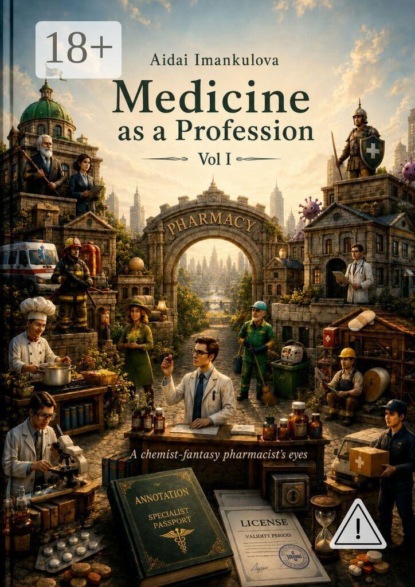
Medicine as a profession. Vol I. A chemist-fantasy pharmacist’s eyes




- -
- 100%
- +

Cover designer Aidai Imankulova
Translator Aidai Imankulova
Cover created by DALL-E
© Aidai Imankulova, 2026
© Aidai Imankulova, cover design, 2026
© Aidai Imankulova, translation, 2026
ISBN 978-5-0071-3234-3 (т. 1)
ISBN 978-5-0071-3235-0
Created with Ridero smart publishing system
Medical Disclaimer
The author kindly reminds readers that all materials presented in this book are created solely for educational, popular-science, and entertainment purposes. The professional metaphors described herein are intended to explain the underlying logic of molecular mechanisms but do not constitute a guide to action.
The governance of the Body-State, interpretation of symptoms, and treatment of any pathologies must be conducted strictly under the guidance of a qualified medical professional — your attending physician. Never engage in self-treatment, handle the ecology of your body with care, and always thoroughly double-check the original official instructions and physical labels of medications before use!
A Note to the Reader
Why Medicines Resemble People of Various Professions
Every time an ordinary person walks into a pharmacy, they see endless rows of boxes with hard-to-pronounce chemical names. For most, it is a dead, intimidating Latin and dull, grey instruction sheets. But to a chemist-fantasizer, a pharmacy is a vast, bustling, and densely populated megacity, where every molecule is a living specialist with its own unique character, educational background, and strict job descriptions.
Medicines are surprisingly like humans. They have a “primary profession” — the reason they are most frequently hired for a job (the main therapeutic effect). They possess “additional skills” (when they can temporarily step in for a colleague from another department). And, of course, they have their own “occupational hazards” (side effects). Just as a construction worker who is exhausted after a long day might accidentally step on someone’s foot, a potent medicine, while performing heavy labor, can slightly disrupt neighboring peaceful organs.
Understanding medicines through the world of professions is the only way to stop blindly memorizing commercial trademarks and begin to see the very core and beautiful logic of biological processes.
The Body as a State: Organs, Ministries, and System Crises
To understand how this city of professions is structured, let us imagine the human body as a sovereign, high-tech state. In this country, a strict hierarchy rules, where every system and every organ is a vital Ministry, agency, or emergency service:
• Central Administration (Hypothalamus and Pituitary Gland): The highest government executive. They meet in the most secure bunker of the brain, making strategic decisions and dispatching directives-hormones across the country. We will analyze the work of these top-ranking officials in detail in Chapter 3.
• Ministry of Communications and Digital Development (The Nervous System): It enmeshes the entire country with millions of kilometers of fiber-optic cables, instantly transmitting signals from the outskirts to the center.
• Ministry of Energy (The Thyroid Gland): A true thermal power plant in a single person, responsible for how brightly the lights burn in the regions, and how quickly cells consume fuel and generate heat.
• Ministry of Defence and Border Control (The Immune System): Patrols the borders of the State around the clock, tracking down virus-spies and ruthlessly destroying the fortified bases of bacterial invaders.
• Ministry of Internal Affairs and Security (Allergy): A special internal police force that occasionally lapses into paranoia and begins storming peaceful citizens (harmless flower pollen or ripe strawberries), causing senseless havoc on the streets.
• Public Utilities and Environmental Oversight (The GI Tract and Kidneys): The main water treatment plants, garbage trucks, and chemical complexes of the country. They dispose of tons of waste, process raw materials, and monitor the cleanliness of internal rivers — blood and lymph.
• Transport and Hydraulics (The Cardiovascular System): A highly complex network of roads, overpasses, and pipelines, along which logistical trains run continuously, delivering oxygen to the most remote provinces of the organism.
When a person is healthy, all Ministries work like clockwork. But illness is always a disruption of the usual rhythm, a specific system crisis: a fire, an accident at the water utility, a traffic collapse, an economic downturn, or an internal rebellion. And at this exact moment, they step onto the stage — the professionals from the pharmacy packages. Some will arrive as crisis managers, some as emergency firefighters, and others as clever and subtle diplomats.
What is Your Medicine’s Job?
Pharmacology often seems like an impregnable fortress. It is barricaded behind thousands of complex names, Latin terms, and endless commercial trademarks. Medical and pharmacy students spend sleepless nights trying to memorize these lists, while novice pharmacists at the counter initially get lost in the sheer volume of brands on the shelves. But in reality, everything is much easier, more logical, and more interesting than what is written in academic textbooks.
By education, I am a chemist. I graduated from the Mendeleev University of Chemical Technology in Moscow. At the time, a rigorous, foundational chemistry education trained my brain to handle colossal amounts of information. We memorized tons of massive encyclopedic formulas, complex reaction mechanisms, and endless classifications of alcohols, acids, complex salts, and polymers.
When, after such training, I came to work in a retail pharmacy, pharmacology seemed even simpler in comparison. Here, you didn’t have to assemble molecules from scratch — you just needed to understand the logic of distributing drugs among professional guilds (pharmacological groups). Thanks to this system, I managed to fully master a huge pharmacy matrix in just one month, flipping through reference books in a Moscow metro car on my way to work.
But by no means does everyone have a foundational specialized education. For most people, all these dry Latin classifications are a true nightmare. That is exactly why I decided to write this book. I want to completely remove complex formulas, heavy terms, and academic unwieldiness from the text. Instead, I suggest turning on your imagination, utilizing figurative thinking, and translating the complex scientific language into the understandable language of everyday life.
After all, every molecule, just like a real employee, possesses:
• Its primary profession (the main therapeutic effect);
• Additional skills (secondary effects);
• Working tools (the molecular mechanism of action);
• A workplace (a specific receptor, enzyme, or tissue);
• Hiring regulations (indications for use);
• Occupational hazards and restrictions (side effects and contraindications);
• An arrival route to the site (the route of administration and pharmacokinetics).
When a fire of inflammation breaks out in the State, brave firefighters — NSAIDs — rush to the call. If pipes burst and the country is flooding, the emergency water utility service — diuretics — takes over. When blind gridlocks form on the roads-vessels, the situation is saved by specialized equipment — anticoagulants. And if the cells of the State are locked and starving while the food warehouses are full, the treasurer-insulin comes to the rescue — the chief keymaster of the energy system, who holds the code to any locked door.
A Translator Book
I want to emphasize a crucial point. What lies before you is not just a collection of artistic inventions for the sake of a beautiful word. Every analogy in this book is strictly verified. It is built upon real biochemistry, physiology, and the unshakeable principles of evidence-based medicine. The images of professions are needed to unlock your intuition and logic without blind memorization. This book does not replace a classic pharmacology textbook. It becomes its translator — a reliable bridge between dry science and living human perception.
Memorizing a complex chemical formula or an abstract commercial brand name is difficult. Memorizing the profession, position, and area of responsibility of a molecule is as easy as pie.
Before you is the First Book of a large diptych: “Medicine as a Profession.” In it, we will figure out exactly what jobs medicines do. We will enter the Body-State and get to know those who save it from catastrophes every single day.
As for the history behind each specialist, the long journey they had to take from an idea to the pharmacy shelf, and the dramas of harsh trials they had to break through — we will remain silent for now. Let that remain an intrigue for the Second Book, “The Fate of a Medicine.” In the meantime, let us open the doors of this amazing pharmacy together!
Chapter 1. The Golden Rule of Pharmacology, or How Molecules Get Hired
When you open a box of pills, you see more than just compressed white powder. You are holding the resume of a highly qualified specialist who has arrived in the Body-State under an urgent contract. To understand how pharmacology works, you need to grasp its golden rule: a medicine behaves inside the organism in exactly the same way a person behaves at their job. It has its own responsibilities, professional habits, corporate conflicts, and even inevitable production overheads.
Primary and Additional Professions: A Jack-of-All-Trades
In academic textbooks, this is dully referred to as “the primary therapeutic and secondary pharmacological effects.” In our universe, however, every molecule has a main specialty for which it is hired most often, and a whole bundle of extra talents.
Imagine a popular and highly experienced employee named Aspirin. His primary profession is a Firefighter. When an emergency strikes the State, and the flames of high fever and inflammation rage, Aspirin promptly arrives at the scene and puts out the fire. However, he has an excellent additional skill that he has mastered to perfection — he knows how to moonshine as a Traffic Controller, preventing platelet-cells from sticking together into dangerous gridlocks. At some point, the State’s Ministry of Health decided that this side skill of his was even more valuable than the main one. As a result, Aspirin in low dosages (cardio forms) began to be hired full-time exclusively as a traffic inspector for the prevention of heart attacks, almost forgetting his firefighting past.
Specialist Profile
• Pharmacological Group Name: Nonsteroidal anti-inflammatory drugs (NSAIDs), antiplatelet agents.
• Site of Service in the Organism: Foci of inflammation (any tissues) and major blood vessels.
• Working Tool (Physiological Mechanism): Irreversible blockade of cyclooxygenase enzymes (COX-1 and COX-2). In the role of a Firefighter, Aspirin halts the synthesis of prostaglandins — the main chemical “alarm sirens” that cause swelling, pain, and fever. In the role of a Traffic Controller, he permanently blocks the synthesis of thromboxane A2 in platelets. The cell loses its ability to secrete sticky protein and can no longer grip tightly to its neighbors, maintaining ideal blood fluidity on the road-vessels.
• Side Effects: Aggressive erosion of the protective stomach mucus, triggering hidden bleeding (“excessive thinning”), specific bronchospasms (“aspirin-induced asthma”).
• Affected Organs (Risks): Gastrointestinal tract, kidney filters, respiratory tract.
• Hiring Requirements (Indications): Prevention of thrombosis and ischemic catastrophes (for low doses), management of acute pain syndrome, fever during infectious fires.
• Strict Contraindications: Erosions and ulcers of the GI tract in the acute phase, hemophilia and a tendency to bleed, third trimester of pregnancy, children under 12 years of age (risk of severe liver damage — Reye’s syndrome).
• Logistics and Transport (Dosage Forms): Standard and effervescent (soluble) tablets, enteric-coated tablets (to reduce stomach harm). Absorbed in the GI tract, works systemically throughout the body.
• Delivery Speed: Standard passenger train. Action begins in 20—30 minutes, peak concentration at the site is reached in 1—2 hours.
It also happens that an additional skill completely overshadows the main specialty, forcing a molecule to change its role forever. Sildenafil was originally hired for a prestigious position as a Hydraulic Engineer to improve blood flow in the major vessels of the heart. But during his test run, it turned out that he had a phenomenal side talent — he perfectly directed targeted hydraulic pressure to the pelvic organs. In the end, Sildenafil quit cardiology entirely, took the resonant pseudonym Viagra, and became the world’s highest-paid specialist in a completely different, intimate sphere.
Specialist Profile
• Pharmacological Group Name: Agents for the treatment of erectile dysfunction, PDE-5 inhibitors.
• Site of Service in the Organism: Smooth muscle structures of the pelvic vessels (highways of targeted pressure distribution).
• Working Tool (Physiological Mechanism): Selective blockade of the phosphodiesterase type 5 (PDE-5) enzyme. Normally, this enzyme works like a “shut-off valve” that quickly cuts off the inflow of hydraulic fluid (blood) after a task is completed. By blocking this valve, Sildenafil allows cyclic guanosine monophosphate (cGMP) to accumulate. The vessels remain maximally dilated, ensuring a powerful and stable influx of blood to the site.
• Side Effects: Sudden rushes of blood to the face and heat, nasal congestion, moderate headache, short-term changes in color perception (the world around may turn blue).
• Affected Organs (Risks): Vascular system of the brain and face, visual analyzer.
• Hiring Requirements (Indications): Erectile dysfunction of various origins, pulmonary hypertension.
• Strict Contraindications: Concurrent use of nitric oxide donors or nitrates (risk of a fatal drop in pressure inside the pipes), severe heart failure, recently suffered heart attack or stroke.
• Logistics and Transport (Dosage Forms): Oral coated tablets. Absorbed in the intestine, requires a preliminary light diet (fatty food blocks molecules from boarding the train).
• Delivery Speed: Express train. Appears at the site in 30—60 minutes, the contract remains valid for 4—5 hours.
Side Effects: Production Noise and Accidental Damage to Neighbors
The medical community and patients often study the long list of side effects in the instruction leaflet with anxiety. But let’s be honest: perfect workers do not exist. Any serious activity leaves traces, and any complex job has its overheads. Side effects of medicines are not the molecule’s mistake. They are the production noise of its profession, or the result of its powerful working tools accidentally brushing against adjacent departments of the State. A specialist arrives, honestly performs their main function, but along the way, they might spill, flood, or scratch something else.
Imagine a brave brigade of firefighters — the NSAID group (for instance, Ibuprofen). They are called out when a furious fire of pain and inflammation breaks out in a joint within the organism. The firefighters act professionally: they shut off the chemical valves (COX enzymes) that feed the fire. But the trouble is that the foam they use to extinguish the flames inevitably flows down the pipes. It floods and erodes the thin protective layer on the stomach walls, because those very same valves in peacetime were responsible for producing protective mucus. The fire in the joint is successfully put out, but a breach — an ulcer — has now formed in the digestion department because of this foam. The firefighter did not want to harm the stomach; his equipment simply comes with such operational overheads.
Specialist Profile
• Pharmacological Group Name: Nonsteroidal anti-inflammatory drugs (NSAIDs).
• Site of Service in the Organism: Foci of tissue damage, joints, central thermoregulatory nodes of the brain.
• Working Tool (Physiological Mechanism): Reversible blockade of COX-1 and COX-2 enzymes. By blocking COX-2, Ibuprofen promptly extinguishes the focus of inflammation, soothes pain, and commands the hypothalamus to reduce the temperature. But simultaneously, the blocked COX-1 stops the synthesis of prostaglandins in the stomach walls. Because of this, the production of protective mucus and bicarbonates drops, and the stomach’s own native acid begins to digest its own walls.
• Side Effects: Heartburn, nausea, ulceration of the GI mucous membranes, fluid retention in peripheral regions (swelling), increased pressure in the vessel-pipes.
• Affected Organs (Risks): Stomach, duodenum, kidneys.
• Hiring Requirements (Indications): Acute joint and muscle pain, headaches and toothaches, feverish states during cold-related accidents.
• Strict Contraindications: Peptic ulcer disease in the acute phase, severe renal or heart failure, last trimester of pregnancy.
• Logistics and Transport (Dosage Forms): Tablets, liquid-center capsules (accelerated boarding), suspensions (children’s squad), gels for external border repairs.
• Delivery Speed: Fast freight train. When taken orally, it begins to work in 30—40 minutes, holding positions for up to 4—6 hours.
And now let’s take a look at the Ministry of Defence and the Border Control service, where the rugged military special forces serve — antibiotics. They are hired when dangerous armed gangs — pathogenic bacteria — break into the State. Antibiotics enter the site with no compromises. They act tough, opening fire to kill: they blow up the cell walls of the invaders or permanently break their internal machinery for assembling proteins. But in the process of this special operation, they cannot work with surgical precision. Their heavy artillery inevitably hits peaceful citizens — the beneficial microflora of the Intestine, which has no protection against military-grade weapons. The special forces liquidated the invaders and saved the State from doom, but the local digestive infrastructure is temporarily destroyed, and a communal chaos (dysbacteriosis) begins in the department. That is exactly why, when hiring a serious specialist, we must always be prepared to do a little “cleaning up” after them.
Pharmacological Groups as Professional Guilds, or Why We Don’t Get Haircuts from Taxi Drivers
In our everyday life, we clearly separate specialists by their professional skills. If a pipe leaks in your apartment, you call a plumber, not a head chef from a restaurant. When you need a fashionable haircut, you go to a barber, not a taxi driver. You look for a highly targeted master for a specific task.
The exact same rule applies in the universe of the Body-State. If acute poisoning occurs at a chemical plant, the Cabinet of Ministers will not send Vitamins (who work more like gentle coaches for personal growth and spiritual strengthening) or Sleeping Pills (whose task is simply to turn off the lights in the Ministry of Communications on time). In case of poisoning, the State calls upon rugged, professional Sorbents — an emergency response cleaning service that physically binds, packs into bags, and carries all toxic waste off the territory.
That is exactly why all pharmaceutical drugs in a massive pharmacy matrix are strictly divided into pharmacological groups. A pharmacological group is a professional guild, a workshop of narrow-profile specialists. Each such guild has its own specialization (they can only do one specific job and do not meddle in other people’s business) and its own strict place of work (a specific organ, tissue, or a tiny molecular machine-receptor).
Therefore, when critical pressure rises in the transport system (vessels), the guild of Antihypertensive drugs is dispatched to the call. Within this guild, there are different masters: some loosen the nuts on the vessel-pipes, some pump out excess water, but all of them work toward one goal — to save the roads from bursting. And they will never go to war with bacteria, because there is a completely different trade union for that — antibiotics. By understanding which “guild” a molecule belongs to, you instantly understand which site it will arrive at and what problem it will rush to solve.
The Course of Treatment as an Employment Contract and Tutor Sessions
When a doctor writes you a prescription, you act as an employer signing an official labor agreement (contract) with the medicine. This document strictly dictates three things: the volume of work (dosage), the shift schedule (frequency of intake), and the duration of service (course of treatment).
In our lives, we constantly encounter contract systems. If you need to brush up on your English, you understand that a single session with a tutor will yield no results. You hire a teacher for six months and study with strict regularity — for instance, twice a week. If you want to fix your posture, you don’t expect a miracle from a single visit to a massage therapist; instead, you buy a package for a course of ten sessions. A cosmetologist, a gym trainer, a car mechanic — they all work in sessions and courses, because only a systematic approach yields a cumulative and lasting effect.
In the Body-State, this law of discipline applies even more strictly. You cannot just call a specialist once so they can “stand in the room.” Each molecule is hired for a strictly defined volume of work. Based on duration, these contracts come in three types:
1. A short-term contract for a single task (Freelance). This includes, for example, the antipyretic Paracetamol or the pain reliever Ibuprofen. These are classic freelancers. An emergency occurred — a fire of high temperature. You call a specialist, he promptly puts out the flames, receives his “fee” (gets metabolized), leaves the body, and the contract is closed. If there is no fire tomorrow, no one calls Paracetamol back to work.
2. A strict fixed-term contract (Session work). The most vivid example is antibiotics. They are hired as a rugged military contingent strictly for a specific term: for example, taking pills twice a day — morning and evening — for 7 days. A clear shift schedule is written into the contract so that an armed patrol is constantly on duty in the State. If a patient stops taking pills on the third day because “I already feel better,” they commit an occupational crime. They prematurely and unilaterally breach the contract, firing an army of mercenaries right in the middle of a battle. The bacteria immediately stage a mutiny, seize new departments, and mutate, developing a defense against this weapon.
3. A lifelong contract (Permanent staff). Some molecules get a job in the State forever. These are drugs for chronic high blood pressure or diabetes. They become permanent, irreplaceable employees who — every single day, without weekends, vacations, or lunch breaks — maintain order in the transport or energy system of the body. Firing them means instantly returning the system to a state of chaos.
Therefore, when opening a pack of pills, remember: you are hiring a professional. And if their “labor agreement” says to arrive at the site twice a day for a week, ensure they have this access. The employer’s discipline is the sole guarantee of the entire operation’s success.
Chapter 2. Logistics and Supply