

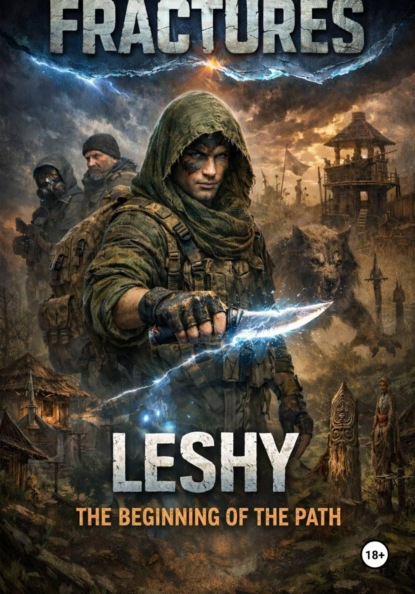
Leshy. Echo of Worlds




- -
- 100%
- +
"Soika," said Lis, coming up from behind. "See that shimmering in the air over there? Don't go there."
"I wasn't going to."
"Good. Some people do. Out of curiosity. After that they don't plan anything anymore."
"Lis," said Gaika.
"Instructing."
"You're going ahead to scout."
"Already going."
* * *
The cement plant had been dead for a long time — so long that it had managed to become a part of the Zone, not just an object on its territory. Buildings with smashed windows, rusted floor slabs, concrete in cracks from which something gray and stubborn was growing. The silence here was different — not empty, but dense, as if the plant remembered sounds and kept them inside.
There were fewer anomalies than outside, in terms of variety. Gaika explained it as they walked: old industrial sites sometimes work that way — too much metal, too complicated a structure of space, some anomalies, such as Electras, are on the contrary attracted to it, Jelly collects in basements, while all sorts of Gravity Concentrates and sinkholes steer clear of built-up areas.
Lika walked and listened — not to Gaika, to the Zone. Studying its sounds. Somewhere far off something crackled at equal intervals. The wind through the empty windows gave a low, drawn-out hum. Underfoot — concrete crumbs, the sound dry and crisp.
Kit walked slowly. Looked at his feet and around him by turns — the rhythm Lis had talked about.
At a ruined wall he stopped. Bent down. Took something small out of a crevice, examined it, put it in a container. Then found a second one — dimly glowing, irregular in shape.
"Artifacts?" asked Lika.
"Two. This one's rare." He showed the second. "Lucky. The anomaly left after the surge, the artifacts stayed."
"Kit's lucky for us," said Lis, who had appeared from somewhere at the side. "Especially with artifacts. And with trouble, by the way, too. One compensates for the other."
"Is that philosophy?" asked Lika.
"It's an observation of statistics," said Lis. "I'm attentive."
Kit put the container into his rucksack. Didn't comment.
They passed through the central building and came out on the other side.
* * *
There were many of them.
Lika didn't immediately understand what she was seeing — just movement between the ruins, slow, unrhythmic. Then the smell arrived before her brain managed to shape the picture into a word.
Zombies were coming out of the ground.
From collapses in the concrete floor of the plant yard, from pits, from cracks. One, a second, a fifth. Silently — without rasping, without the characteristic sound she had read about in descriptions. They simply walked. Slowly and inexorably, like water through cracks.
"Get ready," said Gaika evenly. "Everyone work. Lika — behind Kit, don't fire without a command."
The next few minutes were noisy.
Kit worked methodically, without fuss — every shot precise, no unnecessary movement. Dub took a position by the wall and held the flank with the expression with which he did everything unpleasant — not angry, just working. Gaika moved fast, chose targets competently, her voice in the communicator even, with no raise in tone.
Lis shot with the ease that comes only when the body knows its business better than the head.
It all ended quickly.
The last zombie fell right at Lika's feet. She stepped back and realized she was gripping her weapon so hard her fingers had turned white. She loosened them. Exhaled.
The silence returned — a different one, the post-battle kind. Ringing.
Dub reloaded. Turned to Lis.
The clip on the back of the head was brief but clear.
"You missed it."
"They came out of the ground," said Lis without offense, rubbing the back of his head. "They weren't there. At all. There were collapses, but around here collapses are knee-deep everywhere."
"Are you a sniper or not?"
"A sniper. But not a geologist and not an X-ray machine. I can't see through concrete."
"Next time check the collapses."
"Next time I'll try not to build a cement plant over their burrow." A pause. "Soika, how are you?"
Lika was looking at what remained of the zombie. Trying to look professionally, as at a fact, not at a picture that would come in her dreams.
"Fine."
"Hands not shaking?"
"No."
Lis nodded.
"Good. For some, they shake after the first time. That's normal if they shake. And normal if they don't. The Zone is different for everyone."
"Lis," said Dub. "Forward."
"Going, going."
* * *
After that they walked at a different rhythm — the Zone pressed more quietly, but more densely. Anomalies turned up regularly. Gaika bypassed them without words, only a gesture — look. Lika looked and memorized.
"This is a 'Flare,'" Lis said, appearing beside her every time Gaika was silent. "See how the air shimmers over it? Like over asphalt in summer, only three times worse. Go around at about five meters." A few steps. "This is a 'Trampoline.' If you step on it — you fly. Beautiful, but inconvenient. Especially the landing." A few more steps. "And this one don't touch at all. I don't know what it's called. Gaika knows, but I always forget, because the main rule is don't touch, not what it's called."
"Lis," said Gaika.
"Instructing."
"You've already said that word four times today."
"Well, you're not wordy, so I'm making up for four."
The chemical fog began unnoticed — first a light haze near the ground, then denser. They put on gas masks without a command, at Gaika's nod.
In the fog it was quiet. Lika walked and thought that her father had gone through such things. Every time. Alone, without a team, without Gaika and her even voice in his ear. Just himself — with a detector and an instinct he knew how to listen to.
Where are you, Dad?
The fog ended after twenty minutes.
Ahead was a forest.
Dark, dense, with trees that grew too close — the branches intertwined so that there were no gaps between them. Light didn't penetrate there. Just a wall of darkness with trees inside it.
At the edge — a cache. Low, almost grown into the ground, with a metal door and a basement. Above the entrance someone's hand had written in marker: "Farther — on your own."
"Rest stop," said Gaika.
Nobody objected.
Dub inspected the perimeter, nodded — clean. Kit opened the door. Inside it was cramped, it smelled of old wood and damp, but the walls held, and the roof didn't leak.
Lis dropped onto a bunk, stretched out his legs, looked at the ceiling.
"Soika."
"What?"
"The first full day in the Zone. Zombies, chemical fog, anomalies, a detour through a dead plant." A pause. "You did well. Seriously. No jokes."
Lika set down her rucksack. Looked at him.
"Thank you."
"Don't mention it." He closed his eyes. "Tomorrow will be more interesting."
"Is that good or bad?"
"In the Zone those words are the same thing."
Dub, settling in a corner, glanced at Lis. Said nothing — kept silent with that rare expression that appeared on him when he agreed but didn't intend to admit it aloud.
Gaika closed the door.
"Tomorrow we go deeper. Where we're going, there are no tourists, and the stalkers, if any go there, are out of their minds. In short, it'll be even more dangerous. Everyone rest."
Beyond the door was darkness. The Zone breathed outside — evenly, patiently. It was in no hurry.
Lika lay with her eyes open and listened to that darkness. Her father was there, inside it. Somewhere. Alive or not — she didn't know yet. But she was going.
These few weeks of gathering data and preparation had brought her closer to solving the mystery of her father's disappearance than all four years of searching.
Chapter 7. Ambush
The night passed quickly — not because she slept well, but because her body simply switched off from exhaustion and switched on again when Gaika quietly said "up" into the darkness of the cache.
Lika had been lying with her eyes open even before that. Listening to the darkness outside — the Zone breathed there as evenly as in the evening, with no change, as if the night meant nothing to it.
They ate in silence. Military rations — heated right in the package, tasteless, but hot. Dub smoked by the door while the others packed. Kit checked his gear methodically, unhurried — every buckle, every pocket. Lis sat on the bunk and looked at the floor.
Silently.
Lika noticed it at once — something was wrong. The Lis she had known for two days couldn't keep quiet even in his sleep. And this one sat with a straight back and stared at a single point, and there was no smile.
Gaika went out first. The others after her.
* * *
The forest took them in without a sound.
The darkness under the crowns was different from outside — dense, without gaps, with that particular smell of old pine needles and something sour that Lika was beginning to associate with the presence of anomalies nearby. Her feet walked on something soft — moss, rotting leaves, ground that gave springily under her weight. The rhythm — feet, horizon, feet. She was already doing it almost automatically.
Lis went ahead in silence. Didn't even look back.
Lika drew up to Gaika — overtook Kit, took a place beside her.
"What's with Lis?"
Gaika didn't slow down.
"Instinct," she said briefly.
"What does instinct mean?"
"It means — something's going to happen." A pause. "He's like a radio for us. As long as he's broadcasting everything that comes into his head — things will be relatively fine. When he goes quiet — expect trouble. It's a sign. It works."
Lika digested this.
"That's not very reassuring."
"No," Gaika agreed. "But it's honest."
Behind them metal clicked softly — Kit had shifted his automatic for a better grip. Dub, without a word, checked the bolt of his shotgun. Both did it without a command, without discussion — they had simply heard the conversation and reacted the way people react for whom this has long since become reflex.
Lika put her hand on her weapon. Didn't draw it — just put it there, to know where it was.
The Zone breathed around them. Quietly, evenly, without warnings.
* * *
Lis didn't come back for a long time.
Usually he showed up after twenty or thirty minutes — surfacing from the bushes at the side, reporting and immediately starting to talk about something unrelated. Now forty minutes had passed. Then an hour. Then an hour and a half.
Gaika didn't stop the group, but slowed the pace — imperceptibly, without words. Dub walked a little to the side, looking into the depth of the forest. Kit kept closer to Lika than usual.
After two hours Lis came out.
Silently. Without a smile. His face closed, his eyes the same quick ones, but the movement different — not working scanning, but something tense, inward.
"Rest stop," said Gaika.
They stopped. A two-minute pause — Gaika was looking at Lis.
"Talk."
He was silent for a second. It was so unlike him that Lika felt something cold run along her spine.
"There's an ambush ahead." His voice was even, quiet. "About six people. Professionals — they work competently, positions chosen right, sectors covered. At first I spotted one by accident, thought I'd imagined it. Then two more, then I decided not to show myself and lie low, to watch." A pause. "They're acting very competently. I think there are motion sensors in the forest. Possibly tripwires on the flanks."
"Did Apex pick up our trail?" said Dub. Spat to the side.
"Don't know. We've never seen them in the Zone, nothing to compare with." Lis took out his handheld. "But that we can't get around them — that's for sure. They've blocked the only passage in this sector. And if they spot that we spotted them — next time we won't be lucky. They'll draw conclusions."
"Can you take them out?"
"One or two. Until I catch a bullet myself." He turned the handheld toward Gaika. "Look here, here and here. The main positions. I didn't find the flanker — he was there, but changed position while I was watching. That's bad."
Gaika looked at the screen. Was silent for several seconds.
Lika stood and listened to numbers forming in her head that she didn't like. Six professional fighters against their five, of whom she was ballast with a weapon and two days' experience in the Zone.
"A decision," said Dub. Not a question — he stated that a decision was needed.
"We go head-on." Gaika put the handheld away. "There's no other option — going around is impossible, waiting is out, they'll realize we've stopped. Lis, you take a position to the right, take out whoever you see, cover us. Kit — you go first, hold the center. Dub — left flank, there may be the one Lis didn't find." A look at Lika. "Soika, you stay behind Kit, don't fall behind and don't stick your head out without a command. You open fire only if something's flying right at you."
"Got it," said Kit.
"Got it," said Dub.
"Got it," said Lis, already turning toward the forest. Then he stopped for a second. "Soika."
Lika looked at him.
"Head down, feet fast. Everything else is our job."
He went into the forest — soundlessly, as he knew how, only a branch swayed slightly after him and that was all.
* * *
They moved fast.
The forest pressed down — dense, dark, with that silence in which the absence of sounds itself makes a sound. Lika heard her own steps, her breathing, the distant crackling sound of an anomaly somewhere off to the right. Nothing more.
Kit moved in front — big, but almost soundless, with that particular calm that, it seemed, was permanent in him. Lika kept behind him. Not because she was afraid — simply because Gaika had said so, and Gaika she had already learned to trust without question.
The ambush should have been ahead.
They passed the supposed point.
Nobody.
Kit stopped for a second — looked around. Lika looked in all directions, expecting a sound, a movement, anything. Dub went left, vanished for a second in the shadow of the trees, came back — shook his head.
Empty.
"Lis," Gaika said quietly into the communicator. "What do you see?"
"Nothing." His voice was quiet, concentrated. "The positions are empty. Maybe something spooked them or we weren't the target."
A short tap on the microphone. Crackle. Silence.
The connection cut off.
"Lis," Gaika repeated. No answer.
"Lis," once more.
Silence.
"Spread out." Gaika's voice didn't change, but something in it became different — harder, colder. "Kit, cover Soika. Dub — eyes open."
They spread out. Lika pressed against a tree — back to the trunk, weapon in her hands, fingers correct, as she'd been taught. She looked where Lis had gone.
Alive. He must be alive.
She remembered his face in the cache — the way it sometimes was without a smile. And how he had said "head down, feet fast" before leaving. As if he understood that he was going first to meet something he hadn't yet seen.
That jester who had chattered without stopping the whole way, who had given her a call sign and explained about Electras and "don't touch the pretty things" — could be dead now. Because of this assignment. Because of her, in a way.
Something clenched inside and didn't unclench.
Twenty minutes of silence.
Lika counted them — not on purpose, the seconds simply added up on their own, because her mind needed something to hold on to.
* * *
A voice came from the depth of the forest.
Hard. Steely. Without the intonation that invites conversation — just a sound that occupies space and doesn't ask permission.
"So you're just going to stand there like statues? Pants at least dry?"
Lika didn't immediately realize it wasn't a mercenary. She just stood and listened to the voice echo off the trunks.
"Where's Lis?" Gaika shouted. Sharply, without a pause.
"He'd be dead if I hadn't heard your call sign before you managed to walk into this ambush." A pause, short. "Why'd you come, Gaika? Don't tell me you missed me?"
Silence.
Lika saw Gaika freeze — for a fraction of a second, almost imperceptibly. Then something in her face changed.
"Leshy?" Her voice became different. Not softer — just different. "Is that you?"
Nobody lowered their weapon. The barrels pointed to where the voice came from — into the darkness between the trees, where nothing could be seen.
"You bastard," said Gaika. Without anger, just a word. "Come out already. And bring Lis to me — alive."
A pause.
"I have something for you," she added. "A surprise. Only first come out and take a good look at the passenger."
The darkness between the trees did not answer at once.
Lika stood by the trunk, weapon in her hands, and looked where Gaika was looking. The legend of the Zone, a ghost who for two years hadn't wanted to be found.
Somewhere out there, in the darkness, he was.
Chapter 8. The Meeting
Lis came out of the trees alone.
He walked without raising his head — slowly, without the lightness with which he usually moved. Hands free, weapon put away. He stopped a few steps from the group.
No one behind him.
"What does this mean?" Gaika spoke quietly. "Where's Leshy?"
Lis raised his eyes. There was something unfamiliar on his face — not fear, not anger. Just the quiet lostness of a man who had been outplayed so cleanly that he couldn't even manage to be offended.
"He asked me to tell you he doesn't want to see old friends."
Gaika looked at him for a second. Then she raised her eyes to the forest.
"Leshy." Her voice was level. "We have Vikki with us."
Silence.
A bullet went into the ground at Gaika's feet before anyone could react — just a short crack that had suddenly sprung up out of nowhere, and a little fountain of dirt centimeters from the toe of her boot. Then, a fraction of a second later, a crack from the other side — and the bark of the tree beside Kit's temple threw out a splinter.
Two shots. Two positions. Less than a second.
Everyone cleared the lines at once — not on command, the body simply did it by itself, reflex. Kit behind a trunk. Dub to the side. Lika pressed herself to a tree and realized she wasn't breathing.
"Why are you lying to me, Gaika?"
The voice came from the left. Then — a crack, and the same voice, now from the right, from another position:
"Vikki died. There. In that city."
Lika felt something change in the air. The voice was hard — but there was something else in it, under the hardness, something that made her uneasy in a different way than the bullets did.
"Leshy, come out and see for yourself," said Gaika.
The forest was silent.
"Lower your weapons." Gaika spoke evenly, without turning around. "He's already shown he could kill all of us in under a minute. If he wanted to — we'd already be lying down."
Kit and Dub exchanged glances. Lowered their barrels. Slowly, without sudden movements.
Lis just kept standing in the same place — arms at his sides, eyes on the ground. Silent. It was so unlike him that Lika looked at him almost with alarm — more, perhaps, than at the forest the bullets had just come from.
* * *
Borland lay in the roots of an old oak and looked through the scope.
Lis stood like a man who had just been told he wasn't who he thought he was. Borland could have sympathized — but not now. Lis had gone and started the cat-and-mouse game himself, and lost it himself. A good lesson, even if a bitter one.
Borland shifted the scope.
The girl by the trunk.
He looked for a second. Two. Three.
His hand found the pendant under his clothes by itself — he barely noticed doing it. His fingers closed on the metal. Warm. Familiar.
He hadn't opened the pendant in several months. Now he opened it.
The photograph had faded at the edges — he had looked at it so many times that the paper had started to give. The smile. The hair. The flower at the end of the braid.
Back to the scope.
The girl by the tree was looking into the forest — to where, she thought, he might be. Her face open. The hair the same. The ears — no, the ears were different. And at the end of the braid, nothing.
Borland lay there and didn't move.
She isn't Vikki.
The thought came by itself, without pain — just a fact, which he said over inside because it needed to be said. Not Vikki. A completely different person, a completely different place, a completely different story.
But the face.
He closed the pendant. Put it back under his clothes.
Go out and talk. Just talk — and that's it.
It was a bad idea. He understood that. The conversation would lead nowhere — he would say no, they would leave, and everything would go back to how it was. The house. The rain. The Cutter on the shelf. Empty inside.
Borland looked through the scope for another second.
Then he put the rifle away and began to move in their direction.
* * *
Lika heard the voice before she understood that he was right beside her.
"Turn around."
She flinched — sharply, with her whole body. Turned.
He was standing a meter behind her. How he had gotten there she hadn't heard — not a step, not a rustle. There was simply nothing, and now there he was, looking at her.
Lika looked at him.
Young — younger than she had expected from a legend. Twenty-something. Tall, wiry — not monumental like Kit, something else: tightness, economy, not a single wasted movement. Dark hair, short. A closed face, without expression, the kind people get when they stopped showing what they think long ago. Light eyes, cold. They looked straight — not aggressively, just right through her, the way you look at something you need to assess and make a decision about.
A weapon on his shoulder. On his hip, a knife in a sheath, the handle worn, clearly a working one. Plain gear, nothing extra — every item in its place, nothing decorative.
Under his clothes, on a cord — something small. Lika didn't have time to make it out.
He looked at her the way you look at something impossible. Not with admiration — with that particular expression of a brain receiving information and not knowing where to put it.
Then — a quiet whistle through his teeth.
"Gaika." He didn't look around. "Tell me honestly — are you making people out of test tubes at that institute of yours now?"
"No, Leshy." Gaika's voice was level. "So, then — shall we talk? Or are you going to keep devouring her with your eyes?"
Borland, with visible effort, shifted his gaze to Gaika.
"What do you need?"
"We don't need anything. But Soika needs your help."
He was silent for a second. Then he nodded shortly — not agreeing, just taking it under advisement — and raised his palm, stopping Gaika before she could go on.
"Come on. We'll talk somewhere else."
He turned and went into the forest. Without looking back.
* * *
They walked for about three hours.
Lika walked and watched him.
Borland moved differently from everyone she had seen in the Zone these days. Gaika walked competently, economically — a professional with experience. Kit — dependable as a machine, but you could see he sensed anomalies worse than the others. Lis — lightly, with that birdlike attentiveness that never switched off for a second. Dub, just Dub, experienced and that was all.
This one was different.
He didn't look at his feet. Didn't check a handheld or a detector. He simply walked — and the Zone parted before him, as if it knew he was coming. An anomaly on the left he skirted several steps before the detector in Lika's hands chirped. Another — without even slowing, just veered a little to the right, as if there were markings there that only he could see.
Once he stopped. Stood about three seconds — didn't move, just stood and, it seemed, listened to the air. Then went a slightly different way. Two hundred meters on, they saw why: where he had been about to pass, the ground was heaved up by a fresh surge.
Lika didn't understand how he had sensed it.
Lis walked next to her — silently, which was strange in itself. Once he leaned toward her ear:
"I heard he always walks like that. Don't ask how. Nobody knows."