

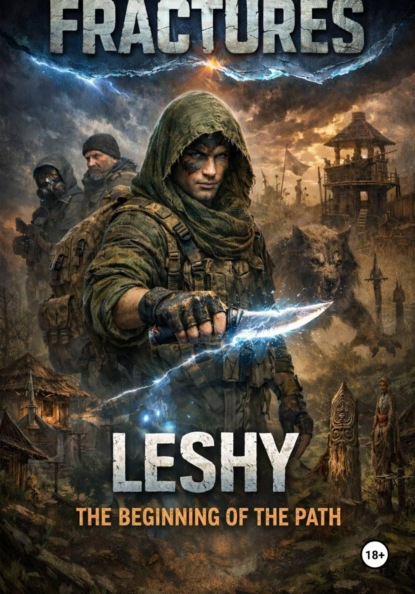
Leshy. The Beginning of the Path



- -
- 100%
- +

Prologue. A Debt for a Debt
The Zone forgives no weakness. But sometimes it gives strange gifts — the kind that burn the soul more fiercely than any anomaly.
* * *
For three days they had been moving through the fractures.
Khimik had long since stopped counting worlds. After the fifth crossing they began to blur into one confused mess — different skies, different smells, different deaths. The artifact known as "Soul," bound to his chest with an old bandage, pulsed steadily and dully, like a toothache. Each tear in the fabric of space cost him more than the last — not physically, no. Physically, Andrei could have walked for a long time yet. But something inside him, at a level he had never found a name for, fractured slightly with each passage. As if he himself bore the same scars he left in the tissue of reality.
Behind them lay a scorched bubble where the very air had tried to devour a man alive. There was nowhere to return to.
"Hey," said Prigorshnya, adjusting his rifle strap, "I've been thinking."
"That's a bad start," answered Khimik, not lifting his eyes from the detector.
"No, seriously. We've been crawling through these bubbles for three days now. There's something nasty everywhere, something always wants to eat us. But this world..." Nikita fell silent, looking around. "It breathes differently. Do you feel it?"
Khimik raised his head. The forest began abruptly — dense, dark, with trees whose trunks bent against all visible logic, as if reaching toward invisible currents. The leaves glowed pale blue whenever the "Soul" sent a light ripple outward. The air was heavy, damp, saturated with ozone and the smell of wet earth after an old storm.
The detector was silent. There were anomalies, but far away. And — oddly — they weren't moving.
"I feel it," said Khimik.
A path revealed itself on its own — barely visible, but well-worn. Someone had walked here regularly and for a long time. They followed it, because the alternative was to push through luminous bushes, and Khimik had once stuck his hand into one such bush in the third bubble. The memory was vivid and instructive.
They heard the drums when the forest began to thin.
A low, rhythmic rumble came from the earth — or seemed to come from the earth. Prigorshnya instinctively raised his rifle. Khimik touched his shoulder and shook his head: not now.
The village appeared all at once, without warning. It stood in a hollow, surrounded by a ring of anomalies — not random ones, but arranged, brought to some non-obvious order. The "Carousels" spun at precise intervals. Between them burned signs — spirals scorched into the earth that Khimik couldn't read but felt: this was no decoration. It was a map. A schematic one could follow.
The tribespeople met them at the boundary of the ring.
Tall, lean, with pale skin. Ritual scars ran from their wrists upward, over their shoulders, to their necks — spirals resembling those burned into the earth. Their spears were in hand but pointed downward. Khimik noticed that none of them were looking at him or Prigorshnya — they were looking at the "Soul." At the faint glow the artifact gave off through his jacket.
An old man stepped out from behind the warriors.
Ancient. So old that age had ceased to have meaning. One eye — dark, alive, attentive. The other — white, sightless, yet somehow it seemed that this one saw more. He approached Khimik without stopping until less than a meter remained between them, and stared for a long time at his chest — where the "Soul" pulsed beneath his jacket.
"You have come in the hour of blood," he said at last. The language was broken, with hard consonants, but understandable. "The Surge is coming. A great Surge."
"We weren't looking for trouble," said Khimik.
"The Surge doesn't ask who was looking for it." The elder turned his head slightly. "But the one-who-walks-through-tears has come at the right time. Perhaps that is not coincidence either."
Prigorshnya gave a quiet whistle. Khimik would have done the same, if that had been his style.
* * *
The Surge began at sunset.
First — silence. The birds fell quiet all at once, as if cut off. The detector screamed and died — the anomalous background spiked beyond the scale. Then the earth trembled with a fine vibration, and from the fractures at the forest's edge came a flood.
Pseudodogs led the first wave — fast, with burning eyes, in packs of twenty to thirty. Behind them came armored boars, huge as small armored vehicles, foaming at the mouth. And behind them — something Khimik had no name for. Long, many-legged, nearly soundless, they moved like water, flowing around obstacles, and wherever they passed, the grass turned black.
"What the hell is that?" asked Prigorshnya, racking his weapon.
"Don't know," said Khimik. "Shoot for center mass until we figure it out."
They stood shoulder to shoulder with the village warriors. The tribespeople fought differently — silently, without shouts, cleanly and terribly. They knew where the wave would pass. They knew which anomaly would trigger on its own, and which needed a push. Their spears, smeared with sap from certain plants, entered the boars' armor plating exactly where it wasn't — at the joints, beneath the throat, behind the ear. This was not courage. This was knowledge.
The "Soul" on Khimik's chest flared. He hadn't planned to use it — but the long many-legged creatures were heading straight for children the tribespeople hadn't managed to shelter. Andrei cut the space diagonally, opening a brief corridor into the void between bubbles. The creatures were sucked in along with their silence. The cut sealed.
"Beautiful!" shouted Prigorshnya from behind an overturned cart where he'd taken cover. "Got more of those?"
"Two times, maybe three. After that — you're on your own."
"Fine, I'll manage."
He did manage. Prigorshnya was frightening in battle in his own way — not through skill, though he had enough, but through a kind of cheerful fearlessness. He cursed, moved, shot from his knee, from the hip, in motion, and somehow never took a hit. Khimik had once told him this wasn't luck but some hidden instinct. Prigorshnya said it was cowboy karma, and the subject was never raised again.
They drove the village back.
But there was a price.
* * *
Two warriors died in the final wave when an armored boar broke through the line. They stood in front of the children. One died immediately. The second — a woman — fought on furiously until the very end, as the battle was already finishing. She lay beside a dead mutant. The sky was frozen in her eyes forever.
Their child stepped out from the crowd of children in silence, his gaze passing over his parents. Twelve years old. Thin, wiry, with dark eyes and ritual spiral scars on his forearms — fresh ones, not yet fully healed. He didn't cry. He looked at the bodies with an expression as if something inside him had already switched over and was working differently now. Not broken. Just — differently.
The elder approached the newly orphaned child. He spoke — in a hard, metallic voice, without pause, without sympathy. Like a sentence being read aloud.
Khimik understood the first words — language came quickly to him, one of the few talents he never boasted about. The orphan was to go into the forest. Alone. The law of the tribe. An old law, with its own logic — the weak should not drag the community down in a world where survival is costly. Khimik understood this logic. He had grown up in a world where it was much the same.
Prigorshnya didn't understand it. Or didn't want to.
"No," he said.
Just "no." Without preamble, without pause. He stepped between the elder and the boy, crossed his arms on his chest — big, ungainly, with soot from the battle still on his cheek.
"This kid isn't at fault that his parents went down for all of us. We may be the reason they stepped forward. Maybe not. Maybe they would have either way. But I won't let this kid die in the forest. He's coming with us."
The elder looked at him for a long time. Then — at Khimik.
Khimik was silent. He could be silent in a way that read as an answer. Yes. I agree. Draw your own conclusions.
Something tightened inside — old, uncomfortable. He himself had once been just like this: alone, without a name, without a place, against everything.
"You helped us," said the elder at last. "A debt for a debt. The boy may leave with you." He paused. "But our world will not release him easily. It knows how to hold those it raised."
* * *
In the evening, as the village buried its dead, the elder approached Khimik and held out his hand. Khimik gave up the "Soul" without words — though something inside him resisted. The artifact rested in the old man's palms, glowing quietly, like a smoldering coal. The elder carried it into his home and closed the door.
The air above the house began to thicken. Slowly, almost imperceptibly — like before a storm, but without wind. Prigorshnya stepped back — he felt these things not with his mind but with his skin, a soldier's instinct: something is about to happen. The boy Borland stood nearby and didn't retreat. He stared at the closed door without blinking, as if he could see through it.
When it was over and the air above the house cleared again, the door opened. The elder stepped out, holding a knife in his hands.
A blade two palms long. A hilt of dark, dense wood wrapped in thin strips of leather. The blade was different. It didn't reflect light — it absorbed it. The edges seemed blurred, as if the boundary between metal and air could not quite decide. Looking straight at it, you seemed to see shadows drifting slowly within the blade itself.
"Now it obeys the hand," said the elder. "No need to carry it at your heart. One stroke will open a path where the worlds touch each other." He raised his eyes to Khimik. "But remember: every cut leaves a scar. On the world — and on the one who cuts."
Khimik took the knife. Weighed it. It was light — almost surprisingly so.
"A beauty," said Prigorshnya, peering over his shoulder. "Does it have a name?"
"Your choice," said Khimik.
Nikita took the knife, turned it in his fingers, looked at the blade with the expression one uses for good weapons — with respect and a slight envy for whoever would carry it.
"Cutter," he said. "Simple and to the point."
Borland watched all of this in silence. He didn't yet understand everything — the language, the meaning of the ritual, where they would go and why. But he understood the main thing: his world had just been cut in two. Just as the new knife cut space — without pain, almost without sound, but forever.
* * *
They left through the fracture at dawn.
The elder walked with them to the edge of the anomaly ring. In farewell, he placed his hand on the boy's shoulder — not gently, but firmly, like stamping a seal.
"You will carry our world inside you," he said in his own language, and Borland understood. "This is not a curse. It is a tool. Use it."
Then they stepped into the fracture, and the glowing trees were left behind.
And in the "quiet" world they found after many more crossings, eight years passed.
And the boy they had called Borland grew up. He became a stalker they called Leshy. And one day he wanted to find his way home.
Chapter 1. Farewell
Morning in the "quiet" world smelled of resin and cold embers.
Borland stood at the window, holding his mug with both hands. The tea had gone cold long ago — he'd forgotten about it while packing his bag and never remembered it again. Outside stretched a familiar landscape: low hills, sparse forest, and somewhere beyond the third hill — the faint shimmer of the anomalous zone, visible on clear days even from here. Pale, nearly transparent. Peaceful, if you didn't know what it was.
He knew.
The pack stood by the door — assembled, buckled, heavy exactly as much as it needed to be. No more. Excess weight doesn't kill immediately, but it kills. He had learned this in his first forays, when Khimik drove him through the anomalous strips of the "quiet" world with a load on his back and a stopwatch in hand. It had seemed like cruelty then. Now — he understood.
The Cutter hung on his right hip. The sheath Prigorshnya had made himself — slowly, stubbornly, with curses and three reworkings. It had turned out well. The leather had darkened from time and handling, molded to the shape as if cast. Borland had long since stopped noticing the weight of the knife — it was simply there, like a part of his body. Three and a half years of forays do their work.
A floorboard creaked behind him.
"The tea's cold," said Khimik.
Borland didn't turn around.
"I know."
Andrei walked to the table, sat, set his own mug down before him. Stayed quiet. He could be quiet for a long time and without awkwardness — Borland remembered this from childhood, from the first days, when he didn't yet understand half the words but already understood the pauses.
"Did you plan your route?" Khimik asked at last.
"Through the eastern strip. The fractures are weaker there, I can probe without risk."
"The eastern route is longer."
"I know."
Khimik nodded. Didn't say whether this was right or wrong. Simply noted it. Borland set his mug on the windowsill and finally turned. Andrei sat in his usual pose — elbows on the table, gaze somewhere in the middle of space. Thinking. Or had already thought and was just waiting now.
"You want to talk me out of it?" asked Borland.
"No."
"Then why did you get up so early?"
Khimik raised his eyes. Looked at him — calmly, without excess.
"To see you off," he said simply.
Borland was quiet. Something tightened inside — not painfully, just firmly, like before a jump into a fracture. He nodded and turned back to the window.
* * *
Prigorshnya appeared half an hour later — loudly, as always. He threw open the door, let in the cold morning air, and set a frying pan of eggs on the table — which he had apparently carried across the whole yard.
"Breakfast," he announced. "A proper one. Not up for discussion."
Borland smiled.
"Nikita, I'm leaving, not dying."
"Same thing until you come back." Prigorshnya sat across from him, propped his chin on his fist, and looked at him with the expression one uses for something one is trying to memorize. "Eat."
They ate in silence. The eggs were oversalted — Prigorshnya always seasoned by eye and never got it right. Borland ate everything.
Over breakfast, Khimik unfolded a worn map on the table — not of this particular world, no, it was a composite one, with margin notes, fracture schematics, transition arrows. Eight years of work. He pressed a finger to the eastern sector.
"Here, see — two bubbles are touching closely. The Cutter will take it without effort, one motion. But don't rush. Let it feel where the boundary is."
"I know how the Cutter works."
"You know how it works in these zones. Out there it may be different."
Borland looked at the map. Then — at Khimik.
"You're trying to talk me out of it after all."
"I'm trying to make sure you come back," said Andrei. "Those are different things."
* * *
They went out to see him off to the edge of the hill — both of them, in silence, without unnecessary words. The morning had already brightened, the sky was clear, and the shimmer over the eastern zone had grown slightly stronger — activity. Borland had felt it back in the house but said nothing. No point.
At the top of the hill he stopped and turned.
Prigorshnya stood with his hands in his pockets. Looking to the side — pretending to study the horizon. Khimik stood straight, arms at his sides. Looking at Borland.
"Will you find what you were looking for?" asked Prigorshnya, not turning.
Borland thought.
"I don't know. But not finding it is worse."
Nikita finally turned. Gave a grunt.
"Philosopher." He stepped forward, hugged him briefly, firmly, and clapped his shoulder. "Come back. I'll oversalt something else."
Borland smiled. Then turned to Khimik.
Andrei didn't do embraces. They both knew this. He held out his hand, Borland shook it. The handshake was firm and brief — like a period at the end of a sentence.
"Listen to the Cutter," said Khimik. "Don't rush it. It feels the boundaries better than you."
"I know."
"Now you know." A pause. "Go."
Borland turned and walked down the slope — toward the shimmer, toward the eastern strip, toward the first fracture. The Cutter grew slightly warm against his hip — or he imagined it. He didn't look back.
But he heard Prigorshnya say quietly behind him:
"He's grown up, hasn't he?"
And how Khimik said nothing.
That was enough.
Chapter 2. The Perimeter
The checkpoint on the eastern perimeter looked the way all checkpoints look in "quiet" worlds — slightly sleepy and slightly resigned. A striped barrier, an iron-painted booth, a faded sign reading "Restricted Zone. Entry Prohibited." The sign had once been red. Now — pink, almost tender.
Borland approached unhurriedly.
From the booth a soldier leaned out — young, about twenty, with a mug in his hand and the look of someone pulled away from something important. He took in Borland, assessed the pack, the detector on his belt, the Cutter on his hip. His expression shifted from official to normal.
"Ah, Leshy." He nodded and took a sip. "Back into the zone?"
"Back," confirmed Borland.
"The sergeant said you were planning on being gone a while."
"He did."
The soldier looked at him with a light envy — the kind that comes from standing on one side of a fence and looking at the other.
"There's been activity since morning," he said, nodding toward the zone. "The background is jumping. Yesterday nothing, today the duty officer checked his instruments three times, thought they were broken."
"They weren't broken?"
"They weren't." A pause. "Good luck, then."
The barrier rose. Borland nodded and walked through.
* * *
Beyond the perimeter began a different silence.
Not the kind found in a forest or a field — alive, full of birds and wind. This silence was thick, like cotton. It didn't press, didn't frighten, it simply — was there. Borland knew it well. Three and a half years of forays — that's not a long time, but it's enough to learn when the zone is quiet and settled, and when it has gone still in hiding.
Today it hadn't gone still.
It was breathing.
That was the first thing he felt — before the detector beeped and showed anomalous activity three notches above normal. The air was slightly warmer than it should have been in the morning. The grass beneath his feet — softer. The sparse trees at the zone's edge glowed faintly in shadow, barely noticeable, pale blue — like those he remembered from childhood, from another world, from another life.
Borland stopped. Placed his hand on the Cutter — not to draw it, just like that. A habit.
The zone hummed. Low, almost at the threshold of hearing. Something had changed — not here, not in this particular spot, but deeper, where anomalies gathered more densely and fractures came closer to the surface. He couldn't put it into words — it was the kind of knowledge that doesn't explain itself, it simply lives in the body, in the hands, in that very instinct the elder had called a tool.
Something had shifted. Something was preparing.
He stood there for a minute, maybe two. Then the zone did a strange thing.
Wind came from nowhere — brief, warm, almost gentle. It passed through the grass, rustled the branches, touched his face. And left just as quickly as it had come. As if someone had exhaled.
Borland was not inclined toward lyric. Khimik had cured him of it in his teenage years — practically and without sentiment. But now he caught himself thinking: this is like a farewell. The zone was seeing him off. In its own way, in its own language, which he understood better than he cared to admit.
"Likewise," he said aloud, quietly.
And took out the map.
* * *
The eastern route ran straight — through sparse forest, past two "Carousels" he knew by heart, to the fracture at the old riverbed. Four hours' walk, if he didn't rush. Where the worlds touched each other, the Cutter would open the passage without effort. He felt this.
But the detector beeped again. Borland looked at the screen, then east. The shimmer over the zone was thicker than in the morning. Not a random fluctuation, not a surge — this was restructuring. The zone was changing something inside, and where he had planned to go might now be entirely different from what he had seen last time.
He folded the map. Thought.
To the north, about seven kilometers away, was a stalker base — old, established before Khimik and Prigorshnya had settled in this world. They knew the zone better than the perimeter soldiers. Fresh data was always available there — who had gone in, what they had seen, what had changed. It was a detour. Unplanned, an extra hour and a half.
But walking into a changed zone without information wasn't bravery. It was stupidity. Khimik said it more concisely: "Reconnaissance is not cowardice. Cowardice is not coming back."
Borland adjusted his pack and headed north.
Chapter 3. The Base
Seven kilometers along the edge of the zone — that's not a distance. That's time to think.
Borland walked steadily, the detector at his belt ticking quietly in the background, the Cutter warming his hip through the sheath. The zone on this side was familiar — sparse forest, old anomalous patches he skirted automatically without slowing. Three times over three years he had walked this route. He knew every turn.
So the Tushkans surprised him.
They burst from the bushes to his left — a pack, dense and panicking. The small creatures ran in complete silence, which was itself a bad sign: Tushkans scream when they run from something familiar. When silent — they're running from something they themselves don't understand.
Borland shifted aside, letting the pack through. Moved his rifle.
The Tushkans rushed past — and flew into a Flare.
He saw it out of the corner of his eye a second before they hit it. The Flare was new — it hadn't been here before, he was certain. It had settled in a hollow between two rocks, nearly invisible, faintly shimmering. The Tushkans disappeared into it without a sound. The zone had taken its due.
Borland stopped. Looked around. Whatever the pack had been fleeing never appeared — no sound, no movement in the bushes, no trace. That was more unpleasant than if it had shown itself. A visible threat is an understandable threat.
He waited two minutes. Silence.
Then he looked at the Flare. The anomaly was already discharging — quickly, the energy spent on the Tushkans. Something glinted in the cooling shimmer. He took out his extraction tool — a telescoping rod with a hook on the end, Khimik had made it in the first year — and carefully snagged it.
A small sphere settled in his palm. Warm, dense, with a deep orange glow inside, like coals under ash. The local stalkers called these "Earth's Flame." Not rare, but not junk either — in cold worlds that fractures sometimes led to, an artifact like this was worth more than any equipment. It heated from within, steadily and for a long time, without burns.
Borland turned it in his hand and pocketed it in a container.
"Seeing me off, are you," he said quietly, to no one in particular.
He noted it mentally: a new Flare, Tushkans fleeing something, the pursuer never appeared. All of this — for the bar. They'd appreciate it there.
* * *
The base stood at the edge of the sparse forest — a few timber and metal buildings enclosed by a low fence with motion sensors on the perimeter. No fuss, no signage. Those who needed to knew where it was. Those who didn't — never made it this far.
Borland nodded to the camera at the gate. After a few seconds the bolt clicked.
Inside it smelled of diesel, food, and a little — ozone. The smell of all stalker bases in all the worlds he had managed to see. Khimik had once said it was the smell of people who live on the edge. Prigorshnya had corrected him: the smell of people who are more comfortable on the edge than in the middle.