

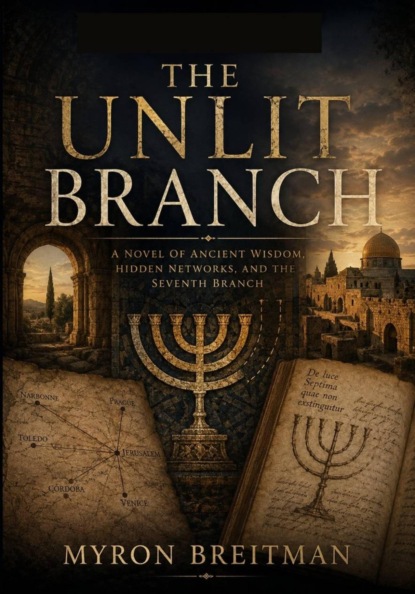
The Unlit Branch


- -
- 100%
- +
There were seven branches.
He had found the evidence of the first.
He had not yet found the branch itself — only its shadow, its coded image, its fingerprint in stone. But the shadow was enough to know that the thing that cast it was real. And the fact that someone was already, this quickly, in his office — the fact that the net had come down before he had even understood what he was swimming toward — told him something else.
Other people had been looking for a long time.
He was not ahead of them. He was, at best, beside them. The only advantage he had — the only advantage that mattered — was that he understood something they apparently didn't: that the light was not hidden to be found. It was hidden to test the quality of finding. It was hidden the way all the most important things are hidden — not behind a lock, but inside a question that only becomes available to the person who has learned how to ask it.
He parked outside his apartment building and sat in the car for a moment, listening to the engine cool, looking at the ordinary street with its ordinary late-October quiet, the cats moving between the parked cars, the light in the bakery window two doors down where someone was already beginning the next morning's bread.
Then he went upstairs and spread his notes across the kitchen table and began, very carefully, to draw a map.
Not of where the branches were. He didn't know that yet.
Of where they might be. Of what shape the network might take if the logic he could already see — the astronomy, the architecture, the patient distributed encoding of a single image across a diaspora that had been scattered across the known world — held consistently. Of what it would look like, from the outside, if you had built a system meant to survive the end of everything you knew and you had built it to last.
He drew until the bakery smell drifted up from the street below and the cats went wherever cats go at dawn and the first light came gray and then gold over the water.
Then he booked a flight to Madrid.
Chapter Two: Searching the Archives
Hebrew University of Jerusalem.
Two days later.
The coffee had gone cold again.
Eli noticed this the way you notice weather through a window you're not planning to open — as a fact about the world that has no immediate bearing on what you're doing. The cup was on the corner of the mahogany table in the library's private research room, and it had been there since eight in the morning, and it was now past ten, and somewhere between then and now it had crossed the threshold from coffee into something that merely occupied the shape of coffee without any of its intentions.
He didn't drink it. He looked at the photographs.
Sara's scans from Madrid were printed now, arranged in a row alongside his own images from Zippori, and the effect of seeing them together in physical space — not on a screen, not mediated by the flattening quality of digital light, but as actual paper objects lying on an actual table — was different from anything he'd felt looking at them separately. On a screen you could enlarge and compare and annotate, and the analytical brain stayed engaged, productive, comfortable. On paper they simply lay there, side by side, asserting their relationship without asking permission.
Six branches instead of seven. The same asymmetric base. The same sequence of subtly differentiated stones along the lowest step, rendered in the Toledo drawing as small dark crosses in ink but unmistakably — unmistakably — the same rhythm, the same spacing, the same patient encoding of something in a language he did not yet fully read.
A thousand years separated the two images. A thousand years and three thousand kilometers. The craftsmen who had laid the Zippori floor and the craftsmen who had cut the Toledo stone had never met, could not have met, had lived in different worlds under different skies speaking different languages — one in the Galilee hills under Roman administration, one in medieval Castile under a Christian kingdom that had not yet decided whether to convert its Jews or expel them. They shared no common biography. They shared no contemporary correspondence.
They shared this.
Eli added a note to his documentation file and reached for the cold coffee without thinking, then set it back down without drinking it.
He had moved his working base to Jerusalem two days ago, after the sedan in the Haifa parking lot and the flashlight moving through his darkened office. The Hebrew University library was not safer in any absolute sense — nowhere is safer in any absolute sense, and the people who sit in parking lots monitoring academics are not deterred by institutional prestige — but it was safer in the specific sense of being full of other people. Witnesses. The continuous low-level traffic of students and faculty and librarians who would notice, who would remember, who constituted the particular social friction that makes uninvited guests visible. Eli had been working in archaeology long enough to know that most bad things happen in empty places. He had arranged not to be in an empty place.
The research room had tall windows that faced the courtyard, and through them he could see the stone paths and the olive trees that the university had planted in the 1960s and that were now genuinely old, genuinely Mediterranean, genuinely part of the landscape rather than additions to it. Students crossed the courtyard in ones and twos. A cat slept on a wall in a patch of October sun with the absolute commitment that cats bring to horizontal surfaces. The morning was ordinary in every visible dimension.
Eli found this reassuring and faintly suspicious in equal measure.
He pulled up the Mediterranean map on his laptop — the one he had started in his kitchen two nights ago, after booking the Madrid flight — and looked at the points he'd marked. Zippori. Toledo. And now, from Sara's email last night, the new ones: Córdoba, Segovia, Girona, Zaragoza, Ávila. All in Spain. All fourteenth century. All documented with the same architectural anomaly, the same six-branched Menorah, the same inexplicable deviation from the canonical form that every trained craftsman in every Jewish community across the Mediterranean had been producing correctly for a thousand years.
He drew lines between them on the screen.
The lines converged.
He stared at the convergence point for a while, then took it off the screen and drew it on paper instead, because paper doesn't lie the way screens lie — paper shows you exactly what you drew, without the screen's tendency to make everything look authoritative, finished, correct. On paper the convergence was tentative, approximate, dependent on the accuracy of his location data and the crudeness of his method. But it was there. Somewhere in the center of the Iberian Peninsula, if you connected all the fourteenth-century Spanish synagogues in Sara's documentation, the lines crossed.
His phone rang.
"Sara." He answered before the second ring.
"I've been in the archives since seven." Her voice had the texture of someone running on coffee and the specific adrenaline of genuine discovery — a texture Eli recognized from his own best days in the field. "Eli, I need to tell you something before I say anything else. I'm coming to Israel."
He sat back. "When?"
"Day after tomorrow. There's a conference at Tel Aviv University — Jewish Heritage in Mediterranean Architecture. I've been asked to present on medieval Spanish synagogues." A brief pause. "I think someone arranged this. The invitation came two weeks ago, before either of us knew we had anything to discuss. But now the timing —"
"Is perfect."
"Or engineered." Another pause, shorter. "Though perhaps those are the same thing, in this particular story."
Eli thought about this. The timing was remarkable — too remarkable to be coincidental, not quite remarkable enough to be certainly intentional. The kind of timing that invites paranoia and rewards patience. He filed it under things that will become clear later and moved on. "What did you find today?"
What she had found was this: the Toledo synagogue was not isolated. In the archive of the Biblioteca Nacional she had located a collection of correspondence — fifteenth century, in a mixture of Hebrew, Judeo-Castilian, and ordinary Castilian — between the administrative bodies of multiple Spanish Jewish communities in the decades before the expulsion. The correspondence was largely administrative: maintenance of community funds, arrangements for itinerant scholars, the bureaucratic texture of communities trying to sustain institutional life under conditions of mounting hostility. Ordinary, in other words.
Except for the recurring phrase.
It appeared in at least eleven of the forty-three letters Sara had catalogued. Always in the same form, always in Hebrew, always appearing in the context of what seemed on the surface to be discussions of synagogue maintenance or architectural renovation: sheva yihyeh shesh kedei she'hashvi'it tichyeh le'olam. Seven will become six so that the seventh may live forever.
"They were coordinating," Sara said. "Not just individually choosing to distort the Menorah image. They were coordinating the distortions across communities. There's a letter from Girona referring to a letter from Toledo which refers to specifications sent from somewhere that isn't named — only referred to as ha-makom, the place."
"The generic Hebrew word for God is also the generic word for place," Eli said, almost to himself.
"Yes. Which makes it either a theological reference or a location reference and possibly, deliberately, both."
Eli wrote ha-makom in his notes and underlined it twice. "Sara. I need to see those documents."
"I'm bringing copies. The originals are staying in the archive." A brief hesitation. "Though I should tell you that when I came in this morning, some of the folders had been moved. Not removed. Not damaged. Just — relocated within the cabinet. Someone had been through them before me."
Eli set down his pen.
"And this morning," Sara continued, her voice dropping slightly, "a man came to my apartment. He said he was a journalist writing about medieval Sephardic communities. He knew about the Toledo synagogue. He knew I'd been researching it. He asked whether I had international collaborators."
"What did you tell him?"
"That I was too busy preparing for the conference. He gave me a card." A pause. "The card had a phone number that, when I tried to look it up later, appears not to exist."
The room felt slightly different after this — same room, same windows, same cat on the wall in the courtyard, but with a texture added that hadn't been there before. The texture of knowing that the perimeter had contracted.
"Sara." He kept his voice even. "Two nights ago, someone broke into my office at Haifa. They copied my files. I've also had unexpected visitors — men in suits who approached me here in the library last night, who knew about the Zippori work, who offered protection in exchange for a conversation I wasn't comfortable having."
A long silence.
"So we're both being watched," she said finally.
"We're both being watched."
"Then we should be careful about what we say on this call."
"Probably. But at this point I think the more important thing is to be careful about what we do when we're physically in the same location. Electronic surveillance is a fact we should assume and work around. Physical risk is different." He paused. "Are you still coming?"
"Yes." No hesitation. "Eli, if they already know about the work, the only thing that changes by my not coming is that we lose the conference access and the chance to examine the documents together. The risk profile doesn't improve."
She was right, and he appreciated that she had done the calculation quickly and correctly. "I'll meet you at Ben Gurion. Day after tomorrow."
"Four-twenty in the afternoon." Another brief hesitation, this one with a different quality — more personal, less tactical. "Eli. What do you think this is? Really. Not the academic framing. What do you think the ancient communities were actually doing?"
He looked at the photographs on the table. The Zippori Menorah with its deliberate incompleteness. The Toledo drawing with its monk's Latin notation in the margin. The map on his laptop with its converging lines.
"I think," he said slowly, "that at some point in history — probably more than once, probably in response to more than one catastrophe — someone understood that the most dangerous place to keep something important is in one place. That if the thing exists in one location, that location can be found and destroyed. But if you distribute the thing — if you break it into pieces and scatter the pieces across a network of communities, encoding each piece in something as durable as stone and as invisible as shadow —"
"Then the whole survives even when any individual part is lost," Sara said.
"Yes. And not just survives. The whole remains readable to someone who knows how to read it. Legible across centuries. Across persecutions. Across the kind of destruction that carries off objects but can't carry off the geometry of a building or the angle of a window or the way morning light falls on a mosaic floor at a specific hour on a specific day."
He could hear her breathing, thinking.
"What were they preserving?" she asked.
"That," Eli said, "is what we're going to find out."
He called Miriam after hanging up with Sara. Miriam answered on the first ring, which meant she had been waiting for the call, which meant something had happened.
"Officials from the Antiquities Authority came to the site this morning." Her voice was controlled in the way that people who are professionally trained in careful observation control their voices when they want to report facts without editorializing. "Two men. They showed credentials. They said it was a routine inspection."
"What did they ask about?"
"The mosaic. Specifically — the photographs we took in the morning light. They wanted to know if we had documented the lighting variations. They asked about measurements taken at different times of day. They asked —" A brief pause. "They asked whether we had been in contact with foreign researchers. They specifically mentioned Spain."
The specificity was not a coincidence. Nothing, at this point, was a coincidence. "What did you tell them?"
"Standard documentation. Nothing about the light research." He heard the faint sound of wind in the background — she was outside, perhaps walking away from others before making this call. "Professor. I've been on excavations since I was nineteen. I've had Antiquities Authority visits on every major site I've worked. They ask about preservation protocols, storage conditions, site security, permit compliance. They have never — not once — asked about lighting conditions or international contacts."
"Then they weren't routine inspectors."
"No. Though the credentials appeared legitimate." Another pause. "How is that possible?"
"Resources," Eli said simply. "Someone with resources can produce very convincing credentials."
He told her what he had told Sara — the broad outline, stripped to essentials: the office break-in, the library encounter, the contact from Madrid. Miriam listened without interrupting, which was one of the things he valued most about her — she understood that the first stage of any investigation was accumulating information rather than interpreting it, and that interpretation proceeded better without premature commentary.
"What do you need me to do?" she said, when he had finished.
"Keep the light research between us. If they come back — any inspectors, any officials, anyone asking about the mosaic — call me before you answer any questions, and verify their credentials through official channels independently. Not through contact information they provide."
"And the materials?"
"You said you moved the files."
"Physical drive, stored off-site. Cloud copies deleted." He heard something in her voice that was almost a smile, though too dry for a real one. "I was thorough."
"Good. Miriam —" He paused. "I know this isn't what you signed up for."
"I signed up to study ancient Jewish art. This seems to be part of that." The dry-almost-smile again. "Just a more kinetic part than usual."
After he hung up, Eli opened the university database and began searching with the methodical patience that was the only reliable tool for finding things that had been buried in the accumulated paper of decades. He was looking for references to the specific Menorah anomaly — the six-branch configuration, the asymmetric base — in the published literature. If the pattern was real, if it was as widespread as Sara's correspondence suggested, then someone must have noticed at some point in the last century of systematic archaeological work.
What he found, over the next two hours, was that several people had noticed. None of them had known what they were looking at.
A French study from 1971, published in a small journal on Provençal Jewish history: a brief mention of "curious Menorah representations" in several medieval synagogue sites in the Languedoc, attributed in a single dismissive sentence to "regional artistic variation in the medieval period." The author had not followed up.
An Italian paper from 2003, more recent, from a researcher at Bologna studying synagogue architecture in the Veneto: a careful description of identical base proportions in three sites, accompanied by high-quality photographs that Eli enlarged on his screen and recognized immediately. The researcher had concluded that the anomaly might represent a lost local artistic tradition specific to the northeastern region. She had not looked at Spain. She had not looked at Galilee.
And then, in a German academic journal from 1995, published in a dry and precise prose that suggested its author was the kind of scholar who distrusted any sentence shorter than forty words, an article by a Professor Hans Müller of Heidelberg's Institute for Jewish Research: thirty pages of meticulous documentation of Menorah representations in medieval synagogue fragments found in Cologne, with a final section that made Eli put down his pen and read very carefully.
These deviations from canonical form, Müller had written, cannot be explained by craftsman error, by regional tradition, or by the documented variations in iconographic transmission that account for other divergences from standard representations in the medieval Ashkenazic context. They are too numerous. They are too consistent. The specific proportional relationships between branches — the reduction from seven to six, the asymmetric treatment of the base, the sequence of differentiated stone in the lower register — are identical across examples separated by both time and geography in ways that preclude accidental convergence. The hypothesis that must be considered, though it falls outside the conventional scope of art-historical analysis, is that these are not representations of a Menorah at all. They are, rather, representations of the absence of something that was once present. They are, to use a term from a different discipline, negative space. They describe, precisely and deliberately, the shape of what is not there.
Eli read this paragraph three times.
Müller had seen it. Had seen it thirty years ago, alone, without a Sara Márquez in Madrid or a mosaic floor in Galilee or a Latin notation in a medieval monk's handwriting. Had seen it from Cologne, looking only at the Ashkenazic material available to him, and had arrived at the threshold of the same insight from a completely different direction.
And then — nothing. Eli searched for subsequent publications by Müller on the subject. Nothing after 1995. A few papers on unrelated topics in the late 1990s. Then silence.
He searched for Müller directly. The Heidelberg university website listed him in the emeritus section, with a note that he had died three years ago. His archives had been transferred to the Institute for Jewish Research.
Eli wrote down the institute's contact information and sat for a moment thinking about what it meant that a scholar who had gotten close — close enough to use the phrase negative space, close enough to see that the Menorah was a description of an absence rather than a presence — had subsequently published nothing further on the subject and had died without, as far as the literature showed, returning to it.
There were two explanations. One was that Müller had reached a dead end and moved on, which happened to scholars all the time. The other was that something had caused him to stop.
Eli did not want to think too carefully about the second explanation. He filed it away and focused on what he could do with what he had.
The footsteps came at half past nine.
The corridor outside the research room was generally quiet in the evenings — most of the library's late users congregated in the reading rooms at the building's center, and this wing, which housed the specialized collections in archaeology and Near Eastern studies, drew a smaller traffic of more specialized researchers who tended to work in the daytime. Eli had noted, when he arrived, which hours the corridor was active. He had been here long enough to know its rhythms.
These footsteps were not rhythmic in the way that purposeful people walking toward a known destination are rhythmic. They were slower. They paused. They had the quality of attention rather than transit.
Eli saved his files to the USB drive he now kept in his jacket's inner pocket at all times and slid the drive into the pocket and closed his laptop. He gathered the photographs from the table — Sara's Toledo prints, his own Zippori images — and folded them into the laptop bag with the unhurried efficiency of a man who is practiced at moving without advertising that he is moving.
Then he went to the door and looked into the corridor.
Two men. Dark suits of the kind that are dark in all seasons, which suggested professional commitment to a look rather than weather-appropriate clothing choices. They were standing near the stairwell at the far end of the corridor, speaking to each other in voices too low to carry, and one of them was looking in the direction of the research room with the kind of directional attention that people try to make look casual and generally don't succeed.
Eli assessed the corridor in both directions. The stairwell at the far end was occupied. The service exit at the near end was not.
He turned back into the room and put on his jacket and picked up his bag and went to the service exit. The door opened into a back stairwell that smelled of cleaning products and conducted sound in the way that institutional stairwells do — amplifying footsteps, bouncing voices, making it impossible to move quietly. He moved quickly instead, trading stealth for speed, taking the stairs two at a time and coming out on the ground floor into the main corridor just as a group of students was filing out of a seminar room, still talking about whatever they had been discussing inside, carrying the ordinary noise of academic life around them like a kind of camouflage.
He joined them. Not conspicuously — he didn't insert himself into their conversation or match their pace exactly. He simply moved in the same direction at approximately the same speed, one more person in a corridor full of people, unremarkable, uninteresting.
"Professor Navon."
The voice came from his left. He kept walking.
"Professor Navon." Closer now, and the particular quality of the voice — patient, certain, experienced in being heard — made him stop. Not out of fear but out of calculation. Running from men in suits in a university corridor is not the kind of thing that ends well for the person running.
He turned.
The taller of the two men from upstairs. He had come down faster than Eli had estimated — either through the main stairs or through a back route Eli hadn't identified, which suggested he knew the building. The second man was not visible, which meant he was positioned somewhere else, which meant this was organized rather than improvised.
"Professor." The man's Hebrew was native, unhurried. "We're not your enemies."