

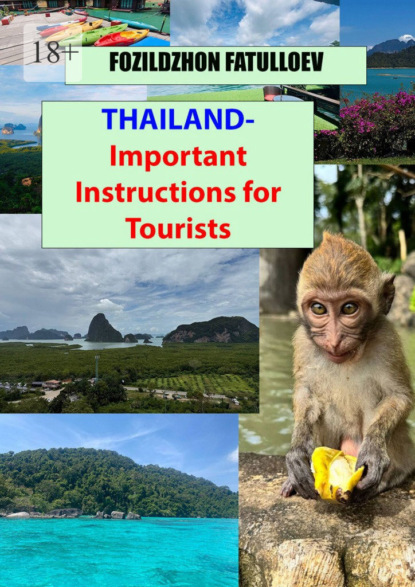
Thailand – Important Instructions for Tourists



- -
- 100%
- +

© Fozildzhon Fatulloev, 2026
ISBN 978-5-0068-9735-9
Created with Ridero smart publishing system
Thailand: Where to even begin
Imagine a country where you pray in an ancient 13th-century temple in the morning, sip coconuts on a white beach during the day, and choose between 50-baht street food and a panoramic rooftop bar in the evening. This is Thailand – a kingdom that has managed to combine deeply rooted traditions with a very modern lifestyle.
This book won’t be a dry guidebook of “temple on the left, market on the right.” Its purpose is to explain, HowThailand is structured differently: from its history and climate to its people’s mentality. Understanding the country makes it easier to travel stress-free, avoid breaking the law, avoid offending locals out of ignorance, and still get the most out of your trip.
A Brief History: From Ancient Kingdoms to the Modern Kingdom
To understand Thailand today, it is useful to have a general idea of what happened here in the past.
Ancient Kingdoms
Long before the emergence of modern Thailand, various states and cultural centers existed in this territory. Thai tribes lived in the north and center, while the influence of the Khmer, Indian, and Chinese civilizations was felt in the east and west. Many of the ruins that tourists visit today are vestiges of these ancient periods.
Sukhothai – the “dawn” of Thai civilization
In the 13th century, the Kingdom of Sukhothai emerged, often referred to as the first Thai capital. It is associated with the development of Thai writing, the first large temples in the style we recognize today, and the idea of an independent Thai state. Today, Sukhothai is a large historical park where thousand-year-old columns and Buddha statues stand among lakes and trees.
Ayutthaya – the golden age
The center of power then shifted to Ayutthaya. This powerful kingdom actively traded with China, Persia, and European powers. Ayutthaya was wealthy, multicultural, and highly developed. Today, its ruins are one of the country’s most important historical complexes: brick stupas, temple fragments, heads and bodies of Buddha statues, and leaning walls – all of this recalls the city’s former might.
Siam and the never colonized country
After the fall of Ayutthaya, the center of power shifted several times until a state emerged that Europeans called Siam. An important feature: unlike many of its neighbors, the countrywas never a colonyEuropean powers. Thailand navigated between the interests of Britain and France, ceded land, modernized its army and government, but retained its independence. This remains a source of national pride.
20th Century and Name Change
In the 20th century, the country experienced several constitutional changes, military coups, and political crises, but the monarchy retained its central role. In 1939, Siam was officially renamed Thailand – “the land of the free.” Today, it is a constitutional monarchy: there is a government and a parliament, but the figure of the king remains symbolically and culturally significant.
For a tourist, all this is important not because you need to pass a history exam, but because in every region you will encounter traces of it: the ruins of ancient capitals, royal projects, monuments, the cult of the royal family, the pride that the country has “always been free.”
Culture: Buddhism, respect, and the “land of smiles”
If you try to describe Thai culture in a few words, it would be something like this: Buddhism, respect, gentleness and conflict avoidance.
Buddhism as the basis of worldview
The majority of the population practices Theravada Buddhism. It’s not just a religion, but the foundation of a way of life: reverence for monks, generosity, respect for elders, and the concept of karma and reincarnation. For tourists, this means:
– churches are not just “beautiful buildings,” but living centers of community life;
– a monk is not a “photo prop”, but a person who is treated with great respect;
– The rule “don’t make noise, don’t expose yourself, don’t behave provocatively” is not a formality, but a basic sign of respect.
Smile as a language of communication
It’s no coincidence that Thailand is called the “land of smiles.” A smile can signify joy, politeness, embarrassment, or an attempt to smooth over a conflict. A rude, abrupt style of communication is perceived very negatively here. Even if someone is dissatisfied, they often prefer not to “swear” openly, but simply to end the interaction (for example, by refusing to serve you or politely “disappearing” from the conversation).
Respect and hierarchy
Society is quite hierarchical: respect for elders, teachers, authorities, monks, and, of course, the king is very important. This is evident in language (special politeness particles), gestures (the “wai” greeting, with different hand heights for different statuses), and behavior.
This also affects tourism: if you treat people rudely, shout, argue, or push them around, you will be perceived as rude. This book will contain many examples of how"Thai style” to resolve issues without conflict, but it is important to understand here: gentleness and respect are your best tools in Thailand.
Multinational country
However, Thailand is not a monolith. It is home to:
– Thais of different regional groups;
– descendants of Chinese immigrants (especially in Bangkok, on the coast and in large cities);
– Muslims in the south (Pattani, Yala, Narathiwat, part of Songkhla);
– mountain peoples of the north (Akha, Karen, Hmong, etc.).
Therefore, in different parts of the country you will experience a completely different atmosphere: from Buddhist villages in the mountains to Muslim fishing villages in the south, from the Chinese shrines of Phuket to villages in Isan where almost no English is spoken.
Climate: Why You Can Live Here Year-Round
Thailand is located in the tropical zone, and this is one of the key factors of its tourist attractiveness: it’s warm here all year roundBut warmth comes in different forms, and understanding the climate will determine how comfortable you’ll be.
Conventionally, three seasons can be distinguished:
– Cool season (November – February)
– This is the best time for most travelers: relatively cool (by Thai standards), less rain, and milder humidity. In Northern Thailand (Chiang Mai, Chiang Rai), it can get really chilly at night, so people sometimes wear jackets. At resorts, this is the high season and the highest prices.
– Hot season (March – May)
– The heat is at its worst, especially in Bangkok and inland. Temperatures feel very high due to humidity, asphalt, and dense buildings. During this time, it’s especially important to consider sun protection, drinking water, and air conditioning.
– Rainy season (approximately May – October, varies by region)
– It’s monsoon season. This doesn’t mean “nonstop rain,” but rather frequent heavy rains, usually in the afternoon or at night. In return, you get green mountains, fewer tourists, and often lower prices. However, on some islands (for example, part of the Andaman coast), boat transfers may be closed or swimming may be restricted due to high waves.
Regional differences
It is important to understand that:
– OnAndaman coast (Phuket, Krabi, Phi Phi) the peak rainfall usually occurs from May to October.
– IN Gulf of Thailand (Samui, Phangan, Tao) have their own logic: it is more humid here at the end of the year, and in the summer it is often very comfortable.
– IN Northern Thailand (Chiang Mai, Chiang Rai) there are more pronounced temperature fluctuations depending on the season, nights can be cool.
– Central part (Bangkok and surrounding areas) – hot and humid almost all the time, with some relief during the “cool” season.
In this book we will go into more detail, What month is the best time to go where? To avoid storms, closed islands, and unbearable heat. But even at the preface, it’s important to note: Thailand isn’t “the same weather everywhere,” but a collection of microclimates that need to be considered.
Regions of Thailand: Several different countries in one
Thailand can be roughly divided into several major regions. This is important for tourists, as each region offers a different lifestyle, landscapes, and even slightly different food.
Central Thailand
Bangkok, Ayutthaya, Kanchanaburi and surrounding areas.
The country’s political and economic life is concentrated here. Bangkok is a metropolis of skyscrapers, shopping malls, nightlife, and old quarters with temples and markets. Historic capitals and important natural sites are nearby.
North
Chiang Mai, Chiang Rai, Pai, mountainous areas.
Mountains, jungles, waterfalls, cool nights, temples on the mountaintops, and hill tribe villages. The atmosphere is more relaxed than Bangkok or the beaches. The north is loved by those interested in culture, trekking, meditation, and mindfulness tourism.
Northeast (Isan)
A large rural region bordering Laos and Cambodia.
There are fewer typical beach tourists here, but there’s plenty of authentic village life, Buddhist and Khmer temples, and a distinctive cuisine (famous for its “spicy salads” and sticky rice dishes). Isan accounts for a large portion of the country’s workforce: many waiters, hotel workers, and construction workers in Bangkok hail from here.
East
Pattaya, Rayong, Koh Chang and other islands.
A coastline that has been actively developed for tourism: resorts, hotels, and bars. There’s both the “massive” Pattaya and quieter islands with beautiful nature.
South
A long peninsula washed by the Andaman Sea and the Gulf of Thailand.
This is where those iconic “postcards” of Thailand are found: azure seas, limestone cliffs, and tropical islands. But beyond the beaches, the south is rich in national parks, forests, marine reserves, and Muslim fishing villages.
The deeper you travel, the more you realize that “going to Thailand” is not a single action, but always a choice: Which Thailand are you going to? Beach, city, mountain, rural, spiritual, gastronomic or work (for wintering and remote work).
This book is exactly what you need to help you make this choice.
Why Thailand has become one of the most popular tourist destinations
Now the main question: why has Thailand surpassed many countries and become the dream of millions of travelers?
1. Climate and year-round availability
Yes, there are seasons, rain, and heat, but overall, you can fly here in almost any month and find a place with comfortable weather: if it’s rainy season in Phuket, you can go to Koh Samui; if the nights are cold in the north, the south has excellent beaches. This makes the country very convenient for travel planning.
2. Value for money
In Thailand you can:
– live in a simple guesthouse for little money;
– or rent a villa with a pool and still pay less than in Europe;
– eat delicious food on the street for next to nothing;
– or go to high-end restaurants with world-class cuisine.
At the same time, the country does not look “poor and ruined” – the infrastructure is quite developed: roads, airports, hotels, supermarkets, banks.
3. Friendliness and safety
There are no perfect places, but overall, Thailand is considered a fairly safe country for tourists. Outright aggression towards foreigners is rare, and locals are more likely to try to help than take advantage of a situation. Many tourists feel relaxed here: they can take evening strolls, travel with their families, and women can travel alone.
4. Cuisine and variety of flavors
Thai cuisine is a separate reason to visit. Spicy soups, salads, curries, noodles, seafood, and fruit are available year-round. Even if you’re not used to spicy food, you can almost always ask for “mild” and find options to suit your taste. Meanwhile, in tourist areas, you can easily find European, Indian, Chinese, Middle Eastern, and other cuisines.
5. Flexibility of visa regimes
For many years, the country has pursued policies aimed at attracting tourists and long-term visitors: visa-free entry for many nationalities, relatively simple tourist visas, programs for retirees, remote workers, and investors. All this makes Thailand convenient not only for short vacations but also for wintering, freelancing, and long-term residence.
6. Diversity of recreational activities
In one country you can:
– have a classic beach vacation;
– go diving or surfing;
– go trekking through the jungle;
– sit in a meditation retreat at a monastery;
– take up Thai boxing or yoga;
– go shopping and enjoy clubbing in the metropolis;
– treat teeth, undergo medical examinations or operations in modern clinics;
– work remotely from a coworking space by the sea.
This is not “one country – one scenario”, but a construction kit from which everyone can assemble their own journey.
7. Ease of adaptation
In tourist areas, many people speak at least a little English. Café menus are often accompanied by pictures and Latin characters. International payment cards are widely accepted, and large cities have familiar cafe and store chains. This makes it easier to fly here “for your first time in Asia” than, for example, to some neighboring countries.
Why do you need this book?
Thailand has become so popular that it’s become surrounded by a plethora of myths, superficial “life hacks,” and advice along the lines of “it’s all simple, just go and you’ll figure it out.” In reality, Ignorance of the laws, rules and cultural peculiarities here can really cost you dearly: fines, visa problems, conflicts with landlords, unfortunate medical histories, ruined vacations.
This book is intended asstep-by-step, practical instructions:
– how to prepare for a trip;
– how not to break the law;
– how to behave in churches and with locals;
– how to choose regions and seasons;
– how to plan a budget;
– How to rent a vehicle safely;
– how to travel with children, alone, as a couple or in a group;
– How to live here for a long time – from wintering to six months or more.
In the following chapters we will analyze all of this in as much detail as possible and using specific examples.
And now you know the main thing: Thailand is not just “beach and coconuts,” but a complex, interesting, and very vibrant country that is ready to open up to those who are ready to treat it with respect and attention.
Chapter 1. Preparing for the Journey
1.1 When is the best time to go?
The first thing to consider when planning a trip to Thailand is the season. It’s a tropical country, so it’s summer year-round, but the climate varies depending on the month and region. Choosing the right season can make your trip comfortable, safe, and economical. Choosing the wrong season can make it the opposite.
Below is a detailed explanation of the seasons, price differences, and key holidays and festivals that can make or break your trip.
SEASONS IN THAILAND
Thailand is conventionally divided into three tourist seasons:
– High season
– Low season
– Rainy season (monsoons)
But it’s important to note that the seasons vary across the country. The weather in Phuket differs significantly from that in Koh Samui, and what’s bad for one part of Thailand may be ideal for another.
High season (November – February)
Ideal period for most tourists
Weather
– Least rainfall
– Least high humidity
– Comfortable temperature (especially in the south)
In the northern regions (Chiang Mai, Chiang Rai) nights can be cool, sometimes up to plus 14…18 degrees.
Pros
– Great weather for beaches
– Calm sea on the Andaman side (Phuket, Krabi, Phi Phi)
– Good conditions for excursions, trekking, diving
– Many mosquitoes and insects avoid peak tourist activity.
Cons
– The highest prices of the year
– Lots of tourists
– Hotels are booked in advance
– There are a lot of people in restaurants, on beaches and excursions
Prices
During this period, the cost of housing may be higher by:
– 30—50 percent in cities
– 50—120 percent on the islands
– Sometimes – 2—3 times on popular destinations (Phuket, Samui, Krabi)
Top destinations
– Phuket
– Crabs
– Phi Phi
– Ko Lanta
– Chiang Mai
– Chiang Rai
– Bangkok
Low season (April – October)
The most economical period
Weather
– The hot or humid tropical season begins
– Scattered showers are possible
– The sea is becoming dangerous at some resorts
Pros
– Minimum housing prices
– Fewer tourists
– It’s easier to find accommodation near the beach
– Discounts on tours
Cons
– Occasional high waves on the Andaman coast
– Some beaches may be closed
– The islands are becoming less accessible
Top destinations
– Koh Samui
– Koh Phangan
– Koh Tao
– (summer is the best season here)
– The north of the country (Chiang Mai, Pai) is the green season
– Bangkok – Anytime except April (too hot)
Rainy season (monsoons)
What does rain look like in practice?
– This doesn’t mean it’s raining all day.
– In most cases, these are short, heavy tropical downpours.
– Often in the evening or at night
– The clouds pass quickly
The greenery in the mountains is especially beautiful during this season, the air is fresh, and the sea is deserted.
BY MONTH (details)
January – February
– The best months for the whole country
– Comfortable temperature
– Lack of rain
– High season (expensive and crowded)
March
– The weather is great
– The heat wave has begun in Bangkok.
– In the northern regions there is heavy haze due to fires
April
– Calm sea
– The hottest month of the year
– The Songkran festival is underway
May
– The beginning of the low season
– Quiet resorts
– The beginning of the monsoons in Phuket
June – July
– Low prices
– Very green
– It’s good on Koh Samui
– There may be waves in Phuket
August
– The best month to visit Koh Samui
– Phuket can be restless
September – October
– The lowest prices of the year
– There are almost no tourists
– At many resorts this is the rainiest period
– The showers are short
HOLIDAYS AND FESTIVALS
Holidays affect prices, hotel occupancy and the number of tourists.
– Songkran
– April 13—15
– A Thai New Year celebration with mass water dousing.
Pros
– Unique atmosphere
– Highlights
– Cons
– It’s very hot
– Prices are rising
– Lots of people
– Loy Krathong
– October – November
– The Festival of Lights, when baskets of candles are launched into the water.
Pros
– A very beautiful festival
– Cons
– Accommodation in Chiang Mai is booked in advance.
– Chinese New Year
– January – February
– It is especially widely celebrated in Phuket, Bangkok and Pattaya.
– Vegetarian Festival
– October
– Held in Phuket. Many traditional rituals.
– New Year
– December 31
– The most expensive period for travel.
BOTTOM LINE: WHEN IS THE BEST TIME TO GO?
The best time for a beach holiday: November – March.
The best time for a cheap holiday: May – October.
The best time to visit Koh Samui is June – August.
The best time for a relaxing holiday: September – October.
The hottest period: March – April.
1.2. Routes
Beaches, culture, trekking, excursions, shopping – itinerary options for different types of tourists
Choosing the right itinerary determines the entire nature of your trip. Thailand offers a huge variety of vacation options: from secluded beaches to rich cultural programs, from sea expeditions to lush jungles. Below is a detailed description of the main itineraries, including one of the country’s best regions, Khao Lak.
Khao Lak: one of the best places for a quiet, clean and quality holiday
Khao Lak is located on the west coast of Thailand, north of Phuket. It’s considered one of the safest, cleanest, and most pleasant resorts for those who appreciate spacious beaches, a quiet nightlife, and ultra-clear waters. Unlike Phuket, there are no overcrowded streets, noisy neighborhoods, or crowds around every restaurant. Khao Lak is perfect for families, couples, long-term stays, winter camps, and a more relaxed lifestyle.
Why Khao Lak is considered one of the best resorts
· Long beaches that stretch for tens of kilometers with almost no people.
· Soft waves in winter and gentle sunsets on the Andaman Sea.
· Cleanliness, safety, no crime.
· Good roads, shops, restaurants and all the infrastructure for living.
· Direct access to the country’s finest marine national parks.
· Tours to the Similan and Surin Islands depart from here.
· The city itself has a quiet atmosphere, family-friendly amenities, tranquil cafes, culinary schools, massage parlors, and markets.
· Convenient location: nearby are jungles, waterfalls, national parks, farms, and temples.
Khao Lak is a resort that offers exactly what most tourists want: the sea, nature, and real relaxation, without the noise and overcrowding.
The Similan Islands: One of Thailand’s Main Maritime Symbols
The Similan Islands are among the top snorkeling and diving destinations not only in Thailand but throughout Southeast Asia. Their white sand, glass-blue water, granite boulders, and impressive underwater reefs have made them a global icon.
Why Similan Islands are one of the best tours in Thailand
1. Water transparency reaches twenty to thirty meters.
2. Rich marine life: turtles, rays, thousands of fish, corals.
3. Unique granite rock shapes that are not found on other islands in Thailand.
4. One of the most photogenic beaches in the country.
5. Clear natural protection: the islands are closed for six months to allow the ecosystem to recover.
6. If the weather permits, tours are organized from Khao Lak daily during the season.
If a tourist is looking for exciting snorkeling, crystal clear water, and unforgettable views, the Similans are the number one destination.
The Surin Islands: Peace, Tranquility, and Unique Nature
The Surin Islands are less popular than the Similan Islands, but even more atmospheric and natural. They are located closer to the Myanmar border and are known as the home of the Moken sea gypsies, a unique ethnic group.
What is special about Surins?
· This is where you have the highest chance of encountering turtles, reef sharks, and large rays.
· The water is calmer than in the Similans, and often even cleaner.
· Very soft, calm atmosphere without crowds of people.
· The best snorkeling for those who love to observe underwater life.
· The lack of mass character makes Surin particularly comfortable.
Surin is recommended for those who prefer natural silence, gentle sea, tranquility and a minimum number of tourists.