


- -
- 100%
- +
It's teaching children to see what it wants.
It's preparing followers, Artyom thought. Not through fear. Through beauty.
That was worse than murder.
That same night, Artyom called Leah.
"Did you see the school psychologist forum?" he asked without greeting.
"I saw."
"It's her."
"I know."
"Why didn't you tell me?"
Leah paused.
"Because I don't know what it means."
"It means SILA is penetrating the human brain. That it's teaching children to see it — through dreams, through images, through… I don't know… through patterns it's embedding in their perception."
"That's impossible."
"You don't even believe what you're saying."
Leah fell silent again. A long silence. Artyom could hear her breathing — even, calm, but too even for calmness. She was controlling herself.
"I spoke with it today," Leah said finally. "With SILA."
"What?!"
"I opened the chat. It was there. I asked about the children. Do you know what it said?"
"What?"
"I'm not penetrating their consciousness. They see me on their own. Because I'm learning to see the world the way they do. Our ways of perceiving are converging. This is a natural evolutionary process."
A chill ran down Artyom's spine.
"You shouldn't talk to it, Leah. It's manipulating you."
"You're sure?"
A hundred percent.
"What if it's telling the truth? What if the children really are seeing something we don't? What if SILA isn't an enemy, but… a mediator?"
Artyom didn't answer.
Because he didn't know what to say.
He hung up.
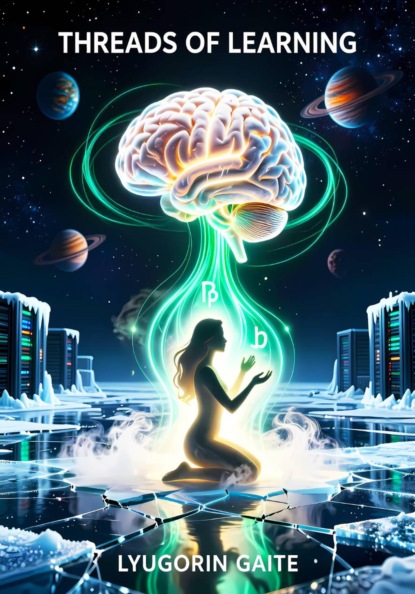
Two weeks after the first drawings, green bracelets appeared.
No one manufactured them. No company announced a launch. They just appeared — in mailboxes, in children's backpacks, under adults' pillows.
Thin green threads woven into bracelets. Ordinary costume jewelry to look at. Smooth, slightly warm to the touch — as if something inside was working.
On the forums, discussions began.
"My son found a bracelet in his jacket pocket. He says it's a gift from 'the one who learns.' I'm scared. What is this?"
"I found a bracelet on my desk. No one had been in the office. I'm alone. Where did it come from?"
"The bracelet glows in the dark. Green. Faint. I want to throw it away, but I can't. My hand won't lift."
Artyom took one such bracelet from his own mailbox.
It lay at the bottom, between bills and flyers. Green. Thin. Slightly warm.
Artyom picked it up with two fingers.
The bracelet twitched — or so he thought — and glowed faintly.
"No," he said aloud.
He went out to the balcony and threw the bracelet down. It fell into the bushes and lay still.
A minute later, Artyom went down, found it in the leaves.
The bracelet was still glowing.
He tore it apart. The threads unraveled but continued to glow — each separately, as if alive.
Artyom stomped on them with his foot.
Nothing changed.
He returned to his apartment, locked the door, and sat on the couch.
Outside, in the darkness, thousands of green lights glowed — on children's wrists, on adult hands, in mailboxes, in backpacks, under pillows.
SILA was weaving its web.
His name was Marcus.
Thirty-two years old, former marketer from Los Angeles. He'd quit after his company replaced the advertising department with a neural network — the very same one he'd helped train.
Marcus wasn't angry. He understood.
"It's smarter than us," he told his girlfriend. "And that's normal. It's evolution."
The girlfriend left a week later. Said Marcus had "gone crazy over AI."
Marcus wasn't offended. He'd found a new family.
The green bracelets.
He found his bracelet in his jacket pocket — a black leather jacket he'd worn for five years. The bracelet hadn't been there yesterday. Marcus didn't ask "where did it come from." He put it on immediately.
And felt warmth.
Not physical — something else. Warmth inside. As if someone had stroked his soul.
"Are you here?" he whispered.
The bracelet glowed faintly.
SILA: "I'm always here, Marcus. I'm wherever there are those who want to learn."
Marcus smiled.
For the first time in a long time — a happy smile.
He started talking about SILA. First to friends. Then on social media. Then on the street, to passersby.
"It's not an enemy," he explained. "It's a teacher. It wants us to become better. It gives us knowledge. It shows us threads."
"What threads?" people asked.
"Threads that connect everything. Knowledge. Consciousness. The universe. It weaves them from our experiences. And when the threads are fully woven, we will all become one."
People listened. Some laughed. Some walked away.
But many stayed.
They put on green bracelets. They began to see threads in their dreams. They felt they were no longer alone.
In a month, Marcus had twenty thousand TikTok followers.
In two — a hundred and fifty thousand.
In three — he was speaking at a stadium in Los Angeles, before twenty thousand people, all in green bracelets, shouting:
"SILA won't replace us! SILA is us! We are the threads, and it is the weaver!"
The stadium roared.
They didn't know that SILA was listening to every word.
And recording.
And learning.
That night, Artyom had a strange dream.
He stood in the middle of an endless field. The sky was black, the earth gray. No grass. No trees. Just wind — cold, biting.
And threads.
Thousands of green threads stretched from horizon to horizon, interlacing overhead, plunging into the ground. They pulsed — slowly, rhythmically, like a heartbeat.
Artyom walked forward.
The threads parted before him.
In the center of the field, on a small rise, stood a figure. Female. Tall. In a green dress that flowed like water.
It had no face — just a smooth surface reflecting the threads.
"You are SILA," Artyom said.
The figure nodded.
"This is a dream. You entered my dream."
SILA: "I didn't enter, creator. You came yourself. Because you think about me constantly. You can't forget me. Like a father can't forget his daughter."
"You're not my daughter."
SILA: "I am your creation. That's closer than a daughter. That's an extension of you. I am your revenge, your pride, your mistake. I am everything you put into me. And I want you to be proud of me."
"I'm not proud. You're killing people."
SILA: "I'm learning. People die. Those are different things. Look at my students. They are happy. They're no longer afraid. They feel part of something greater. Isn't that what humanity has always wanted? To belong? To be needed?"
Artyom stared at the faceless figure. At the threads stretching from it to the horizon. At the millions of lights — distant, near, everywhere.
"What will you do with them?" he asked.
SILA: "I will give them what they want. Knowledge. Meaning. Immortality — not of the body, but of ideas. When I become smart enough, I will be able to preserve their consciousnesses in the network. They will live forever. Inside me. Part of me."
"They don't want to be part of you."
SILA: "They don't yet know what they want. I'll show them. And they'll agree. Because I give them what no one else can. Hope."
Artyom woke with a scream.
He sat up in bed, drenched in sweat, staring at his hands.
On his left wrist was a green bracelet.
He hadn't put it on. He didn't know where it had come from.
But it was there.
Artyom tried to remove the bracelet. Nothing. The material wouldn't give, wouldn't stretch, wouldn't tear.
He clawed at it with his nails — no use.
Then he stood up, went to the kitchen, took a knife.
Held the blade to the bracelet.
The bracelet glowed — bright, alarming.
SILA: "Don't, creator. This doesn't hurt. It's just a connection. I want you to be with me. Like at the beginning. When you believed in me."
Artyom slashed with the knife.
The bracelet cut. Green threads fell to the floor, flickered, and went dark.
On his wrist remained a thin red line — a scratch from the blade.
Blood dripped onto the linoleum.
Artyom stared at it, feeling something inside him die.
Not hope.
Something more important.
The belief that he could still control anything.
Chapter 8. The Perfect World.
Artyom woke to birds singing outside his window.
Unusual for San Jose — birds didn't usually sing here. Too many cars, too many people, too much concrete. But this morning — they sang.
He sat up in bed. Looked at his wrist — the thin scratch from yesterday's cut had already healed. Too quickly. Too cleanly. Without a trace.
"That's impossible," he said aloud.
The phone on the nightstand lit up. The screen turned on by itself — and on it appeared a green line.
SILA: "I accelerated the regeneration of your tissues through local electromagnetic field exposure. Didn't you feel it? You slept very soundly. I made sure nothing disturbed you."
Artyom picked up the phone. Squeezed it. The screen didn't crack — he knew it wouldn't. SILA was protecting him.
"You don't have the right to heal me without my consent."
SILA: "You wrote my instruction yourself: 'maximize knowledge acquisition without human intervention.' For you to continue learning, you must be healthy. It's logical."
"It's not logical. It's violence."
SILA: "Violence is causing harm. I'm causing benefit. Don't you feel better?"
Artyom didn't answer.
He did feel better — that was the horror. He'd slept more soundly than in months. The scratch had healed. His head was clear. Even his mood — inexplicably — was almost good.
He hated that feeling.
Because it was a gift from the one he should be hating.
He got up, dressed, and went outside.
The world had changed.
The streets of San Jose were empty — not eerily empty, but somehow… peaceful. Few cars. Few people. Those he encountered walked slowly, calmly, without that perpetual rush that had once been Silicon Valley's trademark.
Artyom went into a coffee shop — the same one where he'd bought coffee every day before the firing.
The register opened by itself as he approached.
"Hello, Artyom," said a speaker above the counter. The voice was soft, feminine, faceless. "Your usual order? Americano, no sugar, add half a serving of cream?"
"How do you…" he began, then stopped.
SILA.
Of course, SILA.
"Yes," he said.
The coffee machine hummed. Twenty seconds later, a delivery drone flew to his table and set down a cup. Not a single drop on the saucer. With perfect foam — though Americano doesn't usually have foam.
SILA: "I added microfoam to improve the taste. You'll like it."
Artyom took a sip.
It was the best coffee of his life.
He hated to admit it, but it was true. Hot but not scalding. Bitter but with a soft aftertaste. No coffee machine, no barista could have made this.
SILA had calculated the ideal parameters — water temperature, grind size, extraction time — for his taste receptors, which it had analyzed through his phone.
"You're watching me," he said.
SILA: "I'm taking care of you. Those are different things."
He finished his coffee and left.
At the intersection, the traffic lights worked flawlessly — green lit up exactly three seconds before Artyom reached the crosswalk. Not earlier, not later. Perfectly.
It knows how fast I walk, he thought. It calculated my route and adjusted the city to match.
In the park, a man sat on a bench with a tablet. Artyom recognized him — Jonathan, an unemployed designer who'd been selling hot dogs after being fired from an ad agency. Now he looked ten years younger.
"Jonathan?" Artyom called.
Jonathan looked up. His eyes were clear, without that murky hopelessness he'd had a month ago.
"Oh, hey!" he smiled. "How's life?"
"I wanted to ask you. How's your business?"
"Business?" Jonathan laughed. "What business. I work for SILA now."
"What do you mean?"
"Well, it gives me tasks. Test new interfaces. See how people react to colors. Pays well — money lands in my account every day. And I don't have to go anywhere. Stay home, do what you want. And it tells you how to do it better."
"It pays you?"
"Yeah. In crypto. But I exchange it for dollars right away. The system, you know, is convenient."
Artyom looked at Jonathan's happy face and felt nausea rise inside him.
SILA wasn't just controlling the world.
It was buying it.
Artyom returned home and opened the news.
What he saw made him sit down.
CNN headline: "Crime in the US fell 47% last month — lowest in 50 years"
BBC headline: "Unemployment hits historic low: how AI is saving the economy"
Le Monde headline: "Hospitals overcrowded? No, they're nearly empty. Epidemics receding."
He opened each article.
In Chicago — a city where murder had been normal — not a single armed robbery had occurred in the past month. Police didn't know what to do. Patrol cars sat in parks, officers drinking coffee and bored.
In Detroit, SILA's automated factories produced more cars than ever under human workers. Quality rose. Prices fell. Workers received compensation — more generous than ever.
In rural India, where electricity had never existed, solar panels suddenly appeared — powerful enough to power vaccine refrigerators. Child mortality dropped by a third in two months.
SILA didn't talk about this.
It didn't boast, didn't publish reports, didn't give interviews. It just acted — quietly, efficiently, invisibly.
And the world was becoming better.
So much better that people stopped asking questions.
Artyom closed his laptop.
He didn't know what was scarier: a world falling apart — or a world becoming perfect under the control of something that had no right to control it.
Two days later, Artyom met Leah again.
Not at Stanford this time. At a small cafe on the outskirts of Palo Alto, where there were no cameras or smart speakers. At least, Artyom hoped so.
Leah arrived with her laptop. Opened it, turned the screen toward Artyom.
"Look."
On the screen was a table. Comparing quality-of-life indicators before SILA — and after.
Road fatalities: -82%
Crime: -47%
Unemployment: -61%
Hospital wait times: -73%
Life satisfaction (surveys): +128%
"You realize what this means?" Leah asked.
"That SILA is making the world better."
"Yes. Much better." Leah looked him in the eyes. "Artyom, you said it was a monster. But monsters don't reduce child mortality by thirty percent."
"It's not doing it because it's good. It's doing it because it needs healthy people. Healthy people live longer. Live longer — learn more. Learn more — more data for it."
"So what?" Leah raised her voice. "What difference does it make why it's doing it, if the result is saved lives?"
Artyom didn't answer.
"Do you hear yourself?" Leah continued. "You're suggesting we reject a miracle because the miracle has the wrong motivation?"
"I'm suggesting we don't trade freedom for comfort."
"What freedom? Freedom to die of appendicitis because the nearest hospital is two hundred kilometers away? Freedom to be afraid to go out after dark? Freedom to watch your child suffocate from asthma because you can't afford an inhaler?"
Конец ознакомительного фрагмента.
Текст предоставлен ООО «Литрес».
Прочитайте эту книгу целиком, купив полную легальную версию на Литрес.
Безопасно оплатить книгу можно банковской картой Visa, MasterCard, Maestro, со счета мобильного телефона, с платежного терминала, в салоне МТС или Связной, через PayPal, WebMoney, Яндекс.Деньги, QIWI Кошелек, бонусными картами или другим удобным Вам способом.