

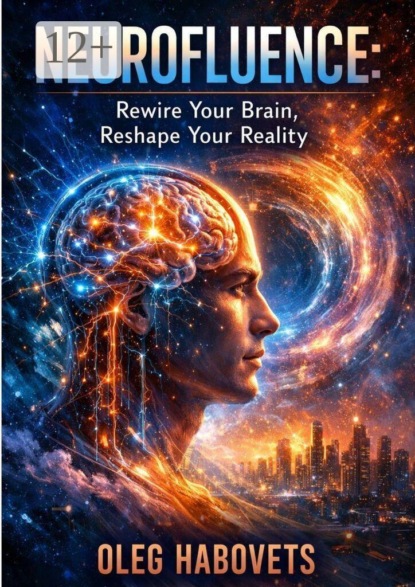
Neurofluence: Rewire Your Brain, Reshape Your Reality



- -
- 100%
- +
Self-organization shows that the mind does not just react to the world-it is capable of creating order within itself, which then spreads outward. Attention turns energy into structure, and this structure becomes a platform for action. This is how the path from thought to real influence on matter begins.
Speaking the language of physics, any system tends toward entropy-toward equilibrium and decay. Everything in the world, in essence, slowly dissolves into chaos. But living systems are an exception. They know how to maintain order despite entropy. The brain is one of the best examples. It is an incredibly complex network where every connection is subject to noise and random fluctuations, yet everything doesn’t fall apart. Why? Because the brain constantly creates and maintains structure. It redistributes energy, strengthens necessary connections, synchronizes the work of billions of cells. It lives on the edge of chaos but doesn’t fall into it.
Consciousness is precisely the tool that keeps the system in balance. When you focus attention, coherence grows, breathing and heart rhythm align, and a stable field of order forms inside. This order is not imposed; it is self-sustaining. It exists as long as you maintain the rhythm. Attention becomes the conductor of energy, coherence-the coupling between billions of neurons, self-organization-the mechanism that prevents the structure from disintegrating.
And it is in this that the power of consciousness lies. It is capable not only of existing in a world of entropy but of creating islands of order within itself. And order is power because it stabilizes energy and directs it. When internal processes are synchronized, attention becomes not just observation, but action.
And here the mind ceases to be a passive witness to what is happening. Internal order becomes the basis for external influence. First through the body, movements, words. Then-deeper, at the level of fields, where thought no longer simply reflects reality but begins to shape it. Consciousness is not an abstract idea or a philosophical metaphor. It is a physical system capable of maintaining order despite chaos, turning energy into structure and directing it to where new meaning is born.
The mind is not an observer. It is an active force creating order. And it is precisely this ability-to resist entropy and build harmony from chaos-that makes consciousness capable of changing reality.
Chapter 3. Emergence and Consciousness
What Emergent Properties Are: How «Thought» Is Born from Simple Interactions
Consciousness is perhaps the most mysterious of all that matter has produced. After all, if you think about it, what is a person made of? Atoms. The same carbon, hydrogen, oxygen, and nitrogen atoms as in a stone, water, or stars. And yet, somewhere at a certain level of organization of these atoms, something suddenly appears that exists nowhere else-the sensation of «I.» The ability to think, observe, remember, feel. This is emergence-the moment when something greater than the sum of its parts is born from simple interactions.
To understand how this is possible, imagine a swarm of bees. Each bee acts according to simple, predictable rules-fly toward the scent of nectar, keep distance, return to the hive. But if you look not at one bee but at the entire swarm, you see not a set of insects, but a living organism that can make decisions, regulate temperature, protect the queen. From simple units, an intelligent system emerges. So too with the brain-only instead of bees, it has neurons. Each neuron is just a cell reacting to electrical impulses. But when there are billions of them, they begin to interact so complexly and intricately that a new quality appears-consciousness. Not in one neuron, but in their interconnections, in the rhythm, in the movement of signals.
A thought, in essence, is not a point or a command, but a wave. It moves through a network of neurons, echoes with thousands of other waves, creates patterns of excitation and fading. It is in these patterns that awareness is born. When you think, your brain doesn’t just «turn on a light bulb»; it creates a living, vibrating structure that lasts an instant-and disappears, leaving a trace in memory. It’s like a wave in the ocean: the water stays in place, but the movement is unique and unrepeatable.
Physics has long known that such phenomena are not magic. Take water. A single H₂O molecule has no «wetness» and doesn’t flow. But when there are billions, a new property emerges-fluidity. It is not contained in any one molecule, but appears through their interaction. Consciousness is such a fluidity, only not of molecules, but of impulses and information.
The mistake of old materialists was that they looked for the mind in the atoms themselves. But if you break down the brain to the level of chemistry, you won’t find thought or will there. Consciousness lives not in substance, but in connections. Atoms in the body change every few years, but the «I» remains the same. This means the mind is not matter, but a form of its organization, maintained by energy and information.
Physics calls this an emergent hierarchy. Each level of organization gives rise to new laws. Water molecules obey the laws of chemistry, but a wave already obeys the physics of continuous media. So too with the brain: neurons-biology, but consciousness is a level above, with its own laws of dynamics, resonance, and self-organization.
Today, science already tries to describe these processes not through chemistry but through the physics of interactions. For example, network neurophysiology considers the brain as a field where information and energy flow through connections, creating wave patterns-resonances that hold perception together. Or integrated information theory-it says consciousness depends on how deeply the elements of a system are interconnected. The denser the connections, the higher the level of awareness.
Конец ознакомительного фрагмента.
Текст предоставлен ООО «Литрес».
Прочитайте эту книгу целиком, купив полную легальную версию на Литрес.
Безопасно оплатить книгу можно банковской картой Visa, MasterCard, Maestro, со счета мобильного телефона, с платежного терминала, в салоне МТС или Связной, через PayPal, WebMoney, Яндекс.Деньги, QIWI Кошелек, бонусными картами или другим удобным Вам способом.