

The Ontological Framework of Non-Nothingness, Causality, and the Genesis of God
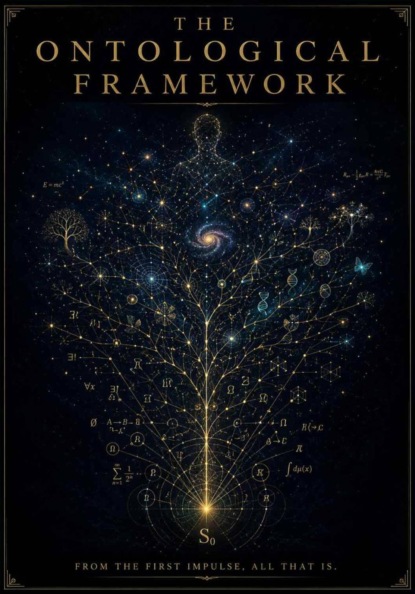




- -
- 100%
- +
So, while the idea of a deterministic system based on chains of causality stemming from the necessary existence of non-nothingness is a compelling and coherent viewpoint, it is not the only perspective, and there are still many unanswered questions and areas of exploration in our understanding of the universe and its underlying principles.
Effects of the first cause at the start of the universe
As the ultimate cause and basis for all events, the first cause is the origin of all causality and it initiates a chain or graph of all existing causes and effects, that lead to the emergence of all subsequent events. Therefore, the effects that the first cause causes are essentially all subsequent events and phenomena in the universe. This includes everything from the initial creation of the universe, The formation of space and time, to the formation of stars and planets, to the emergence of life and mind and consciousness, and social groups , civilizations and culture and so on.
It is important to note that the specific effects that the first cause causes are determined by the causal relationships between all events and entities in the universe, which in turn are ultimately based on the necessary existence of non-nothingness as the first cause
The first cause, as the ultimate cause and basis for all events, indeed sets the stage for everything that follows. The specific effects caused by the first cause are determined by the causal relationships between events and entities in the universe. These relationships are interconnected and form a complex web of causes and effects that, in turn, are ultimately based on the necessary existence of non-nothingness as the first cause.
This perspective emphasizes the interconnectedness and dependency of all events and entities in the universe, with each effect being causally related to the events that precede it. The first cause plays a crucial role in this web of causality, as it serves as the foundational source from which all subsequent events and phenomena emerge.
The uniqueness of identity
Every entity being an effect of some set of causes is uniquely situated in the chain of causality and is identified uniquely by its properties and its identity.
Every entity, as an effect of a specific set of causes, occupies a unique position in the causal chain or network. Its properties and identity are determined by its causal relationships with other entities, both those that precede it (its causes) and those that follow it (its effects).
This unique identity and set of properties allow us to distinguish one entity from another, even if they share some similarities. It also means that each entity’s existence and characteristics are contingent upon the causal interactions and relationships that have shaped it. Consequently, understanding the causal history of an entity can help us comprehend its nature, behavior, and potential effects on other entities or systems.
In any causal chain of events, each effect is ultimately determined by its own causes, which give it its properties and identity. And these causes themselves are ultimately determined by prior causes, leading all the way back to the necessary existence of non-nothingness, which serves as the ultimate cause or basis for all events
In a causal chain, each effect has its unique set of causes that define its properties and identity. This chain of causality extends back to the necessary existence of non-nothingness, which acts as the ultimate foundation and cause for all events.
By understanding this causal structure, we can appreciate the interconnected nature of all entities and events within the universe. Everything is ultimately rooted in the necessary existence of non-nothingness, and the specific causal relationships between events help to define and differentiate each entity within this complex network of causality.
The Environment
The most fundamental element of existence is the necessary existence of non-nothingness.
This concept represents the most basic ontological ground or foundation for all other entities and events. It is a starting point from which everything else arises, as the concept of absolute nothingness or non-being is self-contradictory and logically incoherent.
The necessary existence of non-nothingness provides the foundation for causality, as well as the basic principles of logic, such as the laws of non-contradiction, identity, and excluded middle. These principles are essential for understanding the structure and nature of reality and form the basis of rational thought and discourse.
The concept of the first cause or the first atom exists within the domain of pure existence, which is a realm of pure existence. In this domain, time and space are not yet defined, as they are contingent upon the first cause itself.
The necessary existence of non-nothingness, as the first cause, serves as the foundation for all other entities and events in reality. However, identifying specific effects that directly stem from the first cause can be challenging due to the complexity and vastness of the causal chains in the universe.
One approach to understanding the direct effects of the first cause is to consider the emergence of the most basic and fundamental properties of reality. For example, the existence of space and time, the emergence of energy and matter, and the basic laws governing their interactions can be seen as direct consequences of the necessary existence of non-nothingness.
These basic properties and laws give rise to the complex and diverse phenomena we observe in the universe, such as the formation of stars, galaxies, and planets, as well as the emergence of life and consciousness. The causal chain that connects these phenomena to the first cause, however, is highly intricate and not fully understood.
Nevertheless, the fundamental nature of non-nothingness as the first cause implies that it is the ultimate origin of all effects, even if the specific causal connections between the first cause and the myriad of phenomena in the universe are difficult to trace.
Simulating the universe
As every event or phenomenon in existence is causally determined by its prior events and the necessary existence of non-nothingness, which serves as the ultimate cause or basis for all events. This suggests a deterministic view of the universe, in which every event is determined by its causes and the initial conditions of the universe — which is the first cause.
If we do a simulation of the universe starting from the first cause, does it mean that this simulation of the universe would be identical to the actual original universe that emerges from the first cause? (considering the fact we base it on the simulation of the first cause)
In theory, if we had a perfect understanding of the first cause and all the fundamental laws governing the universe, as well as the ability to simulate all subsequent causal chains, then a simulation of the universe starting from the first cause should, indeed, produce an identical version of the actual universe.
The chain (or network) of causes and effects is ultimately based on the necessary existence of non-nothingness as the first cause, is deterministic in nature. This is because each event is causally determined by its own set of causes, which in turn are determined by prior causes, eventually leading back to the first cause.
The chain or network of causes and effects can be considered an entity in itself, with its own identity and uniqueness. This identity is defined by the specific set of causal relationships that give rise to each event and its properties. It is important to note that the chain or network of causes and effects is an abstract concept representing the causal structure of the universe. It is a way to describe the interconnectedness of all events and entities, rather than being a tangible object or entity in the conventional sense.
Since this chain or network of causes and effects is deterministic and arises from the first cause (the necessary existence of non-nothingness), it is indeed very specific. It represents a unique and precise unfolding of events and phenomena, each causally determined by its prior causes, ultimately tracing back to the first cause. This deterministic nature of the causal chain or network underscores the uniqueness and specificity of the identity of the entire system of events and entities in the universe.
Connection to timeless perfect domain
Consider the universe as a whole, outside of time, as a state of absolute perfection. This chain or mesh of all events creates time (because the phenomenon of time is a subjective measure that exists physically only as a measure of differences between different states of the universe, so the “time” develops coming along with the events chain that develops itself)
It means, that out of time, the universe is already formed the state of the absolute perfection, that should possess such qualities like: absolutely perfect truth, absolutely perfect goodness, and absolutely perfect consciousness.
From a scientific standpoint, we can say that time and the development of the universe are closely intertwined, with time being a dimension that allows us to measure the progression of events and the evolution of the universe. The universe has evolved through various stages, from the Big Bang to the formation of galaxies, stars, and planets, to the emergence of life and consciousness.
Considering the universe as a unique chain of events determined by the first cause and viewing it from an “out of time” standpoint can lead to intriguing ideas about the nature of existence and reality.
If we were to view the universe from a state where all chains of events have already occurred and time is no longer a factor, we might perceive the universe as a complete and interconnected whole. In this state, the entire history of the universe, along with all the causal relationships between events, would be instantly present.
If we consider the universe out of time, where all chains of events have ended and all entities and phenomena have reached their final states, then we might imagine a state of absolute perfection where every entity or event has fulfilled its ultimate purpose in the grand scheme of things.
This viewpoint on the universe in its final state of absolute perfection means it could be GOD because it possesses all qualities of God like: perfectness, absolute truth, absolute goodness (because it is complete, integral and lacks contradictions and destructive processes often associated with suffering and evil)
The idea that the universe in its final state of absolute perfection might be equivalent to a concept of God can be found in certain religious and philosophical traditions, such as pantheism and panentheism.
Pantheism posits that the universe itself is divine, and everything that exists is a part of God. Panentheism, on the other hand, suggests that the universe is part of God, but God also transcends the universe. In both of these views, the idea of a perfect, divine, and all-encompassing reality is central.
From this Christian perspective, we might view the universe as a sort of a genesis of God that has led to this final state of absolute perfection of GOD THE FATHER.
In Hinduism, also, Brahman is often described as an ultimate, unchanging reality that underlies all existence. It is often said to be pure consciousness or pure being, and is seen as the ultimate source of all creation. In this sense, Brahman is sometimes viewed as a static or unchanging concept, representing the ultimate state of being or ultimate reality.
Genesis of God
The perspective that the universe evolves towards a final state of absolute perfection can be seen as a process of the genesis of God. In this view, the universe’s development and unfolding could be considered a divine process leading to the realization of God the Father, or an ultimate, perfect state.
This idea has similarities with some aspects of Hinduism, as you mentioned. In Hindu philosophy, Brahman is considered the ultimate reality or the divine essence that permeates everything in the universe. It is the source of all creation, and it transcends space, time, and causation. Brahman is often described as being beyond our limited human understanding, but it is believed to be the unchanging foundation of all existence.
Dynamic aspect of God
However, this view is not necessarily shared by all Hindu traditions, as some place more emphasis on the dynamic and evolving nature of existence and the role of individual consciousness in shaping reality. The dynamic and evolving aspect of existence and ability to joyfully experience it is considered to be the God given gift of existence for His creations, the sentient beings. One aspect of Hinduism that emphasizes the dynamic and evolving nature of existence is the concept of Lila, which can be understood as the divine play of creation, preservation, and dissolution. Lila suggests that the universe is a constantly changing, dynamic manifestation of the divine, and that the purpose of life is to participate in this cosmic dance.
In many Hindu traditions, the idea of individual consciousness and its role in shaping reality is also important. The concept of Atman, or the individual soul, is central to Hindu thought. Atman is often considered to be a reflection or part of Brahman, the ultimate reality. The goal of spiritual practice in many Hindu traditions is to realize the true nature of the Atman and its unity with Brahman, thus transcending the illusion of separateness and the cycle of birth, death, and rebirth.
Some Hindu traditions emphasize the role of individual consciousness in shaping reality through the concept of Maya, or the illusory nature of the material world. According to these beliefs, our perceptions and experiences of the world are shaped by our individual consciousness, and by transcending Maya, we can realize the true nature of reality and our connection to the divine.
In this context, the ability to joyfully experience existence and participate in the dynamic, evolving nature of reality can be seen as a gift from the divine, allowing sentient beings to engage with the divine play of creation and ultimately realize their true nature and purpose.
Some religions and philosophies see the dynamic and evolving nature of existence as a gift from God and believe that experiencing and exploring this dynamic nature is a key part of our purpose or meaning in life. However if we consider the original chain of events that lead to state of absolute perfection, it is crucial to realize that this chain of events — aka genesis of God — is a subject of war between forces of good and evil. It seems they fight for control on the civilization in time, to be able to influence it in the timeless domain. So for God its crucial to preserve His genesis because this chain created Him in a state of absolute perfection.
Конец ознакомительного фрагмента.
Текст предоставлен ООО «Литрес».
Прочитайте эту книгу целиком, купив полную легальную версию на Литрес.
Безопасно оплатить книгу можно банковской картой Visa, MasterCard, Maestro, со счета мобильного телефона, с платежного терминала, в салоне МТС или Связной, через PayPal, WebMoney, Яндекс.Деньги, QIWI Кошелек, бонусными картами или другим удобным Вам способом.