

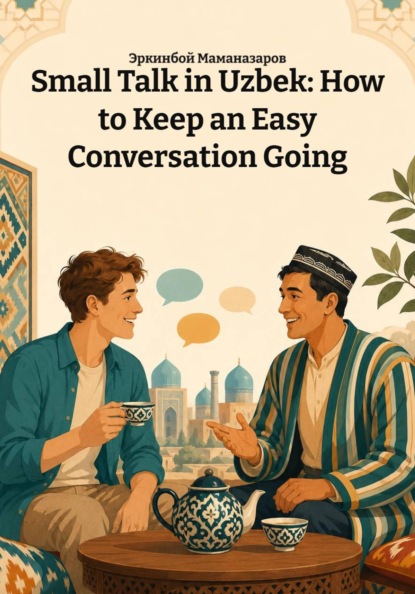
Small Talk in Uzbek: How to Keep an Easy Conversation Going
- -
- 100%
- +

Introduction
Say one full sentence in Uzbek in Samarkand and watch what happens. The shopkeeper stops, breaks into a grin, and suddenly you are not a tourist anymore, you are a guest. That small shift is what this book is about.
Hardly any foreigner tries to speak Uzbek. People expect Russian, or English, or pointing and smiling. So when you offer even a few warm words in their own language, it lands as a real compliment. Doors open, tea appears, prices soften, and strangers want to know your name.
This is not a grammar course, and you will not find verb tables to memorize. It is a book about talking: the easy, friendly, everyday talk that turns a transaction into a conversation and a conversation into a connection.
What "small talk" means hereIn Uzbek culture, greeting someone is not a quick formality. It is a small ritual of respect. People ask how you are, how your family is, whether everyone is healthy, how your work is going, and they may ask more than once in slightly different words. This is not nosiness or filler. It is warmth. The point is not to trade information, it is to show that you see the other person and that you care.
You will also notice that people answer "how are you" positively almost by default. The usual reply is Shukur ("thank God") or yaxshi ("good"), even on a hard day. Long complaints are not the custom. Keep your own answers light and warm too.
Who this book is forYou might be traveling the Silk Road through Tashkent, Samarkand, Bukhara, and Khiva. You might be living or working in Uzbekistan, or working remotely from there. You might have an Uzbek partner, friends, or in-laws, or be reconnecting with family roots. Or you might simply be curious about one of the warmest cultures on earth. Whatever brought you here, this book gives you the words to connect.
How to use this bookRead the dialogues out loud. Not with your eyes, with your mouth. A language lives in sound, and five minutes of speaking aloud will teach you more than an hour of silent reading.
Dip in by situation. Heading to the bazaar? Read that chapter. Invited to someone's home? Read the chapter on being a guest. You do not have to go in order.
And do not wait until your grammar feels "ready." It never does. The goal is not a perfect sentence, it is a real moment with a real person.
A quick word about the alphabetUzbek today is written in the Latin alphabet. You will see it on most signs, menus, and phones, and it is the alphabet this book uses, because it is the one you will actually need. You may still spot the older Cyrillic script on some signage and in older books, but you can get by completely without it.
The good news is that Uzbek spelling is almost entirely phonetic. Once you know how the letters sound, you can read nearly anything.
How to pronounce itMost Uzbek letters sound close to what an English speaker expects. A few need a note. Throughout the book, the simple respelling in brackets shows you how to say each phrase, with the STRESSED syllable in capitals.
Vowels:
a like the a in "father" (ah)
e like the e in "bed" (eh)
i like the ee in "see" (ee)
o like the o in "hot" (o)
u like the oo in "boot" (oo)
oʻ like the aw in "law" (aw)
The tricky consonants:
x is a throaty "kh," like the ch in Scottish "loch" or German "Bach"
gʻ is a soft, throaty "gh," close to a French "r"
q is a deep "k" made far back in the throat
h is a light "h," as in "hello"
j is usually "j" as in "jam"
ch, sh, and ng sound just like in "church," "ship," and "sing"
One more thing. In Uzbek, the stress usually falls on the last syllable. Rahmat ("thank you") is rah-MAT, not RAH-mat.
The one rule that matters most: "Siz" and "sen"Uzbek has two ways to say "you." Siz is the polite, respectful one. Sen is the casual one, for close friends, peers, and children.
Here is the simple rule. Use Siz with anyone older than you, anyone you have just met, and anyone you want to show respect. Use sen only with people you are genuinely close to. When in doubt, always choose Siz. No one was ever offended by too much respect.
You can hear the difference in the verb ending:
Qalaysiz? (kah-lay-SEEZ) "How are you?" (polite)
Qalaysan? (kah-lay-SAHN) "How are you?" (casual)
This book shows you both where it matters and flags which one is in use.
How to address peopleUzbeks rarely call an older person by their bare first name. They add a warm, respectful word. Learn these few and you will sound natural right away:
aka (ah-KAH) older brother, and a respectful way to address any man older than you. Often used after the name: Rustam aka.
opa (oh-PAH) older sister, and a respectful word for any older woman.
uka (oo-KAH) younger brother, a warm word for a younger man.
domla / ustoz teacher, also used for any learned or respected person.
xoʻjayin (khaw-jah-YEEN) "boss," used at work.
Safe topics, and ones to handle with careSafe and welcome: family, parents' health, where you are from, your impressions of Uzbekistan, food, the weather, work, children. These open hearts.
Better to avoid, especially early on: prying about money or salary, politics, pushing someone about religion, criticizing Uzbekistan or Islam, very personal questions to women, and the classic "when are you getting married?"
A note on religious phrasesYou will hear words like Inshalloh ("God willing"), Xudo xohlasa ("if God wills"), Shukur ("thank God"), and Barakalla ("well done," "bless you") all the time. They are everyday speech, used by almost everyone, and you do not need to be religious to use them. Treat them as ordinary, friendly conversation.
Your ten-phrase starter kitIf you learn nothing else before your trip, learn these:
Assalomu alaykum (ah-sah-LOH-moo ah-lay-KOOM) Hello (literally "peace be upon you")
Vaalaykum assalom (wah-ah-lay-KOOM ah-sah-LOM) the reply to the above
Rahmat (rah-MAT) thank you
Kechirasiz (keh-chee-rah-SEEZ) excuse me / sorry
Ha / Yoʻq (hah / yawq) yes / no
Qalaysiz? (kah-lay-SEEZ) how are you?
Yaxshi (yahkh-SHEE) good / fine
Iltimos (eel-tee-MOS) please
Mayli (MY-lee) okay / alright
Xayr (KHAYR) bye
One last thingDo not be afraid of mistakes. You will mix up a word, mangle a sound, forget an ending. It does not matter at all. In Uzbekistan, people do not laugh at the foreigner who tries, they admire them. Your effort is the gift. So take a breath, walk up, and say it.
Chapter 1. Greetings and Starting a Conversation
What this chapter is aboutEvery conversation begins with a greeting, and for Uzbeks this is the most important part of it. Greet someone warmly and correctly, and half the work is already done. The person is on your side before you have said anything else.
The one greeting that works everywhere is Assalomu alaykum. It is a wish of peace, and it sounds respectful to everyone: an elder, a boss, a stranger. The reply is always Vaalaykum assalom. Burn that pair into your memory.
There is also a casual Salom, "hi," for friends and people your own age. But with anyone older, reach for Assalomu alaykum.
And remember the Uzbek habit: people ask "how are you" more than once, in different words. That is warmth, not repetition. Just answer each one kindly.
DialoguesSardor aka: Assalomu alaykum, Bahodir aka! Hello, Bahodir aka!
Bahodir aka: Vaalaykum assalom, Sardor aka! Qalaysiz, yaxshimisiz? And peace be upon you, Sardor aka! How are you, all well?
Sardor aka: Shukur, yaxshi. Oʻzingiz qalaysiz? Ishlar qalay? Thank God, good. And you? How is work?
Bahodir aka: Hammasi yaxshi, rahmat. Tinchlikmi, oilangiz sogʻmi? Everything is good, thank you. All well, is your family healthy?
Sardor aka: Rahmat, hammasi joyida. Thank you, everything is in order.
Jasur: Salom, Aziz! Nima gaplar? Hi, Aziz! What's new?
Aziz: Salom! Yaxshi, oʻzing-chi? Hi! Good, and you?
Jasur: Zoʻr. Nima qilyapsan? Great. What are you up to?
Aziz: Ishdan kelyapman, biroz charchadim. Coming home from work, a little tired.
(Two friends, so everything is in the casual "sen": oʻzing-chi, qilyapsan.)
Kamola opa: Xayrli tong! Good morning!
Dilnoza opa: Xayrli tong! Yaxshi dam oldingizmi? Good morning! Did you rest well?
Kamola opa: Rahmat, yaxshi. Bugun havo sovuq-a? Thank you, yes. It's cold today, isn't it?
Dilnoza opa: Ha, juda sovuq. Issiqroq kiying. Yes, very cold. Dress warmly.
Tom: Assalomu alaykum, Rustam aka! Hello, Rustam aka!
Rustam aka: Vaalaykum assalom! Voy, oʻzbekcha gapiryapsizmi? Zoʻr! And peace be upon you! Oh, you speak Uzbek? Wonderful!
Tom: Ozgina. Oʻrganyapman. A little. I'm learning.
Rustam aka: Barakalla! Qalaysiz, yaxshimisiz? Well done! How are you, all well?
Tom: Yaxshi, rahmat. Oʻzingiz-chi? Good, thank you. And you?
Useful phrases (with pronunciation)Greetings:
Assalomu alaykum! (ah-sah-LOH-moo ah-lay-KOOM) Hello! (universal, respectful)
Vaalaykum assalom! (wah-ah-lay-KOOM ah-sah-LOM) the reply
Salom! (sah-LOM) Hi! (for friends and peers)
Xayrli tong! (KHAYR-lee TONG) Good morning!
Xayrli kun! (KHAYR-lee KOON) Good day!
Xayrli kech! (KHAYR-lee KECH) Good evening!
How are you (polite):
Qalaysiz? (kah-lay-SEEZ) How are you?
Yaxshimisiz? (yahkh-shee-mee-SEEZ) Are you well?
Ishlar qalay? (eesh-LAR kah-LAY) How is work, how are things?
Tinchlikmi? (teench-leek-MEE) Is all well? (literally "is it peaceful?")
Oʻzingiz qalaysiz? (aw-zeen-GEEZ kah-lay-SEEZ) And how are you?
How are you (casual):
Qalaysan? (kah-lay-SAHN) How are you? (to a friend)
Nima gaplar? (nee-MAH gap-LAR) What's new?
Oʻzing-chi? (AW-zeeng-chee) And you?
Replies:
Yaxshi, rahmat. (yahkh-SHEE, rah-MAT) Good, thank you.
Shukur. (shoo-KOOR) Thank God (I'm well).
Zoʻr. (zawr) Great.
Yomon emas. (yo-MON eh-MAS) Not bad.
Cultural notesAlways reply to Assalomu alaykum with Vaalaykum assalom. People notice and appreciate the correct response.
Several "how are you" questions in a row are normal. Do not think the person mishears you. Answer each one warmly.
The younger person usually greets first, as a sign of respect. If you greet an elder first, it always reads as polite.
Men often shake hands, sometimes with both hands or with the right hand placed over the heart, especially with elders. With women, follow their lead. Many prefer a light nod and a hand over the heart rather than a handshake.
Do not be surprised if "hello" comes bundled with questions about your family and health. That bundle is the Uzbek greeting.
Exercises1. What would you say? Pick a greeting for each situation:
an elderly neighbor in the morning;
a friend your own age at a shop;
your boss in the afternoon.
2. Role-play. Rustam aka greets you: Assalomu alaykum! Qalaysiz? Reply, then ask him two questions about how he is doing.
3. Speaking task. Record a voice message to yourself: greet someone respectfully and ask three different "how are you" questions.
Mini-projectFor one week, greet the same Uzbek-speaking person (a neighbor, a colleague, a shopkeeper) in Uzbek. Add one new phrase from this chapter each day. Note how the person's reaction changes from the first day to the last.
Chapter 2. Introductions: Name, Country, and Work
What this chapter is aboutAfter hello comes getting to know each other, and here a few simple questions go a long way. One move works especially well with Uzbeks: ask where they are from. People are proud of their home region and will happily tell you about their city.
As a foreigner, expect the questions to come back at you. Which country are you from? Is this your first time here? Do you like Uzbekistan? Have a warm answer ready, and you will charm almost anyone. Questions about family and children are friendly too, not nosy.
A handful of city names helps you sound at home: Toshkent, Samarqand, Buxoro, Fargʻona, Andijon, Xiva, Namangan, Qarshi, Nukus.
DialoguesOlim aka: Tanishib qoʻyaylik. Mening ismim Olim. Let's get acquainted. My name is Olim.
Sarah: Juda yaxshi. Mening ismim Sarah. Tanishganimdan xursandman. Very nice. My name is Sarah. Pleased to meet you.
Olim aka: Men ham. Qaysi davlatdansiz, Sarah? Me too. Which country are you from, Sarah?
Sarah: Men Angliyadanman. Oʻzingiz-chi? I'm from England. And you?
Olim aka: Men samarqandlikman. I'm from Samarkand.
Akmal aka: Oʻzbekistonga birinchi marta keldingizmi? Is this your first time in Uzbekistan?
David: Ha, birinchi marta. Juda chiroyli! Yes, my first time. It's beautiful!
Конец ознакомительного фрагмента.
Текст предоставлен ООО «Литрес».
Прочитайте эту книгу целиком, купив полную легальную версию на Литрес.
Безопасно оплатить книгу можно банковской картой Visa, MasterCard, Maestro, со счета мобильного телефона, с платежного терминала, в салоне МТС или Связной, через PayPal, WebMoney, Яндекс.Деньги, QIWI Кошелек, бонусными картами или другим удобным Вам способом.