

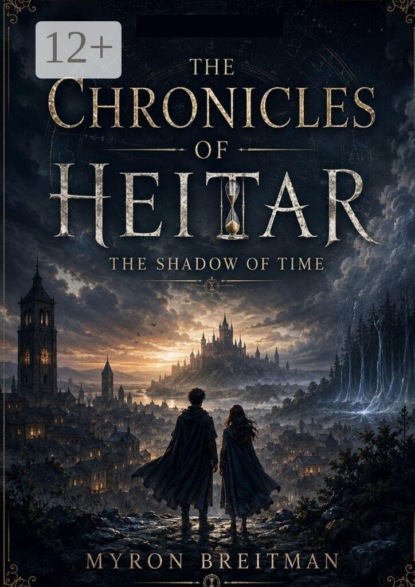
The Chronicles Of Heitar — The Shadow Of Time
- -
- 100%
- +
The figure dissolved.
The Forest went quiet in a different way — not the tense quiet of a space holding its breath, but the settled quiet of a space that has said what it needed to say and is now waiting to see if it was understood.
She fell to her knees. Not in collapse — in the specific way that people kneel when the body needs to be closer to the ground because the ground is the most real thing currently available.
He crouched beside her.
“I don’t know who I am,” she said. Her voice was very quiet.
“You’re the person who saw that,” he said. “And stayed.”
She looked at him.
He put his hand against her temple, not to do anything with his magic — just contact. The warmth of it. The undeniable factual presence of another person.
“Your illusions tried to be the truth,” he said. “But they had no love in them. And you do.”
She was quiet for a long moment.
Then the Forest went entirely still around them, and the stillness was different again — not holding, not waiting, not watching. It was the stillness of acknowledgment. Of something large and old recognizing something it had been looking for.
She breathed out, very slowly.
“Thank you,” she said.
“I didn’t give you anything,” he said. “I only reminded you of what you have.”
They sat in the Forest’s deep silence for a time that was not measurable by the Forest’s own sideways-moving measure. Long enough for the specific aftermath of intensity to pass — not the intensity itself, which had changed them rather than passing, but the physiological weight of it, the shaking at the periphery of things, the heightened alertness that did not yet know the immediate demand had been met.
He looked at the trees around them. The enormous ones, the house-diameter trunks, the plated bark.
“The Forest tested us,” he said. “And it did not succeed.”
“It wasn’t trying to succeed,” she said. “You said that. It was trying to show us.”
“Yes.” He paused. “And what it showed us — the visions of me wounded, alone. You losing yourself. These are not inevitabilities. They are the possibilities that the Forest considered worth showing us. Which means they are real enough to warrant being seen.”
She looked at him. “The wound. The aloneness.”
“Yes.”
“Then we have to make sure those futures don’t close us off from each other,” she said. “Whatever happens in there — however deep it gets — we stay within reach.”
“Yes,” he said. “Always within reach.”
He stood and helped her up and they looked together at the path ahead — the deeper path, the one that led into the Forest’s interior with the specific quality of a path that knows where it is going and would appreciate being taken seriously.
“It’s only started,” he said.
“I know,” she said. But in her eyes, which had been afraid and then unafraid and were now something he did not quite have a word for — something in the range of determined, or the specific word for determined-and-clear-eyed-about-the-cost — there was no retreat.
He did not say: we should rest first. He did not say: perhaps we should find shelter before going deeper. He did not say any of the things that were true and practical and beside the point.
He said: “Then we go deeper.”
She nodded once.
And the Forest, old beyond the reach of anyone currently alive to remember how it came to be, received them as they moved into its interior — not with welcome, not with threat, but with the particular quality of attention it had been maintaining since before the city of Heitar existed. The quality of a thing that has been waiting for something specific and has, at last, recognized it.
A quality that was, he thought, as close as this place could come to yes.
Chapter Six — Merissa’s Illusions
The Forest breathed.
Not rustled, not creaked, not produced the ordinary sounds of a place inhabited by wind and leaf and the minor lives of small creatures. Breathed — in some deep, foundational rhythm that she felt not in her ears but in her sternum, a pulse that operated at a frequency below hearing, arriving as a quality of the air against her skin rather than as sound. As if the entire structure of this place were the chest cavity of something vast and patient, its inhalation and exhalation a cycle so slow that you could only perceive individual moments of it, never the whole.
Day and night here were the same thing, made continuous.
That was the word she kept returning to: continuous. The light outside — the ordinary world’s light, which divided itself so clearly into illuminated and dark, into the identifiable positions of a sun moving across a sky — had no equivalent here. What the Forest offered instead was a twilight that was not the twilight of transitional hours but a permanent condition, a specific quality of luminosity that existed for its own reasons and not in relationship to any external source. In this light, shadows had the same weight as the things that cast them. Everything was equally present, equally available to the eye, equally refusing to be background.
She was losing herself.
Not dramatically. Not in the way of the figure the Forest had made from her fear — that had been acute, a crisis with a recognizable shape, something she and Kaen had been able to address directly. This was different: incremental, sideways, the kind of losing that does not announce itself but is only perceptible by comparison, when you look at where you are and cannot quite remember the path from where you were.
It had begun with small things.
A stone she stepped on that felt, for the half-second of contact, like the wooden toy horse she had owned at age six — smooth-worn, warm in a specific way, carrying in its surface the ghost of a particular afternoon in the kitchen of the northern house, her mother’s voice from the next room. The sensation was gone before she could reach it. But it left something behind: a faint overlay, the memory and the present moment briefly superimposed, and when she looked at the stone after stepping off it, it looked like a stone, but it also looked like the toy, the way that if you have seen two slides projected on the same screen you cannot entirely separate them even after one has been removed.
A branch that she passed with her hand — just brushed, barely contact — that was, for an instant, her mother’s hand.
The sound of water somewhere in the Forest’s distances, which she could not locate and which arrived, each time she caught it, as her father’s voice speaking her name from another room.
She was not creating these. She understood this — had understood it since the outer edge, had been making herself understand it carefully because the alternative, which was to believe that her magic was failing, that the distinction between what she made and what the Forest made through her was collapsing, was worse than the truth.
The truth was that the Forest was using her. Not against her will, not against her interests — using the natural mechanism of her magic as an instrument for its own expression, the way water uses the shape of the riverbed to define its course. She was the material through which the Forest chose to communicate certain things, because her particular magic was the right substrate for what the Forest needed to say.
This was not reassuring.
“Kaen,” she said.
He was three steps ahead of her on the path and turned immediately. The quality of his attention when he turned — fully present, no delay, no moment of orienting himself away from whatever he had been thinking about — was something she noted and was grateful for. He was managing his own version of whatever the Forest was doing to them, but he was managing it without closing any part of himself off from her.
“I’m here,” he said.
“I know.” She looked at her hands. They were producing a low, continuous mist now — barely visible, something that was more a quality of the air around her than a substance, a slight softening of everything in her immediate vicinity. She had not told her hands to do this. They were doing it the way lungs breathe, automatically, because the environment required it. “The Forest is making things through me. I can’t — I don’t know where I end and it begins.”
He came back to her. He looked at the mist around her hands with the focused attention of someone reading a situation with the specific skills they have.
“You’re still here,” he said. “You’re telling me about it. That’s you.”
“Yes.”
“Your illusions are starting to talk to you,” he said. “Not the Forest’s constructions. Your own. They’re starting to live.”
She looked at him.
“Sylva said this would happen,” she said. It was not quite a question.
“Sylva said the Forest shows you what’s in you,” he said. “Your magic is inside you. So the Forest is showing you your magic, from the inside.”
She stood with this for a moment.
“I don’t know where I end,” she said again, “and where it begins.”
“Tell me,” he said quietly, “when you feel yourself.”
She thought about this.
“When I’m talking to you,” she said.
“Then keep talking to me,” he said. “About whatever you see. Whatever you feel. Don’t hold it.”
She looked at the trees around them. The enormous ones, their bark plated and mineral, each one carrying in its surface the Forest’s memory like a library carries books — densely, without apparent order, accessible only to the right kind of attention.
“I see a woman in that tree,” she said. “Not in the bark. Not on the surface. Inside it. She’s been there a long time. I think — I think she went in deliberately. I think the tree was her choice.”
He looked at the tree. She could tell from his expression that he did not see the woman.
“What does she look like?” he asked.
“Old. Patient. She’s not — she’s not unhappy. She’s very far from unhappy. She’s just — she’s become part of the structure. Part of the memory that holds the Forest together.” She paused. “There are others. In other trees. People who came here and became part of it.” She looked at him. “Is that what happened to our parents?”
The question arrived without her planning it, and she felt, in the asking of it, the specific quality of a fear she had been carrying since the beginning without quite naming: not that their parents were lost, not that their parents were dead, but that their parents had become something other than what they had been — that in the Forest’s deep territory, the category of person was flexible, and flexibility in that category was not reversible.
He was quiet for a moment.
“I don’t know,” he said. He said it with the honesty that was one of the things she had always most valued in him — not the false comfort of an easier answer, but the respect of the true one. “I don’t know what form they’re in. I don’t know if the form they’re in looks like the form we remember.” He paused. “But Sylva said they went in knowing what they were doing. Whatever form they’re in — it was chosen.”
“That’s not the same as all right,” she said.
“No,” he said. “It’s not the same as all right. But it’s not the same as wrong, either.” He looked at the tree with the woman inside it. “It might be something there’s no word for yet.”
They walked.
The path through the deep Forest was not the path that had led them to the Gate — not marked, not invited, not arranged for them with the Forest’s version of hospitality. It was simply the direction that was most coherent to move in, the direction that offered the least resistance from the space’s own logic. He could feel this through the time-sense, now that the Forest had given him enough time to calibrate to its specific quality: the way that certain directions through this space were more permissive than others, not because they were easier physically but because the Forest’s accumulated memory was arranged in a structure with its own internal logic, and moving with that logic was like moving with a current rather than against one.
Конец ознакомительного фрагмента.
Текст предоставлен ООО «Литрес».
Прочитайте эту книгу целиком, купив полную легальную версию на Литрес.
Безопасно оплатить книгу можно банковской картой Visa, MasterCard, Maestro, со счета мобильного телефона, с платежного терминала, в салоне МТС или Связной, через PayPal, WebMoney, Яндекс.Деньги, QIWI Кошелек, бонусными картами или другим удобным Вам способом.