

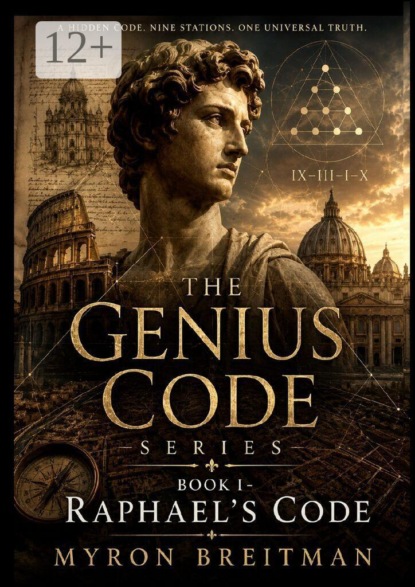
The Genius Code — Book I — Raphael’s Code


- -
- 100%
- +

© Myron Breitman, 2026
ISBN 978-5-0070-9995-0 (т. 1)
ISBN 978-5-0070-9996-7
Created with Ridero smart publishing system
PROLOGUE — The Silenced Circle
Rome, 23:47
Professor Simone Albi knew he would die tonight.
Not because he believed in omens — in forty years of scholarly work he had learned to trust only facts. But when the heavy oak door of the Apostolic Library closed behind him with a dull click, the echo in the corridor rang out like a verdict.
The manuscript was in his bag. Forbidden. Nonexistent, according to every official catalogue. The very one he had been searching for these past eight years.
Codex Perspectivae Raphaelis.
His fingers gripped the worn leather handle of his briefcase so tightly his knuckles went white. His heart was pounding somewhere in his throat. Ahead — fifty meters of marble corridor, lit only by emergency lamps. Then — the side exit through the Cortile del Papagallo. A taxi. A hotel. In the morning — a flight to Zurich, where Miriam Klein was waiting for him, the only person capable of understanding what he had found.
Albi took a step. Then another.
The silence of the Vatican at night is not merely the absence of sound. It is the presence of something ancient, watching, waiting. The professor adjusted his glasses and quickened his pace.
To his left, the busts of Roman pontiffs stood frozen in the dimness. To his right — a stained-glass window depicting Saint Peter, whose empty glass eyes seemed to follow his every movement. Albi found himself recalling the words of his late mentor: “Simone, there are truths the Vatican guards not with prayers, but with silence.”
Now he understood what he had meant.
The manuscript in his bag was not merely a historical document. It was a map. An instruction. A key to a system that Raphael Santi had built five hundred years ago — a system that turned Rome into a colossal machine of meaning, where every fresco, every building, every piazza was a piece of one grand code.
A code capable of changing humanity’s understanding of art, of architecture, of reality itself.
Albi had nearly reached the side exit when he heard footsteps behind him.
Soft. Measured. Inevitable.
He turned.
There was no one in the corridor. Only shadows and the flicker of lamps reflected in the polished marble. But the professor could feel a gaze — heavy, piercing, coming from somewhere in the darkness between the columns.
— Professore Albi.
The voice was quiet, almost polite. No accent. No emotion.
Simone spun around sharply. Before him, as though materialized out of thin air, stood a man in a dark suit. A face — ordinary, forgettable within seconds. Hands — folded in front of him. But the eyes…
The eyes were empty.
— You have taken something that does not belong to you, — the man continued, stepping forward. — The Codex must remain here. Forever.
Albi backed away, clutching the bag to his chest.
— You don’t understand… this isn’t a religious secret. It is knowledge. It belongs to the world, to science, to the people!
— Knowledge that would destroy too much, — the man answered calmly. — Some truths must remain hidden. Not to protect faith. To protect order.
— What order? — the professor gasped, backing toward the door. — Raphael did not create a secret! He created a revelation!
The man tilted his head, as if regretting the inevitable.
— You are mistaken, professore. Raphael created both. And the second is more dangerous.
Albi was no longer listening. He lunged for the door, snatched out his key card, swiped it through the reader. Red light. Access denied.
Panic.
He turned — the man was already two steps away.
— Please… — the professor whispered. — Give me…
But in the next instant something cold and sharp touched his ribs. One strike. Precise. Professional. No wasted movement.
Albi collapsed to his knees, pressing a hand to his side. Blood. So much blood. The bag slipped from his fingers and fell onto the marble with a dull thud.
The man in black picked up the briefcase, opened it, took out the manuscript. He leafed through a few pages, as though verifying its authenticity. Nodded. Then carefully returned the codex and set the bag down beside the dying professor.
— Why… — Albi rasped, feeling his life ebbing away. — Why are you leaving it with me?
The man leaned down, and his voice grew almost gentle:
— Because you are already dead, professore. And the dead do not talk.
He straightened and dissolved into the darkness as silently as he had appeared.
Simone Albi was alone now. Blood spread across the white marble, forming a dark stain like an opening flower.
No. Not like this. Not now.
His last strength. His last chance.
With a trembling hand he pulled a notebook and pencil from his jacket pocket. A page. One page — that was all he had left.
He drew a triangle. Inside it — dots. One. Three. Six. Ten.
The Tetractys.
Beneath the drawing, with his last remaining strength, the professor traced out in shaking letters:
RAPHAELIS: IX — III — I—X
Nine. Three. One. Ten.
A code. Coordinates. A key.
Miriam would understand.
She had to understand.
Simone Albi closed his eyes, pressing the note to his chest. Somewhere in the distance he could hear the voices of Swiss Guards hurrying toward the sound of the fallen body.
But it was already too late.
The professor lay at the entrance to the Apostolic Library — the very place where, five hundred years earlier, according to legend, Raphael Santi had first shown Pope Julius II his first sketches for the Stanze.
The circle had closed. Or had only just begun to open.
CHAPTER 1 — Contours of Silence
Rome, Villa Medici
Three days later,10:15
Miriam Klein hated conferences.
Not the speaking itself — she loved talking about art. Not her colleagues — many of them were brilliant scholars. She hated the ritual: the polite applause, the obligatory questions, the coffee breaks where everyone discussed everything except what actually mattered.
Right now she stood by the tall window of the Aurora Hall, looking out at the villa’s gardens, thinking about the letter.
The letter from Simone Albi had arrived two weeks ago. Short. Urgent. Almost panicked in tone — which was entirely out of character for the meticulous professor she had been corresponding with for the past three years.
“Miriam, I have found what I was looking for.
The Codex Perspectivae — it is real.
And it changes everything.
We need to meet. Urgently. Tell no one.
Come to Rome for your conference.
Simone.”
She had answered right away. Confirmed the dates. But Albi never wrote back.
Twelve days of silence.
Miriam ran a hand over her hair, gathered into a severe knot. Forty-two years old, professor of art history at the University of Zurich, specialist in Renaissance iconographic codes. Twenty publications. One monograph on symbolism in Botticelli’s work. She was used to precision, logic, facts.
But these last few days something had been wrong.
Albi wasn’t the type to simply vanish. Not even when absorbed in research.
— Dr. Klein?
She turned. Behind her stood a man of about thirty-five — tall, in a tweed jacket with elbow patches, dark hair carelessly tousled, attentive brown eyes. In his hands — a tablet and a cup of espresso.
— Andrea Rossi, — he introduced himself, with a light Italian accent. — Sapienza University of Rome. Architectural history. I just heard your lecture. Brilliant.
— Thank you, — Miriam answered cautiously.
Compliments at conferences usually preceded either criticism or a request for co-authorship. But something in his gaze was… sincere.
— Especially the part about the hidden axes in Raphael’s compositions, — Andrea went on, taking a sip of his coffee. — You said that The School of Athens is built not merely according to the laws of perspective, but on the principle of architectural projection. Like a building transposed onto a wall.
Miriam nodded. It was her favorite subject.
— Raphael wasn’t just a painter. He thought like an architect. Every fresco is a spatial model.
— Exactly! — Andrea brightened. — I work on something similar. Only from the other direction — I study how Rome’s architecture influenced the compositions of the frescoes. The axes of the streets, the proportions of the buildings, the sightlines… You know, sometimes it seems Raphael didn’t just look at the city. He… read it. Like a text.
Miriam felt something stir inside her.
Read the city like a text.
That was precisely what Albi had said three years ago: “Raphael read Rome not with his eyes, but with geometry.”
— Signor Rossi…
— Andrea, please.
— Andrea. — She paused. — Do you happen to know Professor Simone Albi?
Andrea’s face changed. His smile softened, but something like sorrow appeared in his eyes.
— I do. Simone is a remarkable scholar. Though… these past six months he’s become very secretive. Stopped publishing. Barely answered letters. Said he was busy with “the great discovery of his life.” — Andrea shrugged. — Do you work with him?
— We correspond, — Miriam answered evasively. — Or rather, we used to. He disappeared two weeks ago. Doesn’t answer.
Andrea frowned.
— Strange. Though, knowing Simone… when he throws himself headfirst into research, he can go silent for weeks. Once he spent three months studying a single fragment of a fresco in the Sistine Chapel. Every day. Six hours at a time.
— What was he looking for?
— A vanishing point, — Andrea smiled wryly. — In the perspective Michelangelo supposedly hid within the composition. Simone was convinced that the great masters left messages in the geometry of their works.
Miriam felt her heart beat faster.
— And did he find it?
— No. Or rather, he never got the chance to prove it. The Vatican cut off his access after he tried to take measurements of the chapel at an improper hour. — Andrea shook his head. — Simone is a genius, but sometimes he gets a little too… carried away.
Or he isn’t carried away at all. Perhaps he finds what others don’t want to see.
— Are you presenting today? — Miriam asked, changing the subject.
— At four, — Andrea nodded. — A paper on Bramante’s axes in the layout of the Belvedere Courtyard. Rather dull subject, to be honest. — He smiled. — But if you’re interested, I’d be glad to see you in the hall.
— I’ll be there, — Miriam promised.
Somewhere in the depths of the villa, a bell rang. The break was over.
Andrea finished his espresso and set the cup on the windowsill.
— It was a pleasure meeting you, Dr. Klein. I hope we’ll talk more about Raphael. I have a few hypotheses I think you might like.
— I’d be delighted, — Miriam answered, extending her hand.
He shook it — firm, warm, confident — and headed for the exit.
Miriam watched him go, then turned back to the window.
Rome lay below, drenched in midday sun. The Eternal City. A city of secrets, encoded in stone, in paint, in proportion.
Somewhere down there, in that labyrinth of streets and palaces, was Simone Albi.
Alive or dead.
With the codex or without it.
Miriam took out her phone and opened his last letter again.
“The Codex Perspectivae — it is real. And it changes everything.”
She closed her eyes.
Tomorrow — a meeting with the conference organizers. The day after — her second talk.
But tonight she would go to the Vatican. To the Apostolic Library.
To where Albi had worked.
To where the answers must be.
Outside the window, Rome breathed history, secrets, and beauty.
And somewhere in its depths, in the shadow of cathedrals and palazzos, the truth was hiding.
Miriam intended to find it.
CHAPTER 2 — A Hand in Stone
Rome, Villa Medici 14:30
Miriam sat in the back row of the conference hall, but she didn’t hear a single word.
On stage, a professor from the University of Florence was talking about the influence of Neoplatonism on Botticelli’s compositions. The slides changed one after another: Primavera, The Birth of Venus, diagrams of the golden ratio. Ordinary academic routine.
But Miriam was thinking about something else.
About Albi’s letter. About the codex. About twelve days of silence.
She opened her laptop and checked her email once more.
Nothing.
Then — messaging apps, her phone, even the old art-history forum where Albi sometimes posted notes.
Silence.
This is wrong.
Simone Albi was a man of habit. He answered letters within a day. Published articles every three months. Kept a meticulous online research journal.
And now — total silence.
Miriam dialed the number for his department at the University of Rome. Long rings. An answering machine.
“You have reached the Department of Art History. All staff are currently unavailable. Please leave a message after the tone.”
She hung up without leaving one.
On stage, the lecturer finished his talk. Applause. Questions from the floor. Miriam mechanically snapped her laptop shut and stood.
She needed air.
She walked out into the corridor, past the stands of new book releases and exhibition posters, pushed open a heavy door, and stepped out onto the terrace.
Rome lay below, drenched in the afternoon sun. Domes, cypresses, red tiled roofs. The Eternal City, which had watched empires, popes, painters, and geniuses be born and die.
— Dr. Klein?
She turned. Andrea Rossi stood by a column, phone in hand. His face was pale.
— Have you heard already? — he asked quietly.
— What?
Andrea held out his phone to her.
On the screen — a news site, La Repubblica. A large headline:
TRAGEDY AT THE VATICAN: PROFESSOR MURDERED IN THE APOSTOLIC LIBRARY
Miriam felt the ground go out from under her.
She took the phone with trembling hands and began to read.
The article reported that a professor of Renaissance art in his late fifties had been found dead in the Vatican overnight, his body discovered near the entrance to the Apostolic Library around midnight, with a stab wound cited as the preliminary cause of death; police were treating robbery as one possible line of inquiry, a Vatican spokesperson noted that the professor had been authorized to work in the archives and was in the building legally, and the investigation was said to be ongoing.
Miriam closed her eyes.
No.
No, no, no.
— Miriam? — Andrea called out cautiously. — Are you all right?
She opened her eyes and looked at him. There was something in her gaze that made him take a step back.
— This wasn’t a robbery, — she said flatly.
— How do you know?
— Because Albi found what he was looking for. And he wrote to me about it two weeks ago.
Andrea frowned.
— What are you talking about?
Miriam took out her phone, opened Albi’s letter, and showed it to him.
Andrea read in silence, and with every line his face grew more serious.
— The Codex Perspectivae, — he whispered, once he’d finished. — My God. He really found it.
— You know what that is?
Andrea nodded, leaning against the balustrade.
— A legend. One of the most famous myths among art historians. Supposedly, before his death, Raphael wrote a treatise on perspective and geometry — but not an ordinary one, but… — he hesitated, searching for words. — The Codex Perspectivae was said to contain a system. A way of embedding meanings into architecture and painting so they’d function as a single whole. Like… like some vast machine of images.
— A machine of images?
— Imagine, — Andrea spoke faster now, caught up in the idea. — The city as a text. Every building — a word. Every street — a sentence. And the frescoes on the walls — punctuation marks, setting the rhythm and the meaning. Raphael, if the legend is to be believed, understood this better than anyone. And he tried to build a system by which the city itself could speak.
Miriam listened without looking away.
— But the codex was thought lost. Most scholars don’t even believe it ever existed. No mentions in any documents, no trace of it at all…
— Until now, — Miriam cut in. — Albi found it. And they killed him.
Silence.
The wind stirred the cypress leaves in the villa’s garden. Somewhere below, in the city, cars honked, street vendors called out, tourists laughed.
Life went on.
And Simone Albi no longer existed.
— What are we going to do? — Andrea asked quietly.
Miriam looked at him.
— Do you want to help?
— Simone was my friend, — Andrea said simply. — Not a close one, but… he helped me when I was just starting out. Gave me access to his archives, introduced me to the right people. If he found something important, I want to know what it was. And I want to know who killed him.
Miriam nodded.
— Then we need to get into the Apostolic Library.
— Now? There will be police there for certain.
— That’s exactly why now, — Miriam said. — While the evidence is still fresh. Before anything that might have been left is cleared away.
Andrea checked his watch.
— The cordon comes down in an hour. I have a contact in the Vatican administration — he can get us in as consultants.
— Consultants?
— The police asked for help from art history specialists. To understand exactly what Albi was searching for in the archives. — Andrea gave a crooked smile. — I can recommend the two of us.
Miriam studied him for a long moment.
— You understand we’d be walking into something very dangerous?
— I understand.
— Albi wasn’t killed for no reason. Someone didn’t want the codex to become public knowledge.
— I understand, — Andrea repeated. — But if we don’t try to find out the truth, his death will have meant nothing. And I can’t accept that.
Miriam nodded slowly.
— All right. When can we get in?
— I’ll call now. I think I can arrange everything by six this evening.
He took out his phone and stepped to the edge of the terrace, dialing a number.
Miriam was left alone.
She opened Albi’s letter again and reread the last line:
“The Codex Perspectivae — it is real. And it changes everything.”
What did you find, Simone?
And who was so afraid of it that they killed you?
Behind her, Andrea’s voice rang out:
— Done. Six this evening. Main entrance. Inspector Giuliani of the Vatican police will meet us.
Miriam turned.
— Thank you.
— Don’t mention it, — Andrea paused, then added more quietly: — Miriam… if we really do find something important… are you prepared for the consequences?
She looked out at Rome, spread out below. A city that had guarded Raphael’s secret for five hundred years.
A city that had just killed a man for getting too close to the answer.
— I’m prepared, — she said. — Are you?
Andrea nodded.
— Yes. I’m prepared.
They stood on the terrace of the Villa Medici, two scholars who, in a few hours, would walk into the place where a murder had been committed.
And begin searching for the thing that had cost a man his life.
Raphael’s code.
The key to a secret hidden in the very heart of Rome.
A key that had been hunted for centuries.
And one that, perhaps, was never meant to be found.
CHAPTER 3 — The Invisible Cross
Vatican, Apostolic Library 18:05
Inspector Carlo Giuliani was a man who had seen too much.
Fifty-eight years old, gray hair, a severe dark suit, and eyes that had no room left for surprise. Thirty years in the Vatican gendarmerie had taught him not to ask unnecessary questions and not to trust simple answers.
— Dr. Klein, Signor Rossi, — he shook their hands at the library entrance. — Thank you for agreeing to help. We need specialists who understand what Professor Albi was working on.
— We knew him, — Miriam said quietly. — It’s the least we can do.
Giuliani nodded and led them inside.
At night, the Apostolic Library resembled a cathedral — high vaults, silence, the smell of old paper and incense. But now that silence was broken by the flashes of forensic cameras and the hushed voices of police officers.
They crossed the main hall, passing shelves of manuscripts more than a thousand years old, and stopped at a side corridor.
A chalk outline of a human figure had been drawn on the floor.
Miriam felt her throat tighten.
Here. Right here he died.
— The body was discovered at 23:47, — Giuliani began, taking out a notebook. — A Swiss Guard heard the sound of a fall and came running. Professor Albi was still alive, but unconscious. The ambulance arrived eight minutes later. He died on the way to the hospital.
— Cause of death? — Andrea asked.
— A single stab wound. Precise. Professional. Between the ribs, straight to the heart. — Giuliani looked at them. — This wasn’t a random brawl. The killer knew what he was doing.
Miriam swept her eyes over the corridor. No signs of a struggle. No disorder. Only the chalk figure on the marble floor and a dark bloodstain that had already been mostly wiped away.
— Was anything stolen? — she asked.
— That’s the strange part, — Giuliani frowned. — Nothing. The professor still had his watch, his wallet with cash and credit cards, his phone. Even his briefcase was still on him.
— His briefcase? — Andrea asked sharply. — What was in it?
Giuliani produced a clear evidence bag. Inside — a worn leather bag.
— A notebook, pens, glasses, a coffee thermos. And this.
He showed them another bag. Inside lay a page torn from the notebook, stained with blood.
Miriam stepped closer.
On the page — a drawing. A triangle divided into rows of dots. One dot at the top, three beneath it, six below that, ten at the base.
The Tetractys.
The sacred symbol of the Pythagoreans. The sum of the first four numbers: 1+2+3+4=10. Perfection. Harmony. The order of the universe.