

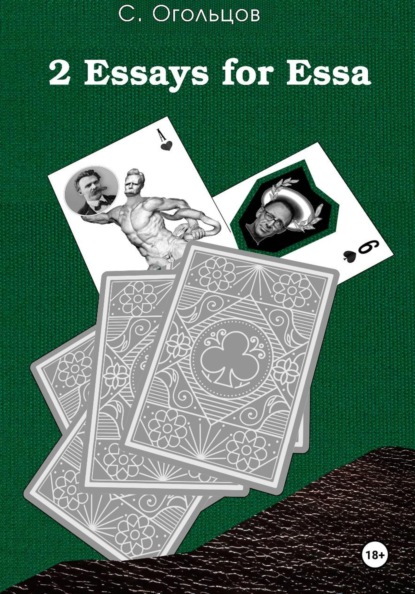
2 Essays for Essa



- -
- 100%
- +
2:25
A magnificent piece of style and clarity, exquisitely crafted. Every other sentence begs to be placed on a Gold Plaque of Winged Aphorisms. Here he's more poet than philosopher.
(But he's also a philosopher, something Pushkin lacked, and today all sorts of scum toss the dung-ball 'compiler' at him!)
The essence of philosophical instruction is not to pose as a 'defender of truth', not to suffer in the name of truth, in self-defense from the assholes attacking you. Live easily in pleasant solitude; if you lurk and watch your enemies' movements, you'll simply wear yourself out. Exactly what the mudaks want you to… Why make them happy by climbing onto the stage to act a farcical screamer? That's all your philosophy, which, like everything else, started out as a protracted tragedy, will turn to.
(A day ago, some contemporary poet, a character in the ongoing Pessimistic SitCom, was complaining about someone else:
'I don't understand! I made sure he won the Iskander Prize, and now he… !'
What's there to understand? Now that ungrateful 'he' wants to take you down so he becomes the kingmaker of the prize. It's as old as time.
What to do?! A matter of taste: whether to mount the podium as the 'offended side' or enjoy exquisite solitude while leafing through Nietzsche. Well, my friend, it's your free choice…)
2:26
Of course, all this is clever, subtle, and beautiful, but it's not written for this world. Not for the goddamn 21st century, where a sentence longer than one line is a crime against the rules of the style sheet, a violation of the unconditional bootlicking due to anything in our great homeland—therefore, dear to us and sacred, by default.
(Don’t miss brushing out the awkward spots, listed explicitly in the RosKomStat (RKS) directive-circulars, from the messy scraps that don't align with the required provisions for writing when at the process of writing.
And in the light of the 150-year statute of limitations, it's hard to immediately discern in his free-spirited revelry, that:
– no one lies as much as the indignant
(and if he's indignant for a holy cause? – then he's a sacrilegious liar, and that's all about him);
– cynicism is the rare and only meeting ground for cooperation between a vile soul (in the author's words, 'vulgar soul') and sincerity.
(But why the heck would you want to hang out with vile souls? Of course, there's no obligation, but if you're a philosopher, then endure even this foul turn in your bio, which in reality may be its best part.)
– every chosen (emphasis added) person has his own castle, a refuge, where he escapes (emphasis added) from the crowd, from those who are more numerous.
(chosen == the one who learns the hard way, the 'average' one possesses in their composition (here comes a cynic's quote):
‘2 to 3 holes and one head, the practical worth of the latter is open to doubt’.)
However, cynics themselves are defined by the author as a cross of monkey and goat who can talk and brag about how awesome he poops and fucks. But why learn such obscenities, and why the 'average' person, who’s also just a goat-monkey, only they keep quiet about it?
Because there's nothing else to learn except God
(bruh, don't take that fork—it's goddamn boring there, and everything by rote, I tell thee. If still in doubt, ask defrocked Okhlobystin; the guy barely survived… )
A human being (returning to the author) is made up of sexual urges, the need for multiple meals a day, and vanity.
See? Not a thing from tangible anatomy! And here I split with Nietzsche, because in my personal system (before meeting Fritzi), the trinity of compound stimulants that keep the 'field of life' alive was defined as: stomach, dick, and gray matter ('screw the mazzafooker!').
Of course, in the Chunk at hand from the current Section, I could have easily overlooked a thing or two (oh, Sensei is a master of equivocation! Unrivaled!), but that's enough for me today.
2:27
The Chunk starts with a list of horse gaits (presumably), so as to clearly benchmark the speed of thinking among humans. The bottommost notch is defined as 'frog leap'. For my case, there should be added to the scale the under-bottommost one: 'prancing snail’.
Then, with the edge of a cotton swab (to leave a tenderer feel, so to speak), the topic of friendship is touched upon. Extremely brief, because this subject matter can be expounded either in a few words or in multi-volume discourses.
When you stepped into making friends, then (if I understood him correctly) be ready to die any moment from obscene laughing at yourself. I can't help but agree. Sometimes, the shorter the saying, the wiser the author.
2:28
Doesn't he have anything better to do? 'Nietzsche's philosophy' was the buzz word, when you didn’t have a chance to find a sliver of his works. And Now? How much of philosophy can you put your finger on in this entire Chunk 28?
Pure ethnography and literary criticism. He's ridiculing… although no, they ridicule someone in front of someone else, but here he—sooner and more accurately—is making fun of himself, that's for sure—to have a good healthy laugh you should know what you’re laughing at.
Yes, he's plainly making fun of himself. Actually, he laughs at national traits of any people turning on his way. The Germans get the worst of it, but that's understandable—he who can laugh at himself fears no one.
'What's most difficult to translate from one language to another is the tempo of its style, rooted in the character of the race or, physiologically speaking, in the average rate of its 'metabolism.''
Here! Here! In just one sentence—a brilliant literary critic. Miles uncountable, colossally above the present day ass-lickers defaming the usurped denomination, whose pseudo-exaltation stinks a league away…
And a passage or two further, in just a few words, he conveys the very essence of Goethe, of Lessing. And you can't argue with that, his perspicacity’s on a par with X-rays…
Voltaire, Machiavelli (I’d give the latter more credit). Petronius and Aristophanes are treated with utter reverence. The presence of Aristophanes in the world atones for all the Hellenism that allowed itself to exist at all—or something like that—the original says.
Still, in conclusion, he did return to philosophy (sorry for a bit rashy opening the Chunk) to absolve Plato of all his sins simply because they found nothing but a volume of Aristophanes under the pillow of an academic's deathbed. Well done, Dr. Plato, you’re also human in part. Posthumously.
(But where did you come from with such a non-German style, huh? To dig into his Slavic roots? It's no better than rummaging through stale underwear of creators to point the finger: aha! That artist, at certain spots in his canvas, applied paint with his dick, in ecstasy. And the Czar's anthem music was produced by a faggot, and that poetess was a lesbian, and her husband gnawed at bisni having a sex, things like that…
Aesthetes, screw them! Doing their best to yank down to their level those they can never reach. But you, filthy idiots, are an intrinsic detail to this best of worlds, so go on yapping, you curs, that's all you can do.)
But I have to agree to his musing on the nationality permeating the style of creator. I accept the idea; what is, is.
Yet, Fritzi, where did Plato get so Germanic a style, while the Germans of his era hadn't yet risen any further above communal bathing in rivers, hardly propitious for concentrating on syllogisms? I'll ask sarcastically.
However, it's understandable that you've saved that for later with your Franco-Italo-Aquitainian style. The question of style is too broad to be addressed in a single Chunk.
And, Master, next time dwell a bit on style differences due to age. That same Goethe, naive in the crude verses of his wild youth, and the exquisitely graceful poet of his mature age are one creator, just from different ages. And if digging deeper, one will certainly find other factors for theses on styles. But I have no intention of rolling down that path…
2:29
Well, that's a total bomb, Friedrich. I even know what they'd do to you for that in any state with a sufficiently developed secret service and at least a skeleton contingent of bodyguards:
'Independence is the preserve of the few; it is meant for advantage of the strong.'
No, you could easily get away with that as the usual philosophical drivel. But that's not enough for you! You're getting even more brazen:
'… whoever encroaches on it [independence]… enters a labyrinth [in which] no one sees how and where he will get lost, distance himself from people, and be torn to pieces… If such a person dies, it happens so far beyond the realm of human understanding that people don't feel it, don't sympathize—and he can no longer return. He can't return to human compassion! -'
And what next? Well, that's obvious even without philosophy—cosmetic facelifts, regularly. Then a cube-shaped mausoleum—to lie like a waxed mummy, or perhaps a crypt in a neutral country where the police can keep vandals at bay. No spraying those who are down!
Nice and easy it is for you to amuse yourself in the frolics of a playful mind with that cuddly, soft 19th century around! And here one sits trembling all their life like a crucian carp in its hole… Although, with your penchant for French chatter, you had no time to read Saltykov-Shchedrin, right? That's the root of our limited scope of mutual gossip topics. You should upgrade yourself, huh? Widen your outlook horizons. Okay, bruh Friedrich?
2:30
Where on earth do people learn the art of voicing thoughts so deliciously? One might give everything for that; more than half a lost kingdom for an asthmatic horse.
'Our highest insights might—and must!—seem madness, and depending on the circumstances, even crimes, if they reach, unfairly, the ears of those who are neither created nor destined for it.'
Huh? I told ye, didn’t I? A paragraph like that could easily take a herd! Though there’s a catch too—you have to read a passage like that twice before you get the hang of it: what the heck is going on, huh? And when you finally see the light (here, 'if' might fit in nicely to substitute 'when'), you lean back in bliss (reading such stuff while sitting on a stool is a deadly trick)—oh, how wonderful!—and you’re all washed by streams of illuminating truth, like the currents of the Jordan…
But what am I about? The river dried up by 2022 (I'm wary of adding a link to the sad fact—what if The Archaeologist magazine has already been declared an enemy of the people?).
Well, fine, style is style, but I do notice Nietzsche is somehow leaning toward dichotomy, technically. Which promise he gave me with the title alone! All that Manichaean malarkey thrown together at one fell swoop: we don't give a damn about your good and evil, we're completely on the other side of them. Yes, perhaps, but the tools are the same – a simple split into two, and that's the whole point of dichotomy.
And, naturally, he began by cleaving people (which, of course, is nothing new to them) into two groups: those inside and those outside. Moreover, some see the whole mess from above, while others from below.
Beside the difference in the location of their standpoints, the two parts of humanity are further differentiated for dietary reasons:
'What serves as food or delight to the higher (of the two) kind of people must be practically poison to the lower kind, which is different from them.'
And also:
'The virtues of the average person would, perhaps, be vices and weaknesses in a philosopher’s makeup…'
Now even I've realized that Nietzsche's classification, dividing people into just two types, isn't based on racial, political, or sexual-pathological differences. Everything is crystal clear and quite manageable—without a parting look in the mirror, you climb into your closet (some may use a tank acquired at an auction on a military base before an upcoming liquidation) and, sitting in the dark under the hangers with your rags, draw your unbiased conclusion: am I a philosopher or what?
Well, if you're in the habit of snapping selfies before that mirror, then there's no need to climb anywhere. Everything is clear with you—you're from the other set.
For reasons of healthcare and humanism in general, Dr. Friedrich warns human beings in both groups:
'There are books that have an inverse value for the soul and health, depending on whether they are used by a base soul, a base life force, or by a higher and more powerful one: in the first case, these are dangerous, corrosive, and corrupting books; in the second, they serve a herald's cry, summoning the intrepid to their valor.'
From the above quote, it's clear that a philosopher and marketing are two incompatible things: he undertakes, you see, writing a book where he deliberately scares off the vast majority of the readership! Now, who's going to buy it? Have you given the slightest thought to that? Don't count on philosophers; these Diogenes and Zenos are notorious for the fresh breeze in their pockets, strong enough to fly a kite. The wind of freedom, if you please, which is sweet even on a sugarless diet…
Well, for the next quote, a separate restriction should be introduced: 21+.
'Conventional books are always stinking books; the smell of petty people clings to them. Where the crowd eats and drinks, even where it worships, it usually stinks. Stop going to church if you want to breathe clean air.'
2:31
I understand you perfectly, Friedrich. Faith, I’m not lying. Though some of your ideas required rereading to grasp, and at times, with a sigh, roll along like a completely uninformed sausage down Small Spasskaya Street. But in this Chunk 31, your motives are clear to me. Yeah, in general. I swear on my PHILIPS monitor!
(Size: 477x268 mm, Year of Manufacture: 2021, Week of Manufacture: 35, Detailed Timings #0: Resolution: 1920x1080)
In short, you couldn't resist and slipped into the adjacent realm. Poetry and philosophy are a pair of twins, almost Siamese. The goal of both is to compress meaning to the utmost, to squeeze it into a single line or aphorism. Rhyme is secondary. So you've written an ode in prose on the theme of youth. As old as time, my friend!
But I understand—the Section is about the free mind, and where else do we so recklessly curse everything that doesn't suit our free spirit?
'Anger and awe… Two elements of youth that won't rest until they distort their object to the point where it's easier for youth to vent on them, since youth itself 'is something distorting and deceiving.'
And then there follows philosophical advice not to raise immediate banging of the bells of your outrage or admiration, but to go on a little bit pretending to be both. So as not to later bitterly regret your extravagances.
(Ah, Fritzi! Where were you with your advice 50+ years ago!)
By the by, your competitors from the neighboring barracks, where they keep poets, mostly just cry, like, 'Where have you gone, you golden bitch of my dreams!', or else 'Why doesn't my pink horse gallop anymore?' But you've gone deeper and, after self-scolding for the youthful outbursts, you look back on your homilies with a deep-felt sentiment—OMG! What a young lecturer I was then!
In short, the 'cabbage effect': before the last leaf’s left the heart, you're still young, even if not realizing that…
2:32
After indulging in some poetry, the writer decided—no slacking! And there unfolds the persistent labor of the inveterate philosopher. The definition of morality. Commendable, let's roll up our sleeves, because morality defines a person.
He’s really dug deep, back to prehistoric times, when morality was determined by the result of an action or deed. A guy knocked out his old father with a club—well done! Now we'll have something to eat for a whole week. Well, at least for three days.
Therefore, we'll call the morality of that period pre-moral (the author’s both term and emphasis).
Then there came the times of defining morality by the intentions that prompted or underlay the action:
(1)
‘I killed the old fart to grill some shashlik so the tribe could celebrate my birthday party.’ – ‘Good job, bruh!’
(2)
‘The old man just fed me up, so I murked him out.’
Конец ознакомительного фрагмента.
Текст предоставлен ООО «Литрес».
Прочитайте эту книгу целиком, купив полную легальную версию на Литрес.
Безопасно оплатить книгу можно банковской картой Visa, MasterCard, Maestro, со счета мобильного телефона, с платежного терминала, в салоне МТС или Связной, через PayPal, WebMoney, Яндекс.Деньги, QIWI Кошелек, бонусными картами или другим удобным Вам способом.