

Selling Presentation В2В. How to make value greater than price



- -
- 100%
- +
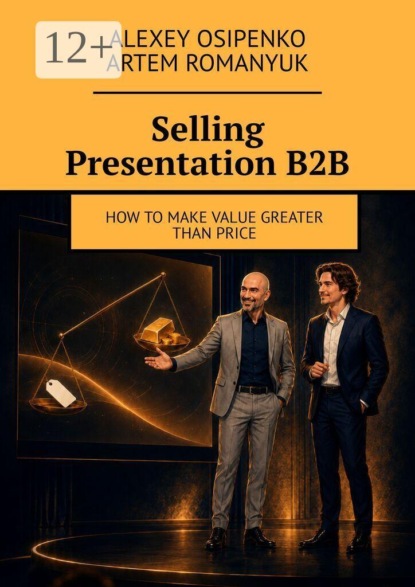
State two: price is heavier than value. I’ll give twenty-five and receive, by my own feel, fifteen at most. What do I say? “Definitely not, goodbye.”
And state three: value outweighs price. I’ll give twenty-five and receive fifty’s worth. Not in banknotes into my hands, but in benefits — plus some emotional pleasantness on top. And I say: “Now that’s excellent! Of course, yes. Bring it.”
And now back to us, the salespeople. If your product is more expensive than the competitors’ — and with strong brands it almost always is — then what is your presentation’s main task? To make value outweigh price in the client’s head. And when that happens, the price stops mattering.
A trap hides here, and faulty logic falls right into it. It whispers: “Let’s lower the price — the scales will rebalance and we’ll win.” No. You need to believe this, to internalize it: the client is not actually looking for a cheap price. The client is looking for large value. When we buy a car, we’re not looking for the cheapest car — you can find a bucket of bolts for a hundred thousand. We’re looking for the car that, within our budget, will bring maximum value. I, for instance, have a personal rule: I don’t buy a car costing more than a month’s income — that’s my cutoff, my motivation. But even within that budget I want to see: hold on, there’s seat heating here, and adjustments, and the full package — and I’m not paying all that much. And when value outweighs in my head — done, I hand over the money with pleasure.
And here is the main thing. The product is the same. Nothing in it changes. The salesperson’s task is to show that this product’s value is higher than its price. That is exactly why you learn the product’s specifications: not to shine with erudition, but to find and show value with the specifications as your footing. How exactly — that is the content of this whole book. But let’s formulate goal number two right now.
Remember: “I’ll think about it” means the scales are in equilibrium. “Definitely not” — price outweighed. “Bring it” — value outweighed. The presentation’s second and main goal is for value to outweigh price in the client’s head. The client is looking not for a cheap price but for large value.
Check Yourself
— What does the client’s phrase “I’ll think about it” actually mean in terms of the price — value scales?
— Why is lowering the price the wrong answer to the scales’ equilibrium, and what is the right one?
— Recall your last major personal purchase: what tipped the value pan for you personally?
Practice
Write out the last three times a client told you “I’ll think about it.” Next to each, write: what lay on the price pan, and what you placed on the value pan. Assess honestly: was there anything there capable of outweighing?
7. Marketing Cellophane
Before handing you the tool, I’ll show what a presentation without it looks like. I ask one of the salespeople — let’s call him Mikhail, he works with developers — to act out a scene with me. I play his client, the customer commissioning a warehouse complex he’s building for himself. Contact is established, needs are uncovered — begin the presentation.
Mikhail begins: “Proceeding from your design solution, our team of technical specialists and I have worked it through. In accordance with the test results obtained, we have offered you our roofing assembly, which comprises such-and-such materials. Proceeding from our long-term relationship, we have prepared an individualized commercial proposal reflecting the very best prices in the region, prompt logistics, possible services in terms of reserve warehouse storage, delivery to the site according to construction readiness…”
I stop him: “Hold it. Do you think any of this hooks me? Do I understand any of it?”
Mikhail is surprised: “But how — we’ve already made initial contact, I’ve uncovered your needs.”
“Fine,” I say, “but what specifically is supposed to interest me? So far this is a preamble that put me to sleep before the presentation even started. As the client, I’ve already mentally left: time is short, get to the point. What are you offering?”
Mikhail gathers himself and delivers the final salvo: “The highest-quality materials suited to your technical solution. The very best price. Prompt logistics and deal terms. Plus I have a contractor who will execute your order in the best possible way, with our supervised installation and on a fast schedule. He is certified, authorized by us. Accordingly, you will receive an optimal solution with the finest technical parameters on a minimal budget.”
Now I ask him to hear himself through my ears. “Look at what you said: I’ll give you the best price for the best quality with an optimal solution and a super-duper contractor. And I, the client, reply: hold on, Misha. Someone exactly like you just came through here. And said, word for word, the same thing. He even wrote it down for me on a slip of paper: best price, optimal quality.”
I gave this phenomenon a name: marketing cellophane. You chew it around in your mouth — “working with us is very profitable,” “a very good price,” “an optimal solution” — and the client doesn’t understand how to swallow it. Cellophane has no taste and doesn’t digest. And the beauty of the situation is that Mikhail sells anyway! He manages — on energy, relationships, persistence. Imagine what happens if we tune up the content a little: he’ll start tearing those customers up.
I assume most of you have roughly the same text. It’s not your fault — it’s the averaged-out presentation of the market; everyone has it. Marketing departments across the country produce cellophane by the ton. But that is exactly why the first person to switch from cellophane to specifics starts to sound like the only living human among robots.
Remember: “best price, high quality, optimal solution” is marketing cellophane. The client has heard it three times today — from you and two of your competitors. Cellophane doesn’t create value; it masks it.
Check Yourself
— By what signs can you recognize marketing cellophane in your own speech?
— Why doesn’t the phrase “the very best quality at the best price” move the scales in the client’s head?
— Which three cellophane phrases do you say most often? Write them out verbatim.
Practice
Record your typical product presentation on a voice recorder — two minutes, as if to a client. Listen back and underline every phrase that any of your competitors could deliver without changing a word. That is your cellophane. Keep the list — in the coming sections we will replace every phrase.
8. FBMS: The Formula That Flips the Scales
Now the tool. Draw a table with four columns. This is the technology I call FBMS — after the first letters: Feature, Benefit, Monetization, Story. The abbreviation is mine; the individual elements I didn’t invent — they’ve been known for a long time — but the idea of assembling them into a sequential formula, into a punch combination, is mine. The formula has one job: for the value of your offer to take shape in the client’s head — and outweigh the price.
Let’s take each element apart.
The feature is information about you. Who I am, who we are, what we can do, the product’s specifications, the company’s qualities. Features are also advantages: it’s precisely thanks to good features that you differ from competitors in some way. The feature answers the questions: who are we? what are we like? what do we have? what can we do?
The benefit is what the client gets by using your feature. The benefit answers the question: what does this give the client? I have twenty years of experience — that’s a feature. Thanks to it, you’ll get solutions you’d never have thought of on your own — now that’s a benefit.
Monetization is the conversion of the benefit into concrete money. You will earn this much. You will save this much. Here it is, the pearl almost everyone skips — and it’s the first thing I want to teach you: converting abstract benefits into concrete sums.
The story anchors everything said with an example from experience. “Here, for instance, one client…” The human brain is built so that it can dispute a sum — but a story it remembers.
The combination sounds like this: we have such-and-such a feature. It will let you gain such-and-such a benefit. Converted into money, that’s this much. And here’s a case in point. Four steps — and onto the value pan drops a weight that can actually be weighed.
Remember: FBMS — Feature, Benefit, Monetization, Story. The feature says who we are. The benefit — what it gives the client. Monetization — how much that is in money. The story — why it can be believed.
Check Yourself
— What question does each of the four FBMS elements answer?
— How does a benefit fundamentally differ from a feature, and why are they so often confused?
— Which of the four elements is most often missing from presentations — including yours?
Practice
Draw a table with four columns: feature, benefit, monetization, story. Don’t fill it in yet — just hang it where you can see it. In the next two sections we’ll fill it in together, first on a toy example, then on your product.
9. The Trainer: Selling a Phone
Before going into your price list, let’s play with an object lying next to you right now — the phone. We’ll run its presentation through the FBMS logic. A toy example — but it’s exactly where the formula becomes tangible.
I ask the salespeople: name some feature of the phone. “A good camera,” says one. Excellent, that’s a feature. Now on to benefits. Explain to me, the buyer, what the point of this camera is for me. What will I get?
Nikolai tries: “It will let you take high-quality pictures. Indistinguishable from a professional’s.”
Watch closely: this is the trap almost everyone falls into. “The camera lets you take high-quality pictures” is still a feature. Expanded, prettier — but a feature. And what will those high-quality pictures give me, the consumer?
Nikolai makes a second attempt: “You could start working as a photographer. And earn money. A photographer’s average salary is two hundred and fifty thousand rubles.”
Warmer — money has appeared! True, there’s a catch: the benefit has to land in my life. Becoming a photographer is too complicated a line of destiny; that’s not what I came to buy a phone for. One feature can have several benefits — we’re looking for the one that’s about me. “Shooting quality stories for social media, running your own channel” — yes, that’s a benefit; that’s about an ordinary person’s life.
And now — money in the moment. Dmitry finds the move: “Thanks to this camera you won’t have to buy professional equipment, which costs a hundred and fifty thousand rubles. A friend of mine shoots on his phone — and earns very well.”
There’s the combination! We write it down: a camera with such-and-such specs — no separate camera body needed — converted into money, you save a hundred and fifty thousand rubles. And the story about the friend on top.
Now the catch question: is a hundred and fifty thousand for this phone expensive or not? Feel what happened? I’m already breaking even: the phone paid for itself with the camera alone — and I still have the phone, with all its other functions. The scales trembled.
And we keep loading the value pan. What else does the phone have? Say it’s a well-known brand’s flagship — new, presentable. What will that give me? Think not about the hardware — about life. It’s an element of your professional packaging. In negotiations, a status phone works toward a credit of trust — that’s what status things are bought for. And now we count: if you sell, and your deal’s average ticket is a hundred and fifty thousand rubles, then the client trust created by your quality external packaging will bring you at least one extra deal a month. Converted into money — another hundred and fifty thousand a month. Converted into a year — one million eight hundred thousand.
Stop for a second and register what we’ve done. We took an ordinary banality. Of course the phone has a camera — who doesn’t know a phone has a camera? Everybody knows. Of course it’s new and pretty. That’s banality. And we, professional salespeople, turned banality into money. And the client looks at the calculation and says: “Seriously? I never even thought about that. Turns out there’s money behind every feature.”
Right here let’s also fix the principle by which any monetization is built. I call it “concrete money on an assumed volume.” I don’t know exactly how many deals the status phone will bring you — I invent “one extra deal a month.” But leaning on a concrete fact — your real average ticket — I name a concrete sum. The volume is assumed; the money is concrete. It is exactly this construction that moves the scales: to “you will earn more” the client’s brain is indifferent; to “plus one million eight hundred a year” — no longer.
Remember: banal features turn into money by the principle “concrete money on an assumed volume.” Not “you’ll save on equipment,” but “you’ll save a hundred and fifty thousand.” Not “more deals,” but “one extra deal a month — one million eight hundred a year.”
Check Yourself
— Why is the phrase “the camera lets you take high-quality pictures” not yet a benefit, and how do you turn it into one?
— What does the principle “concrete money on an assumed volume” mean — what in it must be concrete, and what may be assumed?
— How did one phone feature produce two different monetizations — through savings and through earnings?
Practice
Take any object from your desk — a pen, a mug, headphones. Run its presentation through the full combination: feature, benefit, monetization, story. Out loud. One feature, one branch. If it came out funny — excellent: the brain trains on toys and earns on the product.
10. A Feature That Sounds
Now we take a real product. For the example I’ll use a manufacturer of construction materials — insulation — with whose salespeople we filled in this table. You will have your own product, but the mistakes and moves are universal, so follow the logic.
The first column is features. Some features belong to the company, some to the specific product. We start with the company. I ask: dictate what you’ve got.
“We’re the production leaders in our category,” says one. Stop. An utterly useless phrase — my kid can say “I’m a leader.” Give me specifics: what does “leaders” mean, who called you that? The salespeople clarify: “We hold first place in production and sales on the market.” First by what criterion? “We produce and sell the most.” How much more? What if you sell two boards more than your main competitor? And here a number is born: “Thirty percent more than any competitor.” There! “We produce and sell thirty percent more than any competitor” — now that’s different. That sounds.
Next: “Everybody knows us.” What is “everybody knows us”? An abstraction. Everybody knows me too, you know — widely famous in narrow circles. We tune it up. “Our range is stocked in ninety percent of stores in every city” — now that’s specific. Or through research: “According to such-and-such marketing agency, our brand recognition is the highest in the category.” And one salesperson put it beautifully: “Any extruded insulation on the market gets called by our name.” The brand became a household word. Nice — though that’s more a blank for a story than a feature, and we’ll come back to it.
Next: “We have many plants.” How many? “Thirteen plants, twenty-seven years on the market.” Guys, if you have a real superpower — thirteen plants — then say it specifically! “Many plants” could be two. And then tune up even the number: what if they imagine thirteen garage workshops? Add scale: thirteen plants, each two thousand square meters or larger.
And the control example: “A wide range.” Tell me, what do you want to communicate to the client with the phrase “a wide range”? It’s nothing information. “More than fifty items”? Same nonsense, just with a number — a number by itself doesn’t save you if it’s unclear what the client needs it for. The right tune-up: “Thirty items that cover such-and-such blocks of tasks.” See? Even features have to be sold — before any benefits at all.
A separate remark about the household word — there’s a flip side worth thinking about. Recall copy machines: in the popular mind, “Xerox” means any copier, though it’s a brand. And if in my head the word isn’t tied to a specific manufacturer, I come to the market and, without a twinge of conscience, buy a “xerox” of another, cheaper make. Same with diapers: “Pampers” is a brand, but people buy anything at all under that word. So “we’re called by a household name” is a strong card, but it has to be played carefully: by showing in which situation this is the client’s benefit, not just a point of pride.
How many features should be in your master sheet? For a working presentation, six or seven are enough: four about the company, three about the product. But ideally, when I do this work for a company on a turnkey basis, I end up with fifty or sixty items: about the company, the materials, the logistics, the service. Not because all of it should be dumped on the client — remember narrowing the choice! — but because from a big sheet you will select, for each client, the three or four features that are needed by him specifically. That is the next chapter.
Remember: a feature must sound specific and selling. “A wide range” is trash. “Thirty items covering such-and-such tasks” is a feature. If you have a superpower — name it with a number.
Check Yourself
— Why is “we produce thirty percent more than any competitor” stronger than “we are the market leaders”?
— Why doesn’t a number by itself save a feature, and what else must be added to “more than fifty items”?
— What is the benefit and what is the risk of your brand having become a household word?
Practice
Write out six or seven features: four about your company, three about your main product. Now walk through each with the question “More specifically?” — and tune it up to a number or a fact a competitor cannot utter. Nothing formulations — “wide,” “quality,” “well-known” — cross out mercilessly.
11. To Whom, and What It Gives: From Feature to Benefit and to the First Money
We fill in the second column. Benefits answer the question: what does this give the client? And this is the most important thing: if there’s no benefit, the feature loses its meaning entirely. Though let me clarify right away: most important does not yet mean most convincing. Most convincing is money. But meaning is the foundation.
There is a language test here that instantly shows where you are. Watch the first word of the phrase. “We can…”, “We have…”, “We produce…” — those are all features: the subject is we. A benefit begins with the words “This will let you…”, “You will get…” — the subject switches to the client.
Конец ознакомительного фрагмента.
Текст предоставлен ООО «Литрес».
Прочитайте эту книгу целиком, купив полную легальную версию на Литрес.
Безопасно оплатить книгу можно банковской картой Visa, MasterCard, Maestro, со счета мобильного телефона, с платежного терминала, в салоне МТС или Связной, через PayPal, WebMoney, Яндекс.Деньги, QIWI Кошелек, бонусными картами или другим удобным Вам способом.