





- -
- 100%
- +

WARNING
This novel is based on extensive historical research, including the rare Chinese testimonies that have survived, British and French military reports, contemporary journalist accounts, and European museum archives. Although some characters are fictional as individuals, their experiences and actions are based on actual survivor accounts. Details about objects, buildings, and events are as historically accurate as available sources permit. The Summer Palace was truly one of the world's architectural wonders, and its destruction represents one of the greatest cultural losses of the 19th century.
The original version, written in French, has been translated into several foreign languages. Translated versions may contain linguistic errors, misunderstandings, or approximations.

English Version
Pillage
Robert Casanovas
casanovas@hotmail.com
Legal deposit December 2025 – Digital ebook and paperback version
© 2025 Casanovas. All rights reserved
ISBN: 9791098073199
www.international-restitutions.org
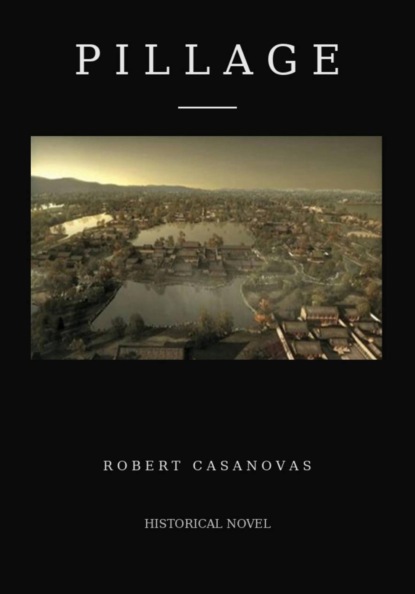
Cover: The restored Old Summer Palace – China Information 2025
By the same author: The stolen room (novel)
The testament was au forgery (novel)
TABLE OF CONTENTS
Prologue
Chapter 1: The Road of Infamy
Chapter 2: The Treasure of the Son of Heaven
Chapter 3: The Silent Witnesses
Chapter 4: The Journey
Epilogue
PILLAGE
PROLOGUE
Paris, November 4, 1859
The cobblestones of Rue Saint-Dominique glistened under a fine rain that transformed Paris into a tableau of greyness. General Charles Guillaume Cousin de Montauban stood before the window, hands behind his back, watching the passersby hurrying beneath their umbrellas.
Behind him, Marshal Randon, Minister of War, leafed through documents with a mechanical gesture. The silence stretched between them, punctuated by the creaking of the floorboards and the occasional rustling of a page. Randon raised his head, his bushy eyebrows furrowed.
"Montauban," he said in a grave voice, "the Emperor is entrusting you with a mission that far exceeds the scope of an ordinary military expedition."
The general pivoted toward him. His chiseled face, marked by campaigns in Africa, remained impassive. His blue eyes, of a disturbing clarity, settled on the minister.
"I am ready to serve the Empire wherever it may be, Monsieur le Maréchal. China frightens me no more than the Algerian deserts."
Randon sketched a smile. He rose from his armchair—his corpulence made each movement laborious—and approached a vast map displayed on an adjacent table. It showed the Chinese Empire in all its extent, an immense territory marked with strange characters and approximate tracings.
"It's not just about courage, Montauban. The English failed last year to force the mouth of the Pei-Ho. Their ships were repulsed, their dead numbered in the dozens. The face they lost gnaws at them like an infected wound. Lord Elgin burns to avenge himself."
The general joined the map in turn, examining it with the attention of a hunter studying his terrain. His finger traced an area from the coast toward the interior.
"They made the mistake of attacking head-on. If I've understood the reports correctly, the Chinese had time to fortify the mouth. We'll need to go around, strike where they don't expect us."
"That's what His Majesty expects of you," Randon replied, placing a hand on the general's shoulder. The familiarity of the gesture contrasted with his usual reserve. "Ten thousand soldiers will be allocated to you. Two brigades under the command of Generals Jamin and Collineau. Seasoned men who will follow you to hell if necessary."
Montauban nodded. He turned away from the map and took a few steps in the room. His mind calculated distances, delays, the innumerable variables of a campaign at the other end of the world.
"And the English? What will be the extent of their commitment?"
"General Grant will have twelve thousand men. More numerous, certainly, but less disciplined than ours. You'll be dealing with colonial troops, Indians, heterogeneous contingents. Coordination will be a challenge in itself."
The general emitted a low grunt. He knew the reputation of British armies, their efficiency tempered by a tendency toward pillage that officers struggled to contain. The idea of a joint campaign worried him, but he let nothing show.
"When must I leave?"
"As soon as possible. The ships are ready at Brest and Toulon. You should be in Hong Kong by February."
Randon returned to his desk and took out an envelope bearing the imperial seal.
"Here are your official instructions. The Emperor includes a personal letter. Don't disappoint him."
The general took the envelope with an almost religious respect. The weight of the paper, the gleam of the red wax, everything embodied the will of the Empire. He slipped the envelope into his tunic, against his heart.
"Your confidence will be justified, Monsieur le Maréchal."
Randon escorted him to the door. Before leaving, Montauban turned one last time.
"May I permit myself a question, Monsieur le Maréchal?"
"I'm listening."
"What do we really know about this Chinese emperor? About this palace everyone talks about so much?"
Randon's face hardened. He hesitated, as if weighing the opportunity to share a confidence.
"The Jesuits who stayed there speak of an architectural marvel. Immense gardens, dozens of palaces. Emperor Hien-Fung resides there more willingly than in the Forbidden City. They say this place contains treasures accumulated over centuries. But these are only rumors, Montauban. Your mission is military. To force the ratification of the Tientsin treaty. The rest… the rest will depend on circumstances."
Montauban went out into the dimly lit corridor. His steps resonated on the marble with a martial cadence. One thought gnawed at him: in distant wars, circumstances had an unfortunate tendency to escape all control.
CHAPTER 1 – THE ROAD TO INFAMY
The Farewells of Paris
Paris, November 10, 1859
A week after his interview with Randon, in the salon of the Montauban family mansion on Rue de Varenne, a very different atmosphere reigned. Heavy garnet velvet curtains muffled the sounds from the street. Bronze candelabras cast a golden light on the assembled faces. Louise de Montauban, the general's wife, presided over this modest circle with an elegance that poorly masked her anxiety.
Seated near the fireplace, she held between her fingers a Sèvres porcelain cup she had not touched. Her two daughters, Mathilde and Clémence, flanked her in an unusual muteness. Facing them, Captain Armand Delmas, a young artillery officer freshly promoted to the general's staff, endeavored to reassure these ladies with an optimism he felt only halfway.
"Madame," he began, choosing his words carefully, "the general your husband is a man of incomparable experience. His campaigns in Algeria have forged him a reputation that the entire army recognizes."
Louise raised her gaze. Her pupils, ordinarily gentle and benevolent, bore a disturbing intensity.
"Captain, I married Charles twenty-three years ago. I've learned to read in his silences what he never says. This expedition worries him more than he wants to admit. China is not Algeria."
The captain leaned forward, joining his hands between his knees. At twenty-eight, he retained that youthful fervor that drives men to believe in military glory. Yet, facing this woman who had lived through so many departures and waits, his assurance wavered.
"For this very reason, the Emperor chose your husband, Madame. Because he knows how to adapt, to anticipate. We won't be alone. The English…"
"The English," cut in Mathilde, the elder daughter, with a touch of acidity in her voice. At twenty-one, she possessed the composure of well-educated young women who read newspapers and follow world affairs. "The same English who were repulsed last year? Father says their Admiral Hope lost four ships and hundreds of men."
The officer searched for his words, but it was Clémence, the younger sister, who broke the awkwardness with the disarming frankness of her seventeen years.
"I've heard that the Emperor of China lives in a marvelous palace, with gardens that extend endlessly. Is it true, Captain?"
"Indeed, extraordinary things are told, Mademoiselle. Missionaries have seen this palace called Yuen-Ming-Yuen, the Garden of Perfect Brightness. It appears to be a city within the city, with artificial lakes, marble bridges, hundreds of pavilions. The Emperor had copies of famous landscapes from all over the Empire built there."
"And the treasures?" asked Mathilde with less innocent curiosity. "They speak of jade, ancient porcelains, precious objects accumulated over dynasties."
Louise set her cup on a pedestal table with a sharp sound that brought attention back to her.
"Mathilde, Clémence, these questions are inappropriate. Your father is leaving on a military mission, not to plunder palaces like a common adventurer."
The reproach, though formulated gently, made the two young women blush. Delmas, embarrassed, tried to salvage the situation.
"Of course, Madame. The general is very clear on this. Our objective is to force the Chinese to respect the treaty signed at Tientsin. The opening of new ports to trade, freedom of movement for our missionaries. Nothing more."
"Nothing more," Louise repeated, fixing him. "And you really believe that, Captain?"
The question caught him off guard. In those scrutinizing eyes, he read a wisdom born of years spent waiting, hoping, dreading news from the front. She had seen men leave with flowers on their rifles and return broken, or not return at all. She knew that conflicts always escape plans, that the unexpected dictates its law.
"I believe, Madame, that the general will do his duty with the honor that characterizes him. What will happen there… no one can really predict. But I give you my word that I will watch over him to the best of my ability."
Louise sketched a sad smile.
"You are a sincere man, Captain. I hope this sincerity will survive what you see in China."
That same evening, in the staff offices on Rue Saint-Dominique, activity was in full swing despite the late hour. General Jamin, commanding the first brigade, and General Collineau, who led the second, were bent over endless lists with Montauban. The smell of tobacco and cold coffee permeated the confined atmosphere.
Jamin was defining limits on a map with his pencil.
"The troops are at full strength. Five thousand men per brigade. Infantry, artillery, engineers. I've made sure we have mountain guns, they'll be indispensable if we have to move away from waterways."
Collineau, more massive and jovial, intervened.
"What worries me isn't the cannons. It's the bellies. Ten thousand men to feed for months in a hostile country. The English will have their own supply lines, we'll have ours. If we find ourselves separated…"
"We won't separate," Montauban cut in with an authority that admitted no reply. "I've warned Grant. Our troops will advance together. The English paid dearly for their isolation last year. They won't make that mistake again."
Jamin put down his pencil and stretched.
"And if the Chinese refuse to negotiate? If we have to march on Beijing?"
The silence that followed carried all the implications of this question. Montauban went to the window and contemplated the Parisian night. A few gas lamps flickered in the darkness. He thought of his wife, his daughters, this comfortable life he was preparing to leave for months.
"Then we'll march on Beijing. And we'll do what must be done."
Collineau exchanged a glance with Jamin. Both knew this determination in Montauban. Once he had made a decision, nothing could shake him. This quality made him a formidable commander. It also worried those who knew him well.
"The men are ready," Jamin affirmed. "They'll embark at Brest in two months."
"Good."
Montauban faced his generals.
"Spread the word: absolute discipline. No pillaging, no excesses. We are the army of the French Empire, not a band of mercenaries. If we must confront the Chinese, we'll do so while respecting the laws of war."
Collineau approved.
"And the English? Their colonial troops are not renowned for their restraint."
"The English do what they want with their men. We will maintain our discipline. However, I have no illusions. Once an army has tasted blood and booty, containing it becomes a challenge. We'll have to be vigilant."
He returned to his desk and took out a blank sheet. In the flickering light of the oil lamp, he began drafting his preliminary orders. His pen scratched the paper with regularity, tracing these words that would seal the fate of thousands of men.
Jamin and Collineau watched him work. They were witnessing a historic moment. In a few months, they would be at the other end of the world, facing a millennial empire that refused to bow before the West. What would happen there would doubtless escape the best-laid plans, the strictest orders.
Wars have their own logic. And this logic, Collineau thought while observing the shadows dancing on the walls, never respects noble intentions.
The next morning, in a room at the Tuileries Palace, Empress Eugénie was receiving Baron Gros, the plenipotentiary designated to accompany the expedition. The rococo gilding, silk hangings, and master paintings created a setting of an opulence that contrasted violently with the austerity of military offices.
Eugénie, in a pale blue satin dress that highlighted her porcelain complexion, stood near a window overlooking the gardens. At thirty-three, she embodied imperial elegance with a natural grace that fascinated the court. But beneath this delicate appearance lay a sharp political intelligence and an iron will.
"Baron Gros, the Emperor asked me to sponsor this expedition. I accepted, of course. But I would like to understand what is expected of this enterprise."
Baron Gros, a seasoned diplomat with an emaciated face and precious manners, bowed with respect.
"Your Majesty, the objective is above all diplomatic. To force the Chinese emperor to ratify the Tientsin treaty, guarantee the security of our Catholic missions, open new ports to French trade."
"And the English? What are their true objectives?"
A gleam of amusement passed through the diplomat's gaze. The Empress had touched the heart of the problem with her usual perspicacity.
"Lord Elgin is a… complex man, Your Majesty. Son of the famous Lord Elgin who brought the Parthenon marbles to London, he bears a prestigious name and an excessive ambition. Last year's failure humiliated him. He will seek to redeem himself through a brilliant victory."
Eugénie took her seat gracefully on a sofa and motioned to Gros to sit facing her.
"Which means?"
"Which means, Your Majesty, that we'll have to navigate skillfully. The English have their own interests, which don't always coincide with ours. The opium trade, for example…"
"Opium," Eugénie repeated with barely veiled disgust. "That infamous trade that the English defend with such ardor."
"Alas, Your Majesty. One of the reasons for this war lies in that. The Chinese want to prohibit its trade, the English want to legalize it. We French are caught between two fires."
The Empress left her seat and took a few steps in the salon, her petticoats rustling on the waxed floor. She stopped before a marquetry globe and spun the sphere until she found China.
"I've heard about this palace. The Yuen-Ming-Yuen. They say it contains wonders."
Gros stiffened. The conversation was taking an unexpected turn.
"Indeed, Your Majesty. The Jesuit missionaries who worked for the emperor report extraordinary descriptions."
"And if these wonders fell into our hands? If the fortunes of war led us to this palace?"
The baron chose his words carefully. Every word spoken before the Empress carried weight.
"The laws of war are clear, Your Majesty. What belongs to the vanquished enemy… becomes the property of the victor. But there is a difference between seizing goods within the framework of military operations and allowing savage pillage."
"Of course."
Eugénie returned to her seat, fixing the diplomat with a thoughtful eye.
"General de Montauban is a man of honor. I count on him to maintain the dignity of our army."
"He will do so, Your Majesty. I am convinced of it."
Eugénie gazed through the window at the carefully maintained gardens, these French-style flowerbeds that embodied order and mastery of nature. She thought of those Chinese gardens everyone spoke of, so different, where nature was celebrated in its apparent freedom.
"Baron Gros, I have endowed the expedition with medical supplies, equipment to care for our wounded. My duty as sponsor requires it. But I also expect something in return."
"Your Majesty?"
"If art objects should fall into our hands, I would like a selection of the finest pieces brought back to me. To constitute a collection. A testimony of this era, of this encounter between two civilizations."
Gros bowed, thus masking the trouble that invaded him. The Empress's words amounted to giving imperial blessing to the seizure of Chinese treasures. He understood that this expedition far exceeded a simple military conflict. It carried within it moral questions that would haunt him for years.
"It shall be done according to your will, Your Majesty."
When he left the palace an hour later, Gros walked at a measured pace, lost in his thoughts. The Parisian sky was a heavy gray that announced snow. In a few weeks, he would be on a ship en route to the other end of the world. He carried with him diplomatic instructions, official orders, and this implicit desire of the Empress.
He wondered how all this would unfold, how noble intentions would transform in the face of ground reality. History had taught him that distant wars always escape the control of those who order them from comfortable palaces.
That same evening, as the street lamps were lighting in the streets of Paris, General de Montauban was returning home. Louise waited for him in the private salon, a piece of embroidery on her knees remaining untouched. When he entered, she raised her eyes and smiled at him with resigned sadness.
"Is it decided? You're leaving?"
"In fifteen days."
He sat beside her and took her hand in his. For a moment, they remained thus without speaking, united in a silence that said more than all words. Outside, Paris continued its carefree life, unaware that events were preparing that would mark history and forever tarnish the honor of those who participated in them.
Preparations accelerated. Ships were loaded, men assembled, final orders given. And one misty morning in late January 1860, the first transports left Brest, carrying toward the Orient a French army that knew not what awaited it.
The Crossing
At Sea, January-June 1860
The frigate Impératrice Eugénie rolled on the Atlantic swell. Aboard, General de Montauban stood on the poop deck, gripping the railing, contemplating the gray immensity extending to the horizon. The salty wind whipped his face, bringing with it a smell of iodine and spray that reminded him of other crossings, other campaigns. But never had he gone so far. Never had the distance between him and Paris been so dizzying.
Behind him, Ship Captain Duperré approached with the swaying gait of sailors who have spent more time at sea than on land. A man in his fifties, his face weathered by sun and salt, his eyelids creased from having scrutinized too many horizons.
"Mon général, we're making good progress. If the weather holds, we should round the Cape of Good Hope in three weeks."
Montauban approved without turning his attention from the ocean. The waves succeeded each other with hypnotic regularity, each similar to the previous one yet unique. He thought of Louise, his daughters, of Paris that was moving a little further away with each beat of his heart.
"Three weeks to the Cape. And how long to Hong Kong?"
"Two and a half months, perhaps three if we must make stops at Aden or Singapore."
Duperré waited a moment.
"You know, mon général, I've made this route a dozen times. The Indian Ocean can be treacherous. Storms arrive without warning, and when they arrive…"
"When they arrive, Captain, we face them like everything else. The soldiers I command do not fear the elements."
A fleeting smile passed over Duperré's lips. He had already transported troops, seen seasoned men on land turn green and trembling as soon as the boat pitched a bit hard. But he kept all commentary to himself.
"Your men are holding up well for now. A few cases of seasickness in the lower batteries, but nothing alarming. The chief medical officer is distributing his potions and advice."
Montauban faced the captain. His blue gaze scrutinized the sailor with intensity.
"Speak to me frankly, Duperré. You who know these seas, these distant lands. What do you think of the expedition? Of our chances?"
The captain hesitated. The question was direct, almost brutal. He wasn't used to a general asking his opinion on strategic questions. But Montauban's voice, with its imperceptible crack, invited confidence.
"I think, mon général, that we're not confronting the Maghreb tribes. The Chinese are numerous, organized. Their empire has existed for millennia. We're going to strike them at the heart, and a wounded empire can react unpredictably."
"You speak like my wife. She too warned me. She has that feminine intuition that sees what military strategists neglect."
"Women are often wiser than us, mon général. They don't have our masculine vanity, our need for glory."
In the distance, other transports of the flotilla were progressing in tight formation, their sails swollen by the following wind.
"How many men are we transporting on our frigate?"
"Three hundred fifty soldiers, mon général. Plus the crew and your staff. We're loaded to the gills. The holds are full of ammunition, provisions, equipment. If we had to face a serious storm…"
"We won't sink, Captain. The Empire needs us in China."
"The ocean knows neither empire nor king, mon général. It takes what it wants, when it wants."
In the lower decks, the atmosphere was quite different. Crammed into cramped spaces where air barely circulated, the soldiers tried to adapt to maritime life that was foreign to them. The smell of sweat, tar, and vomit mingled in a stench that caught in the throat. Hammocks hung in tight rows, swaying to the rhythm of the ship.
Sergeant Beaumont, a forty-year-old veteran marked by a scar across his cheek, tried to maintain his section's morale. Sitting on his pack, he distributed advice and jokes with a gruff good humor that made him an appreciated leader.
"Come on, lads," he called out to a group of greenish recruits, "it's like a boat ride on the Seine. Except it lasts longer and the water's salty."
"Sergeant," moaned a boy who couldn't have been twenty, "I think I'm going to die. My stomach…"
"Your stomach will survive, Dubois. In three days, you'll be used to it. In a week, you'll go up on deck demanding your rum ration like a real sailor."
"And if I never get used to it? If I'm sick for the entire crossing?"
Beaumont leaned toward him with a paternal look.
"You'll be sick. But you'll still arrive in China. And there, believe me, you'll have something else to sink your teeth into besides seasickness."
Another soldier, older, intervened. Corporal Leroux, a man with broad shoulders and thick peasant hands.
"Sergeant, is it true what they say? That the Chinese have secret weapons? Powders that drive you mad, poisons that kill in seconds?"
"Nonsense, Leroux. Propaganda to scare us. The Chinese are men like us. They bleed like us, they die like us."