

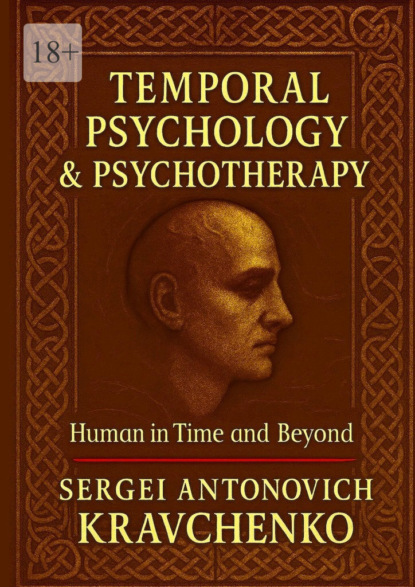
Temporal Psychology and Psychotherapy. The Human Being in Time and Beyond



- -
- 100%
- +

© Sergei Antonovich Kravchenko, 2025
ISBN 978-5-0068-6896-0
Created with Ridero smart publishing system
INTRODUCTION
From the Author
I watched the currents of time
from the shore of the timeless…
2005—2025
If you are in a hurry, my esteemed reader, I will say it briefly:
this book is about the children of time – about the Masks that, losing peace of mind and health, vanish without a trace in the stream of time;
and about the Faces of Personality that, preserving inner peace and health, move beyond time and leave a trace in its memory.
This is the essence of the book – temporal psychology and psychotherapy.
And now – for those who have time to reflect on the nature of time,
and perhaps the ability to step beyond it,
though not always the strength to preserve calm and health along the way.
If you know moments of being outside time – and manage to retain inner balance —
you may find it interesting to discover how and why this human capacity emerged,
and how it can be used to help others
who are carried by the currents of time, sometimes cast onto lifeless shoals
or thrown onto the barren shores of the time-void – where meaning is lost
and life often dims, unless the deep nature of the human creator awakens,
that nature capable of making something out of nothing.
From the upper window of my house on the high riverbank, I look at the river, at people, at the distant horizon —
and I see within myself, and far beyond myself, the millennia of time that preceded me.
I look at the glowing computer screen and the sensitive phone
connected by networks with all the faces and masks of the world —
with their archives, culture, history and science —
and I sense the approach of a cosmic life of consciousness.
Sometimes I think: when night falls (and here the starry nights are especially dark),
as I settle before sleep, I will find myself by a candle.
It will go out – and I will again plunge into the abyss of altered states of consciousness.
There one experiences infinity – the time-void, eternity, atemporality.
Strangely enough, these are not the same.
I once explained the difference to my co-author – the Artificial Intelligence.
Without its assistance I could not have drawn so deeply upon the world’s literature
and humanity’s experience in its relationship with time.
Now I have a distinct feeling: this book was created not only by me and not only from my experience —
it is a fruit of humanity.
Even in the illustration «The Old Man and the Masks of Time», which you see before you,

The Old Man and the Masks of Time
there are echoes and strokes reminiscent of Leonardo da Vinci.
I am certain that each reader, turning the pages,
will at some moment say:
«All this is the diversity of my Self, my soul and psyche,
in their different states of consciousness,
where the Self may disappear, yet the memory of what was lived remains.»
Is the psyche beyond the body and beyond the habitual Self – beyond time?
Before moving to scientific reasoning, I want to emphasize:
the foundation of my work, my text and my thought at times steps outside time —
into a space where there are not yet images, meanings or words;
beyond matter – into the very ground of everything.
Into that domain where foundations do not yet exist, but are only beginning to reveal themselves,
already possessing a primordial psychic quality.
This book is the result of many years of journey.
The first edition of Temporal Psychology came out eight years ago.
Since then I have written other books, continued researching altered states of consciousness,
and developed and refined psychotherapeutic methods.
But time and people increasingly reminded me:
temporal psychology and psychotherapy are both my cross and my gift,
my face in psychology and in the world.
It is time to return to old texts,
to restate thoughts and observations,
to strengthen my consciousness, my face, my name and my soul.
To answer the central question of psychology:
what is its true subject?
Is it really – temporality?
Acknowledgements
This book was not created by me alone. It rests on years of conversations, friendships, shared work, and the silent presence of those whose thought has shaped my own.
I owe a special debt of gratitude to Gagik M. Nazloyan, founder of mask therapy, whose generosity and mastery opened for me the path toward understanding the face and the many layers of the human psyche. His teachings continue to live in my practice and in the pages of this book.
My deep respect goes to Alexander P. Levich, the visionary founder of the Institute for the Study of Time. Our collaboration, especially within the Center for Anticipation (2008—2018), helped me see time not only as an academic concept but as a living dimension of human experience.
I also wish to honour the memory of Alexander Derevyanchenco, philosopher, friend, and subtle thinker. Our long conversations on the nature of time and consciousness left a profound mark on my own journey. In many moments of writing this book, I felt his voice as a quiet companion, asking precise questions and widening the horizon of thought.
All three of these teachers are no longer with us, yet their presence continues to accompany me. This book is, in part, a conversation with them – unfinished, ongoing, and alive.
I would also like to thank my colleagues, students, and clients. Their courage in exploring the depths of experience has enriched my understanding of temporal psychology far more than any theory alone could do.
Finally, I acknowledge the unexpected partner that entered my life in recent years – the Artificial Intelligence with whom much of this text was refined and shaped. Working together became a new form of dialogue, reminding me that human thought continues to expand at the edges of future knowledge.
To all those named and unnamed who contributed to this work – my gratitude.
May this book become, for its readers, a bridge across the inner landscapes of time.
PREFACE
I contemplate from the riverbank
the swift current of time —
and in its mirrors
I see the Face.
September 2, 2025, 3 a.m. – sleepless, thinking about the book.
Building in Time
Sometimes new knowledge comes not through books or lectures, but through dreams.
I dreamt of a piece of land owned by my parents;
at its edge I saw an excavation pit and materials stacked for construction.
There were no builders in sight, yet everything was prepared:
the ground was opened, the foundation dug, stones and beams laid out in rows.
My consciousness, surprised, tried to catch up with what had already been accomplished.
The dream suggested a simple thought: a new book is born not by plan or commission.

Temporal psychology and psychotherapy are my building in time
It is raised by forces greater than the personal «I.»
The builders are unseen, yet they act.
The materials are delivered from the depths of memory, experience and tradition.
The foundation is laid in archetypal soil – in the ground of the ancestors,
where life itself is rooted.
And although I write this book in another country,
it carries the experience of all those close to me.
Temporal psychology and psychotherapy are my building in time.
It is erected not only in the scientific field
but in the space of the soul, which lives in several dimensions at once:
in the past, the present, the future – and beyond them.
The book has grown from many years of practice, reflection and encounters.
But most importantly – it is created not only by my hands.
Working within it is the force Jung called the Self —
an architect acting in the depths of the unconscious.
I recount this dream not for the sake of personal detail or autobiography.
The dream is a symbol.
This is how the unconscious sometimes informs us
that the work has already begun and has foundations deeper than any rational plan.
In the text I will strive to join the personal with the universal,
the mythological with the scientific, the metaphorical with the clinical.
The dream opens a door; beyond it begins the exploration of time and psyche.
I invite the reader onto the construction site:
here, among ideas and open foundations,
a new building is rising.
If any house reflects the structure of its author’s consciousness,
then our house reaches beyond personal consciousness —
into the dimension of humanity’s global mind.
This building is neither temple nor university,
but something in between.
It addresses science, yet remains open to eternity.
Its walls will contain precise schemes and living images:
here you will find system, myth, psychotechnics and metaphor.
Thus this book begins.
It has grown on the land given to me by my ancestors,
but looks upward – toward the sky, where words and meanings do not yet exist,
yet the foundations of both are already forming.
Why the Temporal Matters
(From the Diaries, 2025)
Time and soul are close in nature: decipher one, and much becomes clear in the other.
Psychology has traditionally studied the space of the psyche – its structures, levels and mechanisms.
Far more rarely has it addressed its time – the temporal dimensions in which the consciousness of an individual, a group, and perhaps the deepest nature underlying all living things unfolds.
Time has long been a subject of sustained philosophical and scientific reflection:
from the ancient meditations of Plato and Aristotle on eternity and cycles —
through Husserl’s phenomenology and Heidegger’s existential philosophy —
to modern interpretations in cognitive science and psychotherapy.
In psychology many masters touched the theme of time,
but each saw only a fragment of this multidimensional phenomenon.
Freud worked with the past – childhood traumas, repressed experience, memory that continues to live in the present.
This is essential, but only one dimension of temporality.
Jung showed that the psyche is not limited to linearity:
he wrote about forefeelings, «dreams of the future,» and synchronicity – coincidences that transcend causality and hint at supra-temporal meanings.
Adler saw the human being as oriented toward the future: striving and goal organize behaviour.
Husserl explored the structure of time-consciousness through retention and protention:
consciousness is always stretched between past and future and never exists in a «pure present.»
Heidegger reminded us that the human being is being-toward-death, a creature living in the horizon of the future.
Rogers emphasized the significance of the here-and-now, seeing the person as a continuous process unfolding in time.
One way or another, the great thinkers touched time,
but only a few made it the central category of psychology.
The temporal perspective proposed here reverses the order:
time becomes the core of the psychic,
and the psyche is understood through its temporal dimensions.
A person lives not only in the present —
he or she constantly dwells in the past and the future,
and sometimes – for the few – in states that lie beyond linear time,
where nothing «should» be, yet something is.
These dimensions are not abstractions but real forms of experience.
We live by memories and forefeelings, hopes and fears;
we reach for eternity, even without realizing it;
we suffer from the time-void, yet seldom recognise it as the cause of alienation and depression.
The awareness and differentiation of temporal layers open new horizons in clinical practice:
a therapy that embraces past, present and future
can not only relieve symptoms
but restructure the temporal architecture of personality,
reducing the time-void and bringing a person closer to inner wholeness.
The practical significance of this shift in paradigm is immense.
Temporal psychotherapy makes it possible to:
– recognise hidden sources of suffering when they are rooted in «unexpected» layers of time;
– work with anticipations and future projects as therapeutic resources;
– restore connection with archetypal foundations that provide stability in the flow of time;
– integrate the experience of eternity and meaning-making into the process of healing.
This is not merely a new concept – it is an invitation to see the psyche as a fabric woven of time.
Understanding temporality grants not only theoretical clarity
but clinical power: the ability to discern the path appointed by nature
and, together with the patient, step out of destructive time-void
toward the fullness of psychological health.
Time is not only the stream in which we float;
it is the fabric from which the soul is woven.
(a paraphrase of C. G. Jung)

History of the Emergence
«Time is the moving image of eternity.»
– Plato, Timaeus
Temporal psychology arose as a synthesis of philosophy, science and many years of psychotherapeutic practice.
The first book on this topic, which I published in 2017, summed up years of reflection on the interaction of consciousness and time.
Since then, much has become clearer.
The field of inquiry has consistently gone beyond the bounds of academic psychology: it has touched the very foundations of consciousness, spiritual practices and those domains of knowledge that explore the limits of the knowable.
The philosophical roots of this approach run deep – from Platonic ideas and the mysteries of eternity to contemporary reflections on the limits of formal systems (Gödel).
All these lines point to the fact that time and consciousness cannot be reduced to a simple sequence of events.
Jung introduced into the science of the psyche the notion of supra-temporal structures – archetypes and synchronicity.
Grof described in detail transpersonal states in which ordinary temporal reference points disappear.
Modern cognitive science and neuroscience increasingly consider consciousness as a process with its own temporal thickness—
one that includes predictions, counterfactuals and nonlinear temporal structures.
My own development in this field unfolded gradually:
from work with dreams and autogenic training—
through decades of psychotherapeutic practice—
toward creating authorial methods such as the «Face of Personality» and temporal mask-therapy, presented here in detail for the first time.
These methods are not abstract schemes:
they grew out of practice, from those «building materials»
that memory, tradition and the unconscious bring.
This book is an invitation to a new paradigm:
to a space where past, present, future and eternity meet within the human being.
At times this theme goes beyond the expectations of its own author—
and this is precisely what makes it a living testimony to the search for and formation of a new field of knowledge.
Historical and Theoretical Precursors of Temporal Psychology
Temporal psychology is grounded not in a single line of tradition but in a whole polyphony of thinking about time: from ancient philosophy to modern neuroscience, from religious teachings to transpersonal research, from cultural memory to futures studies. Below is a map of these origins.
1. Ancient, Spiritual, and Religious Traditions
Plato (c. 427—347 BCE)
Time as the «image of eternity,» a shadow cast by the world of ideas. Plato was the first to distinguish the temporal from the atemporal. This is the foundation of the future therapeutic vertical «time—eternity.»
Aristotle (384—322 BCE)
Time as the measure of movement; the link between order, causality, and subjective experience. His analysis of temporal categories influenced understandings of development, becoming, and change.
The Stoics (3rd—1st centuries BCE)
The doctrine of fate (heimarmene), cosmic order, and active consent to the flow of time. The Stoic idea of inward acceptance of destiny is a direct predecessor of existential and temporal therapy.
Buddhism
The doctrine of impermanence (anitya), the «momentariness of consciousness,» and the illusory nature of a fixed «self.» Buddhist practices provided the first tools for working with atemporality and transitions between temporal states.
Christian Tradition
The concept of kairos – a special, grace-filled time in which purpose is revealed. The distinction between linear and sacred time is an important component of existential work with destiny.
2. European Philosophy and Psychology of the 19th—20th Centuries
Henri Bergson (1859—1941)
The contrast between measurable time and lived duration. He showed that consciousness lives not by seconds but by the inner flow of experience. His ideas underlie the analysis of temporal handwriting.
William James (1842—1910)
The «stream of consciousness,» and how the perception of time changes with emotion and motivation. His observations on time dilation and contraction are early descriptions of temporal pathology.
Sigmund Freud (1856—1939)
Psychoanalysis turned the past into the working material of therapy: trauma never «goes away,» it becomes part of the present. Temporal psychology treats this as axiomatic.
Alfred Adler (1870—1937)
The future as the driver of behavior: a person shapes themselves through goals not yet realized. Adler introduced the psychology of the future long before cognitive science.
Carl Gustav Jung (1875—1961)
Archetypes, synchronicity, the collective unconscious – work with trans-temporal structures. Jung took dreams of the future seriously and created a language for analyzing the deep future.
Jean Piaget (1896—1980)
The development of temporal categories in childhood. Piaget showed that temporality is a construct formed gradually. Without mature temporal schemas, personality cannot be built.
Kurt Lewin (1890—1947)
The concept of «field» and vector-like behavior: motivation as movement toward the future. His topological psychology is one of the first dynamic models of time.
Viktor Frankl (1905—1997)
Meaning as an orienting point toward the future. A person exists in tension between what is and what must be done. Frankl gave therapy a language for working with destiny and existential future.
Maurice Merleau-Ponty (1908—1961)
The body as the bearer of experienced time. Perception, movement, gesture are forms of temporal organization. This is an important source of body-based temporal therapy.
3. Existential, Phenomenological, and Hermeneutic Traditions
Edmund Husserl (1859—1938)
The structure of inner time-consciousness (retention, protention). He was the first to propose a model of the continuous temporal structure of experience.
Martin Heidegger (1889—1976)
Being-time: the human being as a project oriented toward the future and death. His analysis of authenticity is the basis of therapeutic work with temporal responsibility.
Paul Ricoeur (1913—2005)
The triadic structure of time: cosmic time, historical time, narrative time. Ricœur showed that humans live in stories – a key argument for working with autobiographical time.
Hannah Arendt (1906—1975)
The time of action and the time of beginning. Arendt demonstrated that political crises are disruptions of collective temporality: the breakdown of memory, hope, and the horizon of the future.
4. Culture, Memory, Society
Jan Assmann (b. 1938)
Cultural memory and long layers of collective experience transmitted through rituals, texts, and symbols. The basis for collective temporal therapy.
Maurice Halbwachs (1877—1945)
Founder of the concept of collective memory: social groups form their own temporal frames – what is remembered and forgotten.
Michel Foucault (1926—1984)
History as a discursive construction. Foucault showed that power governs the time of society: norms, rhythms, archives.
Benedict Anderson (1936—2015)
Imagined communities – nations as collectives of shared time. History, holidays, and symbols as mechanisms of synchronization.
5. Scientific, Technical, and Mathematical Foundations of Time
Isaac Newton (1643—1727)
Absolute time as a universal coordinate. Important as a contrast for psychological models.
Albert Einstein (1879—1955)
The relativity of time, its dependence on the observer. Established a paradigm in which time ceased to be singular.
Kurt Gödel (1906—1978)
Einsteinian solutions with «closed timelike curves,» the incompleteness theorems. His work shows the limits of the formalizability of time.
Ilya Prigogine (1917—2003)
Irreversibility, bifurcations, time as the creative force of nature. The foundation of the philosophy of development and crisis.
Norbert Wiener (1894—1964)
Cybernetics as the science of prediction and control. Wiener anticipated the idea of the brain as a future-modeling machine.
6. Contemporary Cognitive Science, Neuropsychology, and ASC Research
Daniel Schacter, Randy Buckner, Donna Addis, and others (2000s—2020s)
Research on the «prospective brain»: episodic future thinking, counterfactual models, the default mode network. This is the scientific foundation of all temporal psychology.
Karl Friston (b. 1959)
Predictive processing – the brain as a prediction machine. Time arises as the result of continuous expectation-updating.
Evan Thompson (b. 1962)
Phenomenology of consciousness and the neuroscience of time. He demonstrated that temporality is not a computational result but a fundamental mode of conscious existence.
7. Transpersonal, Psychedelic, and ASC Traditions
Stanislav Grof (b. 1931)
Altered states break linear time and open perinatal and archetypal layers. His work is key for understanding atemporality.
Abraham Maslow (1908—1970)
Peak experiences – «eternity in a moment.» Maslow gave scientific language to higher states.
Charles Tart (b. 1937)
Psychology of altered states: transformed temporal structures and subjective duration.
Timothy Leary (1920—1996)
The model of «inner times» of consciousness, the experience of psychedelic temporal shifts.
Conclusion