





- -
- 100%
- +
For the first time since the Holy Land, he truly prayed again — not for victory or wealth, but simply that his wife might live.
But God did not answer him as he had hoped.
The birth came at the end of winter. A blizzard raged beyond the walls, almost every hearth in the castle was burning, servants hurried through the corridors, and Jitka’s chamber smelled of hot water, herbs, and wax.
At last a baby’s cry rang out — a strong boy with a remarkably healthy voice for a newborn.
Konrad wept for the first time in many years, but the joy did not last.
Jitka was too weak. She managed to hold her son only once, studying his face for a long time as though trying to memorize it for a journey she was about to make without him.
«Promise me,» she whispered, and Konrad bent close to her lips. «Whatever happens — protect him. Raise him. Do not let the darkness you carry inside you touch him.»
Konrad flinched so sharply that for a moment he forgot to breathe. It seemed to him that she knew — knew about the temple, the girl, the twenty days, everything he had hidden so carefully even from himself.
«How do you know…» he began, but Jitka only smiled, very faintly.
«I am your wife, Konrad.»
She closed her eyes and never opened them again.
That was how Gavel von Waldeck entered the world — beneath the howl of the blizzard beyond the walls and the silence of a dying mother.
Konrad held his newborn son all night and allowed neither nursemaid nor priest near the cradle, as though he feared that the moment he loosened his arms, the same unknown thing that had once stolen twenty days of his life would take the boy as well.
Outside, the blizzard howled and snow settled over the land of Bohemia. Far across the sea, in the city Konrad had tried with all his strength to forget, remained the memory of the temple, the white-haired girl, the cold palm — and the knowledge that sometimes a war does not end when a man returns home.
Sometimes that is when it begins.
Gavel did not know it yet.
But one day he would.
And then, for the first time, people would call him the Bear of the North.
End of Chapter One.
Chapter Two — The Inheritance of Ashes
Years passed over Waldeck Castle as slowly as the river flowed beneath its walls — peaceful on the surface, yet relentless underneath. Winter gave way to a short, rainy spring; spring to a sultry summer filled with horseflies, when peasants went out to reap barley from narrow fields wrested from the forest; and autumn laid the countryside beneath the first hard frost.
The boy who had once been too weak to survive his first spring without his nursemaid’s remedies grew tall and broad. By fourteen he towered over most of his companions, and by seventeen there were few grown men in the garrison who could look down on him.
He had his mother’s dark hair, but his father’s heavy jaw and the same furrow between the brows that appeared whenever he considered matters not meant for other ears. By seventeen his voice had deepened, and his movements had acquired a peculiar, almost animal grace which the castle folk first took for nothing more than a young warrior’s natural agility.
The Jizera Mountains still held their snow until May. White patches lingered in shaded ravines while grass was already green beside the river and wildthorn had begun to flower. The forest surrounding Waldeck on three sides changed its voice with the seasons: birds and dripping snow in spring; the dry crackle of grasshoppers and the hum of bees in summer; the rustle of fallen leaves beneath a deer’s feet in autumn; and, in winter, a heavy, almost guttural silence broken only by the creak of frozen trunks and the distant howl that made even the bravest hounds raise the hair along their necks.
Adolescence
The castle yard where Gavel trained was a patch of earth between the keep and the stable, trampled so hard that it had become almost as solid as stone and enclosed by a low wattle fence. In the mornings, while dew still clung to the dead autumn grass — or, in winter, before frost had frozen the ground solid — Gavel practiced with wooden swords and then with real steel under the watchful eye of the old armorer, Jost.
Jost was short and powerfully built, his hands marked by old burns from the forge and one eye narrowed by an ancient wound. It did not prevent him from seeing every mistake his pupil made before the boy himself realized it. He always wore the same leather jerkin over a coarse linen shirt, as though he had never owned another set of clothes, and at his belt he carried not a sword but a hammer — the very hammer with which he straightened blades upon the anvil.
Gavel’s day began long before sunrise. First came cold water from a barrel in the yard, which he poured over himself regardless of the season because his father had once told him that a body accustomed to cold feared pain less. Then came a short prayer in the household chapel, poor and cramped, where the shield with the cross and horseshoe still hung upon the wall. Breakfast was a bowl of thin porridge with dried apples in a good harvest year, or simply bread and onions when the year had been stingy.
Then came the yard, the wooden sword, sweat, and more sweat, until his shirt clung to his back even in bitter cold.
Near noon, Jost exchanged the sword for a hunting bow or boar spear. Sometimes they went into the forest with Konrad as well, while the older man still had the strength to mount a horse. It was not sport. The castle table needed game, and the forest in the foothills rewarded those who knew how to listen to it.
Gavel learned to read tracks before he learned to read letters: flattened grass, a fresh scrape in the bark, a scent that the human nose barely noticed but that he seemed to catch with an ease almost insulting to the pride of the other hunters.
He killed his first boar at fourteen.
It was an old, heavy animal with yellowed tusks. It burst from a hazel thicket with a grunt and the pounding of its hooves, and the boy met it with his spear as calmly as if he had done so a hundred times.
Jost stared at the carcass for a long while.
Then he said only:
«Some men do not meet a beast like that at forty the way you met it at fourteen.»
Gavel remembered the words for years.
Father Oswald taught him to read, partly from duty and partly out of respect for the memory of Lady Jitka, who, according to Dragomira, had once been more interested in books than in her spinning wheel. Gavel learned enough Latin letters to read a prayer book and a few of the charters kept in his father’s chest — land grants, rent rolls, and the king’s old letter thanking Konrad for his service on Crusade, yellowed and fragile as the wing of a dead butterfly.
He grew up among the castle’s common people as naturally as among its household. There had scarcely been another hierarchy in his childhood. Václav, the blacksmith’s son, was his companion in games and his first rival in wrestling on the dusty yard. The quiet red-haired daughter of the cattle keeper brought him milk in the mornings and, after once finding him with a split lip from falling off an unbroken colt, wrapped the wound with a clean cloth without saying a word, as though she had done it many times before.
Waldeck was small, poor, and isolated among the forests, but that very poverty and isolation bound its people together more tightly than blood alone could have done.
The sword had behaved strangely in Gavel’s hands from the beginning.
One day, after a particularly sharp thrust knocked Jost’s wooden practice blade aside, the old armorer stepped back, rubbing his aching wrist, and crossed himself without thinking.
«Your father fought well at your age,» he muttered, studying the boy as though seeing him for the first time. «But not like that.»
«How did he fight?»
«Calculated. Solid.»
Jost paused.
«There is something in you, lad. Your strength does not come only from your shoulder, or from the lessons I have given you. It comes from somewhere deeper. From inside.»
Gavel dismissed the remark as nothing more than an old man’s suspicious fussiness.
He did not yet know that the strength sleeping in his blood had not come entirely from his father’s training.
By sixteen he had surpassed every fighting man in the garrison, Jost included — not through strength alone, but through a peculiar instinct for an opponent’s movement. Experienced fighters called it a gift. The superstitious called it a sign.
He went to sleep later than the others and woke with greater energy. A cut across his forearm from a blunted training blade healed in a week where another man’s might have taken a month. The kitchen maids whispered about it behind his back, crossing themselves, but no one said anything openly. The young lord was kind to the servants, and a kind lord was not the sort of man people discussed too loudly over ale.
His father’s shadow
Meanwhile, Konrad was wasting away before their eyes, as though something inside him were being drained by the same ladle with which he had once drawn wine from the barrels.
Jitka’s death had never released him.
He had long since abandoned the training yard and rarely mounted a horse except for matters of the estate. Yet in all weather — rain, snow, or exhausting summer heat — he still walked to the little parish church: a wooden building raised on his own land during the first years after Waldeck was founded, with a single bell cast from the meager donations of the surrounding peasants.
There he spent hours on his knees before a roughly carved crucifix, moving his lips in a silent confession he seemed never able to finish.
Father Oswald, the parish priest, was a man of about fifty, stooped, with a tonsure that had long since been shaved unevenly by an aging, trembling hand. At first he regarded Konrad’s visits as evidence of the piety expected of a worthy knight. He listened patiently, nodded, and murmured words of absolution.
But as the years passed, the confessions grew more confused and feverish — stories of the temple across the sea, of the girl, of flashes of white light.
Oswald began to listen differently.
Not as a confessor, but as a man who could hear beneath the words of a penitent something that sounded less like sin than possession.
«My son,» he said one day, unable to bear it any longer, placing a dry old hand upon the kneeling knight’s shoulder, «what you describe is not a sin requiring absolution. It is a wound requiring another kind of treatment. Perhaps you should seek learned brothers in Prague, men familiar with such matters…»
«No one is familiar with such matters, Father,» Konrad answered hoarsely without raising his head. «No one but me. And I do not know how to live with it.»
Gavel barely noticed these visits. He had his own war — first the training-yard war, then the real one.
He saw only what any son would see: his father aging before his time, speaking less than he once had, sometimes going outside in the middle of the night without a cloak and staring at the stars as though searching them for an answer to a question he did not dare ask in daylight.
Gavel never again asked about the cross on the shield. Something in his father’s face whenever the Holy Land was mentioned was enough to silence his curiosity.
The messenger from Prague
In the Kingdom of Bohemia, as throughout medieval Europe, military service remained both a right and an obligation of the nobility. A knight who received land from the Crown was expected to appear beneath the royal banner at the first summons, with weapons, horse, and, according to his means, a small retinue. Refusal meant dishonor and could threaten the very grant for which blood had once been spilled on foreign soil.
The news of war reached Waldeck in early autumn, when the first rust of decay had touched the forest and cold mist hung over the river each morning.
The messenger was named Ota, a young royal herald already darkened by long roads. His blue cloak was worn at the seams, and a horn hung from his shoulder. Before reading the royal charter at every new gate, he blew it three times.
He arrived at Waldeck with only two armed companions. The times were troubled, and the Crown could spare no larger escort for the northern border. The guard recognized him by the royal arms on his cloak.
A neighboring kingdom had broken an old peace treaty, and the Crown was summoning everyone capable of bearing arms, especially the sons of noble houses bound by the blood-debt of service.
Ota read the charter aloud in the castle yard, standing on an overturned tub so that his voice could be heard from the stable, the kitchen, and the armory. He named the lands from which the army was gathering, the date by which men were to appear, and the place of assembly: Hodkov, three days’ ride to the south, where two rivers met and the old trade road to Prague began.
Gavel was barely eighteen.
Konrad received the news in silence.
He did not try to dissuade his son. Nor did he bless him aloud.
The evening before the departure, he came to the armory, a cramped stone addition hung with blades, mail shirts, and bracers. Gavel was making his final preparations, packing a whetstone, spare straps, and an oiled cloth for cleaning steel.
Konrad stood in the doorway for a long time.
«Keep your blade lower than Jost taught you,» he said at last. «An enemy aims for the throat. Let him aim at empty air.»
«Father, will you go to church tomorrow while I am gone?»
«I will.»
Konrad turned toward the narrow window.
«Someone must pray for both of us.»
He did not tell his son what he was really praying for.
Gavel would not learn that for a long time.
The next morning a small force left Waldeck: Gavel on a bay gelding, two of his father’s older men-at-arms, and a squire from a neighboring village.
Konrad stood on the wall watching until the riders disappeared around the bend in the forest road.
Dragomira stood beside him and secretly crossed herself three times as the party departed — once for the safety of the body, once for the safety of the soul, and once, as she later whispered, «just in case. Who knows what sort of wickedness has taken to the roads these days.»
The gathering at Hodkov
The road to Hodkov took three days, just as Ota had promised. Rain had turned the autumn tracks to mud. The woods thinned into harvested fields, where peasants hurried to bring the last of the grain under cover before the ground became impassable.
By the third evening Gavel saw the glow of countless campfires long before the city walls came into view. The army had already been gathering for weeks, and the fields beyond the walls had become a temporary town of tents, wagons, hitching posts, and rough shelters for armorers.
The camp smelled of everything at once: fire smoke, horse sweat, leather, tar, fresh bread from field ovens, and — almost from the first day — the particular mixture of waste and rot that inevitably accumulated where thousands of people and animals crowded together.
Gavel, accustomed to the silence and restraint of Waldeck, saw for the first time what a real army looked like before battle.
Tents of noble houses displayed their coats of arms. Poorer levies were easy to distinguish by the size and color of their canvas. Open-air forges worked day and night. Horses whinnied without pause.
The Waldeck men were placed under the command of Sir Siegfried von Teschen, a heavyset, aging knight with a face marked by old scars and a reputation for protecting his own men while showing little mercy to anyone else.
Von Teschen accepted Gavel with open skepticism.
He looked the young man up and down like someone who had seen too many beardless heroes fail to survive their first skirmish.
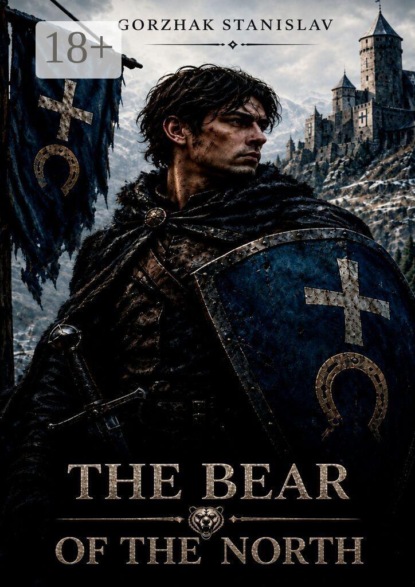
«Konrad von Waldeck’s son,» he said, studying the cross, horseshoe, and blue field on Gavel’s shield. «I’ve heard of your father. A good crusader, they say. We shall see what the son is made of.»
«I am ready to serve, my lord.»
«They all say that.»
The old knight’s smile contained no warmth.
«Readiness is proved without words.»
For the first week Gavel was assigned to mounted patrol — the dullest and, for a newcomer, one of the most useful duties: riding around the camp, checking the roads, and reporting any unfamiliar force on the horizon.
There, among cold misty mornings over the Hodkov fields, he became close to the men with whom he would share cauldrons and blankets for the coming year.
There was Indřich, a grim archer who had lost two fingers from his left hand in the previous war and, according to everyone, had become a better shot because of it.
There was Bohuslav, a young squire Gavel’s own age, cheerful beyond reason and perpetually hungry.
And there was Radek, an old sergeant and veteran of three campaigns. He alone did not seem surprised by how quickly Gavel mastered a horse and weapons.
«I’ve seen it before,» Radek said one day as he watched the young man settle a difficult horse with hardly any effort.
«Sometimes the blood knows what to do before the head has learned it.»
The first snow of war
Military campaigns of that age rarely resembled the swift tales sung by minstrels. Months disappeared into marches, camps, minor clashes over crossings and supply wagons, and only occasionally a great battle decided the fate of an entire campaign.
Hunger, disease, and cold killed as many men as an enemy blade — and sometimes more.
War met Gavel without disguise: endless autumn mud, hunger when the supply train fell a day or two behind, sleepless night marches, and fields where, after a battle, there were more crows than grass.
Von Teschen’s army moved north in late autumn, when rain had turned to wet snow and the roads had become black mire that swallowed wagon wheels almost to the hubs.
The first real clash came at a ford across a nameless stream, where an enemy party tried to intercept a supply train.
The fight was short, vicious, and chaotic — not the magnificent battle Konrad had once described beside the hearth, but a confusion of shouts, freezing water, and blows delivered almost blindly in the gathering dusk.
Gavel killed his first man that day.
It was not in a fair duel. He struck upward without looking when an enemy rider slipped on the wet stones and tried to spear him.
The man’s body was carried away by the current before the fight ended.
Gavel never saw his face.
That night Bohuslav sat beside him at the fire, unsuccessfully trying to dry the same wet footcloth over the flames.
«Hard?» he asked without looking at Gavel.
«I don’t know,» Gavel answered honestly. «I expected it to be harder.»
«Then you were lucky.»
Bohuslav shrugged with the easy indifference to death possessed only by those who had not yet met it closely.
«Maybe it will catch up with you. It happens differently to everyone.»
Many of the men who had ridden from home beside Gavel did not survive the first month. Some fell to enemy steel. Others died of fever from wounds that should have been treated but were not.
One of the two men-at-arms from Waldeck, an old cripple named Yaroslav Kulkhavy, died three weeks after the ford from a festering wound in his thigh. At first it had looked harmless. Then the flesh blackened and swelled.
Gavel spent the man’s final night beside him, listening to the fevered talk of a home and a wife who had been dead for ten years but whom the dying man called as though she were standing beside him.
The bridge at Stag Ford
It was during those first weeks, while the memory of the ford was still fresh, that Gavel learned a lesson he would later value more than any lesson in swordsmanship.
His small company — Gavel, Bohuslav, Indřich, and seven other inexperienced young men — was ordered to hold a narrow wooden bridge over a nameless tributary until the main army had passed toward a more important crossing.
The duty was supposed to be simple.
They were to remain hidden behind freshly thrown branches, let an enemy patrol pass if one appeared, and under no circumstances begin a fight without necessity.
The order came from Držimal, a seasoned soldier who rode away to inspect the neighboring post.
Gavel was left in command.
When an enemy patrol appeared on the opposite bank, Gavel felt the familiar impatience already awakening in his chest.
Six riders.
Tired.
Careless.
Clearly not expecting anyone.
Six against ten, and with the advantage of surprise from the bridge.
The superiority seemed so obvious that he could not imagine why they should not use it.
He did not think that the advantage meant one thing to him and something entirely different to the nine young men beside him, who possessed neither his strength nor his extraordinary luck.
«Now,» he said. «Before they see us. We take them before they can raise the alarm.»
Indřich hesitated. The order had clearly forbidden such a fight.
But Gavel insisted.
His recent reputation as the hero of the ford made his confidence persuasive.
The ten crossed the bridge before the patrol realized they were there.
The fight became nothing like Gavel had imagined.
The six riders were not careless travelers. They were the advance guard of a much larger force camped less than a quarter mile down the road.
The noise of the clash brought reinforcements.
The enemy soon outnumbered Gavel’s little band two to one, then three to one.
Gavel fought as he always had since the night at the ford — without feeling fatigue where any ordinary man should have felt it.
But this time his strength could not protect everyone.
Držimal returned to the post at dusk and found not a quiet bridge, but three fresh graves and a company missing three men.
He did not shout.
He simply stared at Gavel for a long time.
«You’re alive because, apparently, the Devil himself protects you, boy. They were protected only by the order you chose not to obey.»
Gavel had no answer.
Standing above the fresh earth covering Ginek, he finally understood what neither Jost’s training nor his father’s lessons had taught him completely:
The strength inside his own body was a measure for him alone.
It was not a measure for the men fighting beside him.
He could afford risks for which others paid with their lives.
That night, for the first time during the campaign, Gavel could not sleep — not because of pain or the hunger in his chest, but because of something much simpler and much more human.
Bohuslav, the only man willing to speak to him beside the dying fire, neither comforted nor blamed him.
«Držimal was only half right,» he said quietly. «It isn’t the Devil protecting you. But neither is an order the only thing protecting the rest of us.
You know something now that you didn’t know yesterday.