



- -
- 100%
- +
At the same time, in the East Slavic tradition, many elements of the ancient swastika-meander and "single-file" ornament can be traced continuously practically from the Proto-Slavic Trinecko-Komarovo culture (mid-2nd millennium BC) until the end of the 19th century, from which one can conclude that the bearers of the ancient ornamental tradition were also those groups of the East Slavic (Krivichi) population, whose settlements and burial grounds dating back to the IV-VI centuries AD, discovered in 1984-1987 by archaeologist A. N. Bashenkin (Archaeological discoveries in 1984. M. 1986. p. 4; Hills and long mounds in the east in the Novgorod land. Abstracts of the conference "History and archeology of the Novgorod lands", Novgorod. 1987. p. 12-14) in the west of the Vologda region.
Thus, we can conclude that it was on the territory of Eastern Europe among closely related tribes that the most ancient ornamental complexes were formed that remained sacred symbols of Indo-Iranian peoples, on the one hand, and did not lose their sacred functions of amulets and signs of kinship among the East Slavic peoples, up to until the beginning of the 20th century, on the other. A comprehensive consideration of the development of ornaments common to the East Slavic (North Russian) and Indo-Iranian traditions from ancient times to the present day testifies to the single, deeply archaic origins of this tradition, about the long process of development and transformation of ancient archetypes, on the joint development of more diverse, new ornamental patterns over the millennia, about the obvious genetic relationship of these peoples, since similar ornament, of course, can occur among different peoples, but it's hard to believe that the peoples not ethno-genetically related and separated by thousand kilometers distances and millennia, such complex ornamental compositions can appear completely independently of each other, repetitive even in the smallest detail, moreover, performing the same sacred functions of amulets and signs of kinship.
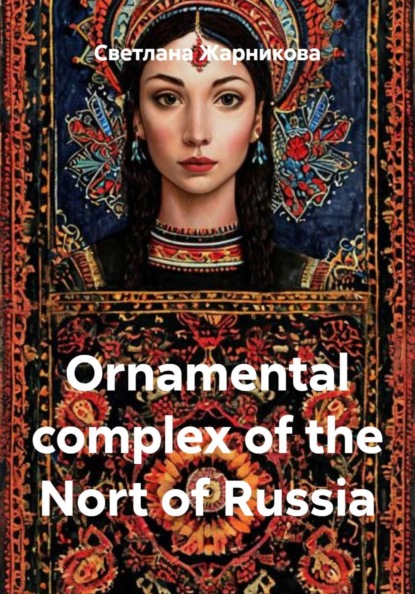
The second chapter of the dissertation is devoted to the analysis of archaic plot compositions in the North Russian textile decor, which also developed in ancient times. A number of zoomorphic, anthropomorphic, ornithomorphic and phytomorphic images, which are the components of these archaic compositions, are quite reliably deciphered on the basis of Eastern Slavic folklore to mythology preserved until the end of the 19th - beginning of the 20th centuries and on the basis of the hymns of the Rig Veda and Avesta, the poems of the Mahabharata, Beliefs of the inhabitants of mountainous Tajikistan and especially the Hindu Kush. And at the same time, some images of the Rig Veda, Avesta and Mahabharata can be deciphered with the help of Eastern European archaeological materials and archaic themes of embroidery, weaving and lace of the North Russian region.
Such is the circle of images associated with the image of a female character in North Russian embroidery, where the forthcoming (unlike the Western Asian circle of images) are not lions, bulls and goats, but moose - horses - geese - swans (or ducks).
Making the assumption that the assimilation of a horse to a bird - a duck, a goose or a swan, preserved in the Rig Veda, as well as the assimilation of a horse to a deer, can have its origins only in those territories where both deer and geese, ducks and swans had to play a huge role in the economic life of people, the author turns to the Neolithic petroglyphs of the White Sea and Onega Lake, where the leading characters are a man, a waterfowl (duck, goose, swan) and an elk. Since only in northern Europe geese, ducks and swans nested in huge numbers until the end of the 19th century, and it was here that these cautious birds, losing their plumage in the spring, became completely defenseless, they not only celebrated with their arrival and departure the arrival and departure of the warm season, but also gave people a large amount of meat food in the most difficult time of the year without food - in late winter - early spring. The sacralization of waterfowl, characteristic of the Proto-Slavic, Indo-Iranian, Scythian, Iranian, Indian and East Slavic (North Russian) traditions, probably has its origins in this ancient Neolithic northeastern European tradition. Judging by the archaeological materials of the Saka tombs of Pazyryk and the Katandkno burial mound, the origins of the contamination of the images of the horse and deer, so characteristic of the Indo-Iranian tradition and recorded in the hymn of the Rig Veda, are also associated with northern latitudes. This conclusion is made due to the fact that the images of the so-called. Horned horses in the Scythian and Saka traditions are in fact often, judging by the design of the muzzle and horns, images of elk. Referring to the idea of N. N. Marr that the first riding and draft animal was a deer, which was only much later replaced by a horse (Means of transportation, tools of self-defense and production in prehistory. L. 1926), we can conclude that this first riding of all representatives of the deer family, only an elk could be an animal in all respects. This conclusion is made in connection with the fact that, firstly, the general dimensions of all other representatives of the deer family do not give them the opportunity to be riding animals, and secondly, already on the Neolithic petroglyphs of the north of Eastern Europe there are images that can be interpreted as a moose team. In addition, modern researchers dealing with the problem of elk domestication state that in a harness and under the top, as well as in the process of domestication, an elk is preferable to a horse, because gets used to the team in 2 days and makes no attempts to hit or bite a person, and at the same time, not every horse can catch up with a running young elk. Only by the fact that the Elk preceded the Indo-Iranians as a riding animal, a horse, can one explain many of the old ways of describing the sacrificial horse in the Rig Veda, as a creature with a horned head and fallow deer hooves (RV, I, 163). In the North Russian tradition, the contamination of the images of the swan-goose and the elk-horse is constantly encountered, and these images, as in the Indo-Iranian mythological tradition, mark only the sphere of the sacred.
A similar situation is typical for the image of the mother goddess, the central character of the plot compositions of North Russian embroidery and weaving. The semantics of this image, its changes and transformations in the process of historical development are traced and disclosed by B. A. Rybakov (Paganism of the ancient Slavs. M. 1981). One of the most significant moments in the images of the East Slavic goddesses - Rozhanitsy (in their North Russian version) is that very often these images in embroidery acquire zoomorphic-phytomorphic features. So widespread is the image of Rozhanitsa, whose body is transformed into a tree, and in the decor of women's hats it is always a golden tree with golden birds - swans (ducklings) on the branches - hands. To decipher this image, the author again uses materials of Indo-Iranian mythology ("Rigveda" and "Avesta"), as well as the circle of beliefs of the inhabitants of the Hindu Kush, as it is believed, the descendants of one of the first waves of Indo-Europeans in this region (Lelekov L.A. On the symbolism of burial vestments. Scytho-Siberian world. Novosibirsk. 1987. p.23). In the hymns of the Rig Veda (V, 78), the world tree is compared with a woman giving birth or is replaced by a woman-goddess-mother, and in the pagan beliefs of the inhabitants of the Hindu Kush, the supreme female deity Dizani (Disney, Dzhestak) was considered both a huge golden tree and a female creature. Referring to the Scythian tradition, the author of this work notes that the images of the serpentine goddess, the foremother of the Scythians, associated with the "childlike symbolism", are also marked with plant motifs. Analyzing the gold embroidery of North Russian women's headdresses, the author comes to the conclusion that the figurative solution of these embroideries does not originate from the Scythian tradition, but is much more archaic and not close to the anthropomorphic appearance of the Scythian goddess - Api, but to the goddess Aditi of the Rig Veda and to kafir goddesses - patrons of childbirth and women in labor - Dazani and Nirmali, embodied in the image of a golden tree.
Analyzing the relics of the cult of the bull and cow (widespread among many Indo-European and non-Indo-European peoples) associated with the worship of the moon and waters in the Indo-Iranian mythopoetic tradition, the author finds them numerous analogies in the folklore and mythopoetic traditions of the Eastern Slavs, in particular, the North Great Russians.
In the hymns of the Rig Veda (V, 78), the world tree is compared with a woman giving birth or is replaced by a woman-goddess-mother, and in the pagan beliefs of the inhabitants of the Hindu Kush, the supreme female deity Dizani (Disney, Dzhestak) was considered both a huge golden tree and a female creature. Referring to the Scythian tradition, the author of this work notes that the images of the serpentine goddess, the foremother of the Scythians, associated with the "childlike symbolism", are also marked with plant motifs. Analyzing the gold embroidery of North Russian women's headdresses, the author comes to the conclusion that the figurative solution of these embroideries does not originate from the Scythian tradition, but is much more archaic and not close to the anthropomorphic appearance of the Scythian goddess - Api, but to the goddess Aditi of the Rig Veda and to kafir goddesses - patrons of childbirth and women in labor - Dazani and Nirmali, embodied in the image of a golden tree. From the fact that the supreme male and female deities of the Indo-Iranian pantheon are associated with cows and bulls, it is concluded that a similar situation was probably characteristic of the archaic East Slavic pantheon. This, according to the author, is evidenced by the constantly emphasized horniness in the images of the goddesses - Rozhanitsy and the fact that the traditional form of East Slavic women's headdresses to one degree or another imitates horniness. It can also be assumed that the bull-shaped male masks depicted on the North Russian old women warriors were the visible embodiment of the image of the supreme East Slavic god Rod, whose analogues are Zeus, Dionysus and, above all, the great Vedic god Rudra in a zoomorphic embodiment by bulls. In the mythology of Hinduism, the bull is also inseparable from the image of the god Shiva-Rudra. The author concludes that in the north of Russian folk embroidery, swearing weaving and lace, not only in geometric ornament, but also in plot compositions, there are many motives that are absolutely identical to those in the ancient Indo-Iranian tradition. It is using such a richest source as Russian and, in particular, North Russian folk art that many mysterious images of the hymns of the Rig Veda and Avesta can be explained. This phenomenon of absolute uniformity of the most ancient layers of mythopoetic perception of the world, which makes it possible to decipher the poetic images of Indo-Iranian mythology with the help of visible images of North Russian peasant art up to the end of the 19th - beginning of the 20th century. XX century, and vice versa, deciphering the images of peasant art, captured in North Russian embroidery, weaving and lace, with the help of the hymns of the Rig Veda and Avesta, mythological representations of mountain Tajiks and residents of the Hindu Kush, not explained by convergence alone, and even less explainable by unity economic and cultural type, can only be explained by the ancient ethnogenetic community of East Slavic in Indo-Iranian peoples.
The third chapter of this dissertation is devoted to the analysis of the archaic ornamentation of the trihedral-grooved carving, which has survived to this day among the Eastern Slavs and Indo-Iranian peoples.
The author pays the main attention to the decor of the North Russian spinning wheel, as a household item that carries a huge and versatile semantic load.
Based on the analysis of the trihedral-notched ornament of the North Russian spinning wheels, the following conclusions are drawn:
firstly, the spinning wheel was a sacred object in the East Slavic tradition, since derivative of the spinning wheel - the thread is sacred in almost all Indo-European peoples (thread of life, thread of fate, thread of thought, etc.) and this is especially clearly manifested in the hymns of the Rig Veda, which emphasizes the connection between spinning and weaving with the Creation of the Universe, the Earth and the act of conception human.
The phallic images present on the North Russian spinning wheels and carved or scratched inscriptions, which represent only one word denoting the male productive principle in the Russian profane vocabulary, indicate that the spinning wheel was probably a kind of symbol of the male principle participating in the process of spinning, similar to the act of creation life.
Second, the spinning wheel in the North Russian tradition, judging by the strictly fixed numerical ratios of the number of geometric elements (often a multiple of 7), was probably a kind of calendar, a symbol of an ordered, cyclical time.
Thirdly, the spinning wheel, closely associated with the symbolism of reproduction, fertility, should play a significant role in the worship of ancestors - the givers of fertility. In this capacity, she probably, for a long time, served as a grave monument. This is convinced by the fact that in Serbia back in the 18th century; Archbishop Pavel Nenadovich demanded that his flock put crosses on the graves instead of the spinning wheels “lifted up” according to the custom (Tolstoy N. I. About one Carpathian-South Slavic isopragma-linguistics. M. 1973). In addition, it seems that it is no coincidence that the Nuristan grave boards are completely identical in shape and decoration to the North Russian spinning wheels and seamstresses. And, finally, it is very significant that the carved trihedral-champled decor covering the entire surface of the stone gravestones of the Moscow Kremlin of the XIV-XV centuries is absolutely similar to the carved decor of the North Russian spinning wheels of the late XIX – early XX century.
Fourth, judging by the structure of the ornamental complexes of the North Russian spinning wheels, they were a kind of visible image of the Universe, the "tree of life" and embodied the idea of the first creation, or the first divine pair of the creators of the world. This finds a clear parallel in the hymns of the Rig Veda, which assert that the first creators of the world - Aditi (mother, father and son at the same time), bisexual Purusha and Rudra, consisting of two halves - male and female, are certainly associated with wood, wood, and the material of the Universe there were wood and yarn. (Mahabharata. Adiparva. M.-L. 1950. p. 53; Mahabharata, Issue V, Book I-II. Ashgabat. 1983-84; Guseva N. R. Hinduism: mythology and its roots. VI. 1973. No 3; Bongard-Levin G. M. Ancient Indian civilization. M. 1980. p. 42).
Fifthly, the author emphasizes that the traditions of trihedral-notched carving, preserved in the East Slavic area, and especially in the Russian North, up to the end of the XIX – early XX century, are just as typical for Ossetia, Armenia and Iran, as well as for the decoration of wooden products from Central Asia, especially Mountainous Tajikistan and, finally, for the Hindu Kush, Pakistan and North-West India. This fact seems to be very important due to the fact that the trihedral-notched ornamentation was, apparently, by no means a simple decor, dictated by the desire only to decorate a wooden product. The completely identical forms characteristic of the North Russian region, rich in forest, and of Central Asia (in particular the Pamirs), poor in construction wood, testify to the symbolic essence of the ornament. This is all the more obvious that in Central Asia (especially in Tajikistan) the wooden parts of the house (shutters, doors, gates, etc.) were necessarily ornamented with trihedral-notched carvings. Whereas in the rich forest of the Finno-Ugric area, such carving was completely absent (Sheleg V. A. North Russian woodcarving: areas and ethnographic traditions. Russian North. L. 1986. p. 55-60). Thus, the presence of the same attitude to the ornamentation of wood products and to the semantics of these ornaments also, in the author's opinion, testifies to the ancient community of peoples who preserve the traditions of trihedral-notched carving, and is not dictated by the presence of forests in their habitat.
In conclusion, the author, on the basis of the analysis of archaic geometric and plot ornamentation, which remained in the North Russian peasant environment until the end of the 19th - beginning of the 20th centuries, as well as existed for a long historical period among those peoples of Eurasia, whose ethnogenesis is associated with the migrations of Indo-Iranian peoples of the Eneolithic era - Bronze and Early Iron, and on the basis of modern data of paleoanthropology, paleoclimatology, archeology and history, he considers it possible to draw the following conclusions:
Firstly, on the territory of Eastern Europe, in particular the Russian North, the ornamental tradition, the origins of which lead to the Upper Paleolithic Kostenko and Mezinian cultures, has developed continuously over the millennia, transforming and changing, but retaining in the East Slavic tradition the most ancient archetypes that have developed even more than 20 millennia ago.
Secondly, the data of archeology and anthropology indicate that these ancient ornamental complexes, formed in Eastern Europe, were brought to Western Siberia, Kazakhstan, to the agricultural oases of Central Asia, to the Transcaucasus, Iran, Afghanistan and Northwestern India from steppes and forest-dampness of Eastern Europe by those agricultural and cattle-breeding, Aryan tribes, which in the II millennium BC began to advance east and southeast from their ancient ancestral home.
Thirdly, preservation in East Slavic and Indo-Iranian mythological fund of a number of absolutely identical plots, rituals and representations, a significant similarity of sacred vocabulary indicate that the addition of these mythopoetic representations and ritual-ritual practice took place in ancient times among closely related tribes living for a long historical period in neighboring interspersed, territories.
Fourthly, many complex and laborious images of ancient Indo-Iranian mythology get the possibility of a certain decipherment when correlating them with the archaeological sites of Eastern Europe of the Paleolithic-Bronze Age and Early Iron Age, as well as comparing them with the subjects of Russian, and in particular, North Russian, folk art.
Fifth, in connection with the question of the location of the ancient ancestral home of the Indo-Iranian tribes, the author turns to the hypothesis of the outstanding Indian thinker and politician Bala Gangadhar Tilak about the northern ancestral home of the Aryans. Proceeding from the fact that the texts of the "Mahabharata" and "Avesta", evidence of Scythian and ancient Greek mythology (Bongard-Levin G. M., Grantovskay E. A. From Scythia to India. M. 1983, Kuklina I. V. Ethnogeography of Scythia according to antique sources. L. 1985) place the ancestral home of the Aryans in those latitudes where the day lasts six months and the night lasts six months, the North Star and the Big Dipper are constantly high overhead, to the north lies the freezing sea, over which the aurora shines, and the main geographical landmark of this ancestral home is the Sacred Mountains, stretching from west to east and dividing rivers into flowing into the North and South Seas, the author comes to the conclusion that the only possible identification of these sacred mountains with those latitudinal uplifts in the north of Eastern Europe, which include the Subpolar Urals, Timan Ridge and Northern Uvaly. This conclusion is made on the basis of the fact that it is here that the main watershed of the rivers of the basin of the Caspian and White seas is located, and also due to the fact that it is at these latitudes that all those natural phenomena are observed on which attention is focused in the above-listed ancient sources. As one of the visual proofs, a map of Ptolemy (Rom. 1490) is given where in the north (according to the Ptolemy's grid at a latitude of 63-64 °, that is, at the latitude of the Northern Urals) mountains called Hyperborean and having a latitudinal orientation are placed. It is from these mountains, according to Ptolemy, that the Volga originates, called by the ancient Avestan name RHA, what can be considered true, so the ancients did not know the true source of the Volga, and such large tributaries as the Kama, Vyatka, Vetluga, Unzha, Kostroma and Sheksna really originate from the Northern Uvals. The author of this work notes that it is in the watershed and at present that very interesting from the point of view of the possibility of comparison are widespread their toponyms and hydronyms with Indo-Iranian vocabulary.
Sixth, modern anthropological data play a huge role in resolving the issue of the ancient population of the European north of our country, which indicates that a certain flattening of the face, characteristic of the ancient population of the north of Eastern Europe, noted on the skulls of the Oleneostrovsky Mesolithic burial ground and traditionally associated with the arrival of of this population because of the Urals "from the territories of the Finno-Ugric peoples, can be explained not by the Uralic origin, not by the mixing of Caucasians with Mongoloids, but by the mixing of northern Caucasians with southern ones (Gokhman I. I. Anthropological features of the ancient population of the north of the European part of the USSR and the way their education.Anthropology of the modern and ancient population of the European part of the USSR. L. 1986). This anthropological type was widespread in the Mesolithic of Eastern Europe and was identified in Ukraine, on the shores of the Sea of Azov, the Mesolithic of Yugoslavia, the Neolithic and Eneolithic of Czechoslovakia. In the Mesolithic period, traces of population migration from the Ural regions to the territory of the north of Eastern Europe "were not found" (Oshibkina S. V. Mesolithic Sukhona and Eastern Prionezhie. M. 1983. p. 284). But since during this period the racial trunks were already formed (Gokhman I. I. 1986), and the peoples of the Ural family developed that special, specifically "Yukaghir" Mongoloid, which A. G. Kozintsev considers to be inherent in one way or another to all peoples of this language family (Cranioscopy and racial classification. SE. 1987. p. 2), then the migration to the north of Eastern Europe of a significant amount of the Ural population in the subsequent Neolithic-Bronze Age seems unlikely. Such a resettlement of the carriers of "Yukaghir" Mongoloidism would have left a noticeable mark on the anthropology of the inhabitants of the Russian North. However, V. P. Alekseev considers the anthropological characteristics of the population of the Vologda, Kostroma, Yaroslavl and Tver provinces to be close to those found in the medieval population of Ukraine and, in particular, near the glades in the middle reaches of the Dnieper (Alekseev V. P. Anthropology of the European part of the USSR. M. 1981), and T. I. Alekseeva came to the conclusion that: “The glades are, apparently, the only group of Slavs in which the anthropological features of the Scythians of the forest belt is manifested” (Alekseeva T. I. Slavs and Germans in the light of anthropological data. VI. 1974. No. 3, p. 62).
Thus, the population of the Yaroslavl, Kostroma, Tver, Novgorod and Vologda provinces, having anthropological characteristics close to the early medieval Slavic tribe of Polyans, to a certain extent retained the "anthropological features of the Scythians of the forest belt." In the light of all of the above, the thesis of Slavic assimilation in the 1st millennium A.D. significant substratum Finno-Ugric population of the North of Eastern Europe seems unsubstantiated. Seventh, on the basis of modern data of anthropology, archeology, linguistics, as well as on the basis of materials from such a source that has preserved an exceptional archaism as Russian folk culture and, in particular, North Russian peasant art, we can conclude that, probably, the territories of the North East Europe was inhabited by Indo-European tribes in the deepest antiquity, since the lands east of Onega and White lakes were not subjected to the last (Valdai) glaciation, significant migrations of the population from beyond the Urals during the Paleolithic-Bronze period to these territories were not, and the most ancient human sites here belong to the Middle and Upper Paleolithic, and in recent years, a significant number of sites of the Mesolithic, Neolithic and Bronze Age have been found.