

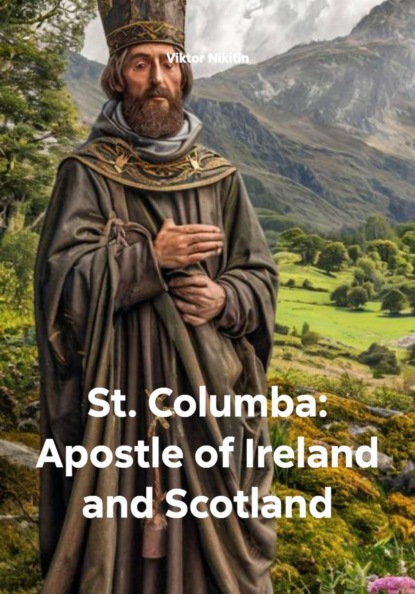
St. Columba: Apostle of Ireland and Scotland




- -
- 100%
- +

Long before the gentle hues of dawn brushed across the hills and glens of early sixth-century Ireland, long before the first cry of the newborn echoed through the humble cottage of noble parents, a divine story was already unfolding, woven of prophecy, bloodline, and celestial purpose. This was the tale of a child destined to become Columba, the “Dove of the Church,” whose name would be whispered with reverence not only in his native land but on distant shores where his faith and courage would plant enduring seeds. To fully grasp the significance of this saint’s life, one must step beyond the simple facts of birth and heritage and enter a world alive with sacred expectation, mystical vision, and the silent stirring of grace preparing a soul for greatness.
Ireland at this time was a land balanced between two worlds. The old gods and the old ways still clung stubbornly to the forests and hilltops, their power felt in the ancient stones, in the songs of wandering bards, and in the whispered fears of superstitious hearts. Yet across this land a new light was breaking, brought by missionaries and saints who carried the message of Christ—light that promised hope, transformation, and eternal life. The year was 521, a year shadowed by the recent passing of one of Ireland’s greatest lights: St. Brigid of Kildare. Her flame, brilliant and enduring, had kindled the Irish Church with warmth and zeal, and even as her earthly lamp was extinguished, her spirit lingered like a soft ember, waiting for a fresh spark to ignite it anew. That spark was to be Columba.
The boy’s lineage was no mere backdrop to his story—it was the living soil from which his destiny would spring. His father, Mancanava, was a prince, born into the royal house of Uí Néill, a dynasty whose power shaped the political and spiritual contours of northern Ireland. These were men who commanded armies and held sway over kingdoms, men whose blood carried the weight of kingship and responsibility. Mancanava’s house was steeped in tradition, pride, and the fierce loyalties of clan and kin. Yet alongside this worldly power, there beat a heart devoted to God, longing for a son who might bring something higher than earthly crown or sword. On his mother’s side, Aethena came from noble Leinster stock, a family closely linked to Caithir, the High King of Ireland, whose reign held the island in uneasy peace. Through her, Columba inherited not only noble blood but the expectation of leadership and influence, a heritage both honor-bound and heavy.
But this child’s story was not destined to be merely one of noble lineage and worldly power. Even before his first breath, the heavens had marked him with signs unmistakable to those who looked for God’s hand in the affairs of men. One night, as Aethena lay resting beneath a sky heavy with stars, a vision came to her, vivid and charged with heavenly light. An angel appeared—radiant, calm, a being of ineffable beauty—holding in his hands a robe unlike any earthly fabric. The garment shimmered with colors beyond the spectrum of human eyes, woven not by loom but by the very light of God’s glory. Gently, the angel draped the robe upon Aethena’s shoulders, bestowing it as a precious gift, a mantle of blessing and promise. Yet, as suddenly as it had been given, the angel withdrew the robe and lifted it into the air, releasing it to the night. The garment rose like a great bird, soaring higher and higher, spreading its vast wings until it covered hills, forests, rivers, and distant plains—a cloak wide enough to shelter entire nations beneath its celestial breadth. The vision filled Aethena with awe and sorrow. “Why must this treasure be taken from me?” she asked, her voice trembling with wonder and grief. The angel’s answer was simple and profound: “It cannot remain with you.” Then a voice, soft yet commanding, filled the air around her: “Woman, do not grieve. You shall bear a son who will lead countless souls to heaven and be numbered among the prophets of the Most High.” These words wrapped around her soul like a holy promise, an unbreakable covenant that this child, growing within her, was destined for a purpose far beyond the reach of kings or warriors.
When the moment of birth came, the household was filled not with the boisterous cries of a typical infant but with a hushed reverence. Columba’s entrance into the world was like the gentle settling of a light that would never be extinguished. His parents, devout and mindful of the angelic message, entrusted him from his earliest days to the care of the priest who baptized him, a man who would become a steadfast spiritual guide and protector. Unlike other children, who filled their days with noise, play, and restlessness, Columba was quiet, deliberate, and still. His eyes held a depth and seriousness far beyond his years, as though they were already searching the heavens for the voice of God. To those around him, his presence radiated a calm purity, a sense of a soul walking already on the path to holiness. His earliest biographer, Adamnán, would later describe him as a child who practiced acts of piety appropriate to his age with such earnest devotion that he seemed more prepared for heaven than for the challenges of earthly life.
This holiness was not hidden in secret but revealed to those who watched him closely. One evening, the priest Cruthenan returned from his duties at the church to find an extraordinary sight. A soft, steady white light glowed from within Columba’s modest dwelling. Concerned that a fire might have broken out, he hurried inside, only to see a gentle flame hovering peacefully over the boy’s head. This light did not burn, flicker, or consume; it shone like a serene halo, a visible sign that God’s favor and presence rested upon the child in a way rare and profound. Overcome with awe and certainty, the priest sank to his knees, recognizing that here was one marked by heaven for a great and holy destiny.
As the years passed, Columba’s love for Scripture and God’s Word blossomed naturally and deeply. One Christmas, he accompanied his teacher to a feast in Rathenaigh, where Bishop Brugacius presided. While the hall filled with the sounds of celebration, Columba’s voice rose clear and strong as he recited the Psalms alongside the bishop. His memorization, confidence, and devotion astonished all who heard him, marking him as a child intimately connected to the divine Word and ready to carry it forth.
Recognizing his exceptional gifts and holiness, his mentors sent him to the renowned monastic school of Moville, led by St. Finnian. Finnian’s reputation for wisdom and sanctity was renowned far beyond Ireland, for he had traveled extensively, learning from scholars in Britain and bringing back a passion for study and prayer that inspired all who came to him. Moville was more than a school; it was a spiritual community where Scripture was studied with reverence, and where the disciplines of prayer, fasting, and asceticism forged men into servants of God. Among this company of students, Columba stood out—not just for his sharp intellect and rapid mastery of texts but for the purity of his heart and the burning zeal with which he pursued holiness. It was this combination of mind and spirit that made him beloved by teachers and peers alike.
His ordination as a deacon marked both a milestone and a new chapter in his life. Soon after, a remarkable event occurred that would become one of the cherished stories of his youth. As the monks prepared to celebrate the Holy Eucharist, they discovered that their supply of wine had run out—a serious crisis for the sacred rite. Calm and trusting, Columba took an empty vessel to a nearby spring and prayed with unwavering faith, calling upon God’s mercy and power. Miraculously, the clear water before him shimmered and transformed into rich, fragrant wine, sufficient to meet the community’s needs. Filled with joy and awe, Columba returned to the monastery and announced the miracle, which was received with reverent astonishment and deep gratitude. It was a visible sign that the young deacon walked closely with God.
Yet Columba’s thirst for wisdom and holiness could not be quenched. Seeking to deepen his formation, he placed himself under the guidance of Germanus, a scholar newly arrived in Ireland whose learning and holiness were quickly acclaimed. Germanus soon realized that Columba was no ordinary pupil. On one occasion, Columba shared a prophecy regarding the judgment about to fall on a wicked man—a prophecy that came true exactly as foretold. This confirmation of divine insight further revealed the extraordinary destiny God had set before him.
Thus, from the nobility of his birth to the visions that marked his mother, from a childhood radiant with holiness to the miracles that confirmed God’s favor, the life of Columba was steadily unfolding as part of a grand divine plan. He was a flame meant to illuminate not only Ireland but faraway lands, a shepherd chosen to lead countless souls toward the light of Christ. Though his journey had only begun, the signs were unmistakable: this boy, nurtured by grace, wisdom, and holy purpose, was destined to become one of the Church’s most enduring saints.
* * *
By the time Columba reached his twenty-fifth year, the quiet certainty that had shaped his youth blossomed into an unshakable resolve. The fire within him, kindled long ago by visions and holy teaching, now burned with a steady, fierce intensity. The boy who once whispered Psalms in a bishop’s hall had grown into a man whose heart beat for more than personal sanctity or local renown. Ireland, his homeland, was alive with monastic fervor—the emerald hills dotted with cloisters where prayer and study were pursued with devotion. Yet to Columba’s discerning gaze, the spiritual map was incomplete. Many lands still lay untouched by the light of the Gospel; many tribes and communities wandered in shadow, lacking the shelter and guidance of a holy place. He saw the urgent need for sanctuaries of faith to spring up like a network of shining beacons across the island—a sacred weave of monasteries where Scripture would be preserved, prayers would rise unceasing, and souls would be nurtured in the ways of Christ.
Конец ознакомительного фрагмента.
Текст предоставлен ООО «Литрес».
Прочитайте эту книгу целиком, купив полную легальную версию на Литрес.
Безопасно оплатить книгу можно банковской картой Visa, MasterCard, Maestro, со счета мобильного телефона, с платежного терминала, в салоне МТС или Связной, через PayPal, WebMoney, Яндекс.Деньги, QIWI Кошелек, бонусными картами или другим удобным Вам способом.