

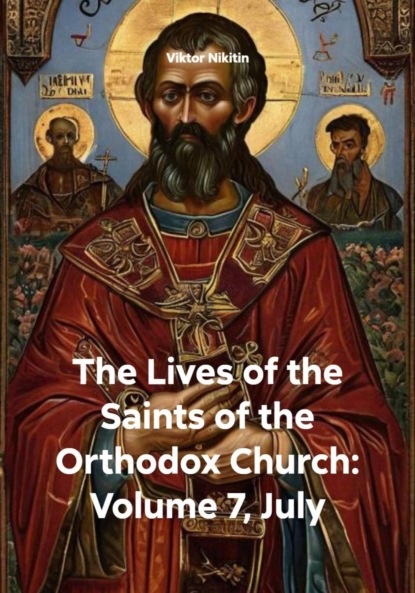
The Lives of the Saints of the Orthodox Church: Volume 7, July




- -
- 100%
- +
Saint Eudocia, in monasticism Euphrosyne, Grand-Duchess of Moscow:
Born into the princely family of Moscow, Eudocia chose a life of profound Christian devotion from an early age. Married to the Grand Duke of Moscow, she supported his reign with prayer and counsel but was never swayed by worldly power or luxury. After the death of her husband, she embraced monasticism, taking the name Euphrosyne and withdrawing into a convent. In monastic life, she became renowned for her humility, deep prayer, and acts of charity, dedicating herself to helping the poor and sick during turbulent political times. Euphrosyne also contributed to the establishment and support of monastic institutions and churches, fostering spiritual renewal in Moscow. Her life stands as a powerful example of sanctity expressed in royal humility and monastic dedication.
Hieromartyr Eustace:
Eustace was a priest who served the Christian community faithfully during periods of persecution. Known for his pastoral zeal and courage, he continued to preach the Gospel and administer sacraments despite the threat of arrest. When imperial authorities intensified their crackdown on Christians, Eustace was arrested for openly confessing his faith. Subjected to brutal tortures designed to force him into apostasy, he remained steadfast, ultimately offering his life as a hieromartyr. His witness underscores the critical role of the clergy as spiritual leaders who sacrifice alongside their flocks.
Martyr Polycarp the New:
Distinct from the early Church Father Polycarp of Smyrna, Polycarp the New was a later martyr whose life reflects the continuing persecution faced by Christians. Known in local tradition as a man of deep faith and piety, Polycarp refused to bow to pagan idols or abandon the Christian confession when faced with threats and imprisonment. His martyrdom, though less widely chronicled, remains an important symbol of the perseverance of the Christian faith across generations. Polycarp the New's steadfastness encourages believers to maintain their witness in hostile environments.
Saint Illtyd, Founder of Llantwit Abbey in Wales:
Saint Illtyd was a major figure in the Christianization of Wales during the 5th and 6th centuries. Born into a noble family, he renounced worldly privileges to embrace monasticism and scholarship. He founded the monastery and school at Llantwit Major (Llanilltud Fawr), which became one of the first centers of learning in Britain. Illtyd’s school trained many future saints, clergy, and scholars, playing a pivotal role in spreading Christian faith and culture. His life was marked by ascetic discipline, teaching, and missionary zeal, and his legacy influenced the Celtic Christian tradition deeply.
Saint Hedda, Bishop of Winchester:
Saint Hedda, also known as Headda, was a monk before becoming bishop of Winchester in the 8th century. His episcopacy was characterized by pastoral diligence and ecclesiastical reform during a period of political complexity in Anglo-Saxon England. He is remembered for his dedication to prayer, liturgical life, and strengthening the Christian community in his diocese. Though his tenure as bishop was relatively brief, his leadership helped ensure the growth and stability of the Church in southern England.
Saint Willibald, Bishop of Eichstatt:
Born into an Anglo-Saxon noble family around 700 AD, Willibald embarked on a pilgrimage to the Holy Land and other sacred sites, enduring many hardships. Upon returning to Europe, he was consecrated the first bishop of Eichstatt in Bavaria. Willibald devoted himself to missionary work, founding churches and monasteries, and converting local pagan populations. His life combined monastic piety with episcopal responsibility, contributing significantly to the Christianization of Germany. His pilgrimage account, written by his sister Saint Walpurga, preserves the memory of his zeal and sanctity.
Saint Sunniva and Companions:
Sunniva was an Irish princess who fled her homeland to avoid a forced pagan marriage. She and her companions sought refuge on the island of Selja in Norway, where they lived as hermits, dedicating themselves to prayer and asceticism. When local pagans threatened them, Sunniva and her followers chose martyrdom rather than renounce their faith. According to legend, their deaths were miraculous, and their remains were venerated as holy relics. Sunniva became the patron saint of Western Norway, symbolizing the courageous spread of Christianity into Scandinavia.
Saint Boisil, Abbot of Melrose:
Boisil was a 7th-century abbot of Melrose Abbey in Northumbria, England, renowned for his gentle spirit and prophetic insight. He was a spiritual mentor to Saint Cuthbert, guiding him in ascetic discipline, prayer, and the monastic life. Boisil was known for his healing abilities and his role as a pastoral leader in a formative period for English Christianity. His teachings and holiness helped lay the foundations for monasticism in northern England.
Saint Ethelburga, Abbess of Faremoutier:
Ethelburga was a noblewoman who embraced the monastic life, becoming abbess of the influential monastery of Faremoutier in what is now France. She was known for her strict observance of monastic discipline, her administrative talents, and her dedication to education and charity. Under her leadership, the monastery thrived as a spiritual and cultural center during a time when Western Europe was experiencing political fragmentation. Her example contributed to the survival and flourishing of monastic traditions in early medieval Europe.
Saint Palladios, Bishop of Ireland and Scotland:
Saint Palladios was a missionary bishop active in Ireland and Scotland during the 6th century, possibly sent from continental Europe as part of the early Christian missionary efforts. He helped establish churches and monastic communities, working in regions still largely pagan. His ministry laid important groundwork for the flourishing of Celtic Christianity and was instrumental in connecting the British Isles with broader Christian traditions.
Saint Maelruain, Abbot of Tallaght:
Maelruain was an 8th-century Irish abbot who founded the monastery of Tallaght near Dublin, an important center for monastic learning and spiritual renewal. Known for his strict adherence to monastic rules, scholarly pursuits, and pastoral care, Maelruain played a key role in shaping Irish monastic spirituality. His leadership attracted many disciples, and the *Tallaght Memoir*, associated with him, reflects the depth of ascetic practice and theological reflection characteristic of Irish monasticism in this era.
Конец ознакомительного фрагмента.
Текст предоставлен ООО «Литрес».
Прочитайте эту книгу целиком, купив полную легальную версию на Литрес.
Безопасно оплатить книгу можно банковской картой Visa, MasterCard, Maestro, со счета мобильного телефона, с платежного терминала, в салоне МТС или Связной, через PayPal, WebMoney, Яндекс.Деньги, QIWI Кошелек, бонусными картами или другим удобным Вам способом.