

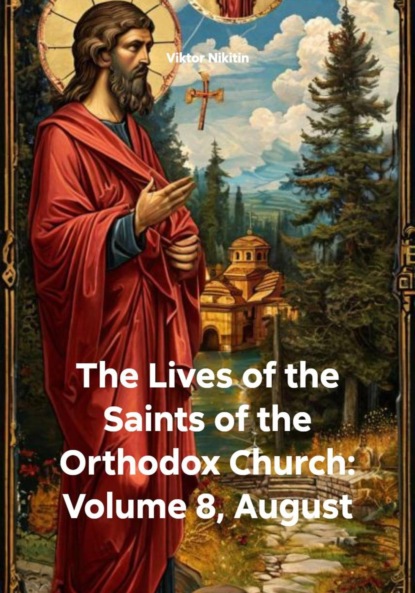
The Lives of the Saints of the Orthodox Church: Volume 8, August

- -
- 100%
- +
Martyr Oswald, King of Northumbria:
Oswald was a 7th-century king of Northumbria whose reign marked a turning point in the Christianization of England. Having spent his youth in exile among the Christian Scots of Dalriada, he returned to reclaim his throne with a firm commitment to establish Christianity in his kingdom. He invited missionaries such as Saint Aidan to spread the Gospel, founded churches, and supported monasteries, thereby fostering a revival of Christian faith and culture. Oswald was renowned not only for his military leadership but for his personal piety, often seen as a warrior-king who fought for the faith. In 642, he was killed in battle against pagan forces, but his death was regarded as martyrdom since he died defending and promoting Christianity. Miracles were reported at his grave, and he was venerated as a saint and protector of England. His legacy endures as a model of a ruler who placed faith above politics.
Venerable Job of Ushchelsk:
Venerable Job was a medieval Russian monk who lived in the monastic community of Ushchelsk. He was celebrated for his austere asceticism, humility, and deep prayer life. Known for fasting rigorously and engaging in constant prayer, Job became a spiritual father to many monks and laypeople. His holiness was accompanied by miracles, including healing and protection of the monastic community from natural disasters and enemies. Job’s teachings emphasized repentance and trusting in God’s mercy, and he was sought after for counsel. His death was mourned deeply by the faithful, who continued to honor him as a wonderworker and intercessor. He is remembered as an example of Russian monastic piety and spiritual strength.
Saint Theoctistus, Bishop of Chernigov:
Saint Theoctistus served as bishop in the medieval city of Chernigov, a vital center of Christian life in Kievan Rus'. He was known for his wisdom, pastoral care, and dedication to the spiritual and material welfare of his flock. During his episcopate, Theoctistus undertook the construction of churches and monasteries, encouraging monasticism and liturgical life. He was deeply concerned with combating pagan practices and heresies, tirelessly teaching the faithful in the Orthodox faith. His humility and gentleness endeared him to all, and his miracles after death further confirmed his sanctity. Theoctistus’ legacy contributed to strengthening Orthodoxy in northeastern Rus' and nurturing Christian culture.
Saint Eugene of Aitola:
Saint Eugene was an ascetic and wonderworker who lived in the region of Aitola. Renowned for his deep spirituality and gift of healing, Eugene dedicated himself to a life of prayer, solitude, and service. Despite living in relative obscurity, his holiness became widely known through miracles of healing and prophecy. Eugene often cared for the sick and poor, embodying Christ’s compassion. His spiritual guidance attracted many disciples, whom he taught humility, repentance, and the love of God. His life stands as a testament to the power of quiet sanctity and the fruits of sincere devotion.
New-Martyr Habakkuk of Thessaloniki:
Habakkuk lived during the period of Ottoman rule over Greece, a time when Christians were frequently pressured to convert to Islam or face severe penalties. A devout believer, Habakkuk openly confessed Christ and refused to abandon his faith. Arrested and imprisoned, he endured harsh treatment intended to force his apostasy. Habakkuk’s courage and steadfastness made a profound impression on both fellow prisoners and guards. After a prolonged period of suffering, he was executed for his faith, thus joining the ranks of new martyrs who bore witness to Christ in difficult times. His martyrdom encouraged the Greek Orthodox faithful to remain firm despite persecution.
Blessed John the Romanian:
John the Romanian was a recent holy fool and ascetic known for his radical humility and spiritual insight. Living a life of poverty and voluntary simplicity, he often behaved in ways that confounded worldly wisdom but concealed profound spiritual teachings. John’s prayers and blessings were credited with many miracles, healing the sick and bringing peace to troubled souls. He spent much time in solitude and prayer, interceding for all who sought him. Despite his apparent folly, John was widely respected for his holiness and was a living example of the Gospel’s call to humility and trust in God’s providence.
Martyrs Afra, Eunomia, Digna, and Eutropia, of Augsburg:
These four holy women were among the early Christian martyrs in the Roman province of Germania. Afra, once a pagan and temple servant, converted to Christianity and dedicated her life to Christ, bringing with her Eunomia, Digna, and Eutropia. Together they formed a close-knit community of believers who offered refuge to persecuted Christians. When discovered, they were arrested and subjected to brutal tortures designed to force them to renounce their faith. Each of them endured these trials with remarkable courage and remained firm in their confession. They were executed, becoming martyrs whose sacrifice inspired the spread of Christianity in the region. Their steadfastness remains a powerful testament to faith overcoming fear.
Saint Gormgalios, Abbot of Ardoilen:
Saint Gormgalios was an Irish monastic leader famed for his strict discipline and spiritual wisdom at the monastery of Ardoilen. His life was marked by ascetic rigor, deep prayer, and zealous care for the monks under his guidance. Gormgalios emphasized charity, humility, and obedience, qualities he embodied himself. His leadership brought peace and spiritual growth to the monastic community, and he was known for prophetic gifts and miracles. After his repose, many sought his intercession, and his example influenced the flourishing of Irish monastic spirituality throughout the region.
* * *
Lives of the Saints Celebrated on August 6
Saint Theoctistus, Bishop of Chernigov:
Saint Theoctistus shepherded the Diocese of Chernigov during a difficult era marked by social unrest and external threats, yet his leadership strengthened the Orthodox Church’s presence in the region. A man of profound faith and learning, he was known for his eloquent sermons, compassionate pastoral care, and dedication to liturgical life. He worked tirelessly to build and restore churches, establishing monastic communities that became spiritual centers for the faithful. Saint Theoctistus was also revered for performing miracles, including healings and deliverances, which affirmed his sanctity among the people. His commitment to preserving Orthodox doctrine amidst heretical influences won him respect and admiration. Upon his repose, many mourned his loss, but his legacy endured through the monasteries and faithful communities he nurtured, inspiring continued growth of Orthodoxy in northern Rus’.
Saint Job the Gorge-dweller on the Mezen River (Solovki):
Saint Job chose the harsh wilderness of the Mezen River’s gorges for his ascetic struggles, embracing extreme isolation to cultivate the purity of heart and mind. His life was marked by relentless fasting, prayer, and vigils, setting an example of total detachment from worldly concerns. Despite his solitude, many pilgrims sought him out, drawn by tales of his wisdom and the spiritual gifts he possessed, such as clairvoyance and healing. Saint Job’s hermitage became a beacon for those yearning for a deeper communion with God, and his guidance helped shape the spiritual ethos of the Solovki monastic tradition. His profound humility made him reluctant to accept any honor, yet God’s grace shone through him, bringing blessings upon the land and the people. His repose was peaceful, and his memory continues to inspire ascetics and monastics who seek the radical path of spiritual purification through solitude and prayer.
New-Martyrs Dimitry, Archbishop of Gdov, and Priest Nicholas (Prozorov):
Archbishop Dimitry and Priest Nicholas lived in a time of severe persecution when the Russian Orthodox Church faced brutal suppression by the Soviet regime. Archbishop Dimitry, known for his pastoral zeal and unwavering defense of Orthodoxy, shepherded his flock despite constant surveillance and harassment. Priest Nicholas, a devoted and courageous clergyman, assisted him faithfully, ministering to the spiritual needs of the faithful with courage and compassion. Both were arrested on false charges related to their faith and leadership. Enduring horrific tortures and imprisonment, they remained steadfast in their confession of Christ. Their martyrdom came as a result of their refusal to renounce their sacred duties or betray their spiritual heritage. Their deaths became a powerful testimony to the endurance of faith under persecution, inspiring countless believers in the darkest days of Soviet oppression. They are commemorated as modern martyrs whose lives affirm the victory of the Church even in times of suffering and trial.
Martyr-Priest Maxim Sandovich of Carpatho-Russia, by the Latins:
Priest Maxim Sandovich served the faithful of Carpatho-Russia during a time of intense religious and political strife, marked by efforts to suppress the Orthodox faith and impose Latin Catholic influence. Educated, articulate, and deeply committed to his ministry, Maxim courageously preached the Orthodox faith and provided pastoral care, strengthening his community’s spiritual identity. His missionary work included educating the faithful about their traditions and defending their right to worship freely. The Latin authorities, perceiving his efforts as a threat, persecuted him relentlessly. He was eventually captured, subjected to cruel torture, and executed for his unyielding stand for Orthodoxy. His martyrdom became a symbol of resistance to forced religious assimilation and a rallying point for Carpatho-Russian believers. Saint Maxim’s steadfast faith and pastoral zeal continue to inspire Orthodox Christians facing challenges to their religious freedom.
Saint Hardulph, Hermit of Breedon:
Saint Hardulph’s life as a hermit in the rugged landscape of Breedon was characterized by simplicity, austerity, and constant prayer. Choosing to withdraw from the distractions of the world, he sought a life wholly dedicated to God through solitude. His hermitage became a place of spiritual refuge and a source of blessing for the local community. Though living in near-complete isolation, Saint Hardulph was renowned for his wisdom, holiness, and humility. His example of asceticism attracted disciples who sought to learn the art of spiritual warfare and contemplation from him. Stories of his miracles and intercessions circulated widely, further elevating his reputation as a holy man. After his repose, his hermitage grew in significance, eventually becoming a site of pilgrimage and veneration. Saint Hardulph’s memory endures as a powerful witness to the transforming power of prayerful solitude and renunciation of worldly attachments.
The repose of Hieroschemamonk Nikon the Cave-dweller of Valaam:
It marked the passing of a monk whose life was dedicated to unceasing prayer and extreme asceticism in the caves near Valaam Monastery. Known for his profound spiritual insight and humility, Nikon was a spiritual father to many, guiding them on the path of repentance and holiness. His life inspired a renewal of monastic fervor on Valaam Island.
The repose of Righteous Priest Basil (Shoustin):
A cherished disciple of the Optina Elders, who exemplified the teachings of hesychasm and pastoral care. Priest Basil’s humility, wisdom, and dedication to the confessional ministry strengthened the spiritual lives of countless faithful during a turbulent period for the Russian Church.
* * *
Lives of the Saints Celebrated on August 7
Martyr Dometius of Persia and Two Disciples:
Martyr Dometius lived during a time when the Persian Empire was hostile to Christianity, enforcing cruel persecutions against believers. A fervent disciple of Christ, Dometius devoted his life to preaching the Gospel and encouraging fellow Christians to remain steadfast. Alongside him were two devoted disciples who shared his zeal and faith. When the authorities demanded they renounce Christ and sacrifice to pagan gods, all three refused resolutely. Subjected to relentless tortures – including scourging, imprisonment, and deprivation – their faith remained unshaken. Their courage inspired many to strengthen their belief, even under threat of death. Finally, they were condemned to die by the sword. Their martyrdom left a profound legacy, demonstrating the power of unwavering faith and the strength found in Christian fellowship during persecution.
Martyrs Marinus the Soldier and Asterius the Senator at Caesaria in Palestine:
Marinus was a soldier known for his bravery and loyalty, while Asterius was a senator esteemed for his wisdom and nobility. Despite their different social standings, both men were united by a fervent Christian faith. In Caesaria, during the imperial crackdown on Christians, Marinus and Asterius openly refused to abandon their faith. Marinus, accustomed to battlefields, faced the tortures with courage, while Asterius used his eloquence to defend the faith before the magistrates. Their trials were lengthy and harsh, involving imprisonment, beatings, and mockery. Both remained steadfast, inspiring other prisoners and even some pagans who witnessed their conviction. They were ultimately executed, their blood a testament to the triumph of faith over worldly power and the high price of discipleship.
Saint Poemen (Pimen) the Much-ailing of the Kiev Caves:
Saint Poemen was a monk known far and wide not only for his holiness but also for the many illnesses he bore throughout his life. His sufferings, which could have made him bitter or despairing, instead became a source of grace and patience. The brethren admired his serene spirit and steadfast trust in God amid trials. Poemen’s life teaches that physical weakness does not hinder spiritual strength, and often, the more one suffers bodily, the more one grows in grace. His humility and gentleness made him a spiritual father to many, and his prayers were considered powerful, often invoking miraculous healings. His legacy remains a beacon for those who suffer, encouraging endurance and deep faith.
Saint Hor (Horus) of the Thebaid, in Egypt:
Saint Horus is one of the great desert fathers whose life epitomizes the ascetic ideal of the early Christian monastic tradition in Egypt. Living in the harsh deserts of Thebaid, he withdrew from the distractions and temptations of the world to seek God in solitude. His days were marked by rigorous fasting, continuous prayer, and spiritual warfare against demonic attacks. Horus was known for his wisdom and spiritual insight, often consulted by other monks who sought his guidance. His struggles and victories over the passions were recorded and have inspired generations of monks and ascetics. He also practiced hospitality to wandering pilgrims, showing charity even while living a solitary life. His life exemplifies the transformative power of desert asceticism and the pursuit of holiness through renunciation.
Saint Pimen, Faster of the Kiev Caves:
Saint Pimen was distinguished by his extraordinary discipline in fasting, using this ascetic practice as a means of spiritual purification. Living in the Kiev Caves, a renowned center of Orthodox monasticism, he combined rigorous bodily discipline with profound humility and prayerfulness. His fasts were sometimes extreme, but always balanced by deep love for God and neighbor. Pimen’s fasting was not for self-glorification but a method of mortifying the flesh to elevate the soul toward God. He was also a gifted spiritual counselor, guiding many monks and laypeople on the path of repentance. His example demonstrates the integral role of fasting in Orthodox spirituality and the way asceticism can deepen one’s communion with God.
Virgin-Martyr Potamia the Wonder-worker:
Potamia was a young woman who consecrated her virginity to Christ, living a life of prayer and service in her community. She was renowned for her deep compassion and miracles attributed to her intercessions even before her death. During a wave of persecutions, Potamia was arrested for her faith and steadfastly refused to renounce Christ, despite the pleas and threats of the persecutors. Her torture was severe: she was scourged, imprisoned, and subjected to harsh conditions, yet her spirit remained unbroken. She was eventually martyred, her death witnessed by many who were moved by her courage and holiness. After her passing, miracles multiplied at her tomb, confirming her sanctity. Potamia is remembered as a model of purity, fearless faith, and divine power working through a humble servant.
Saint Dometius of Philotheou Monastery on Mount Athos:
Saint Dometius was a monk who lived at the Philotheou Monastery on the sacred Mount Athos. His life was marked by extreme humility and dedication to the monastic rule. He was known for his constant prayer and ascetic struggles, often fasting and spending entire nights in vigil. Despite his rigorous life, he was gentle and compassionate toward his brethren, always ready to lend a listening ear or comforting word. Dometius’s holiness was evident in his spiritual gifts, including healing and clairvoyance, which he used discreetly to assist others. He was a spiritual father to many monks and laypeople, encouraging repentance, humility, and the pursuit of divine love. His life serves as a timeless example of monastic devotion on Mount Athos.
Saint Mercurius, Bishop of Smolensk (Kiev Caves):
Saint Mercurius was a bishop known for his pastoral zeal and strong defense of Orthodox doctrine. He was also a monk of the Kiev Caves, where he had been formed in the ascetic tradition. As Bishop of Smolensk, he faced numerous challenges, including heresies and external threats to the Church. Mercurius responded with steadfast faith, wisdom, and a tireless commitment to pastoral care. He was known for his generosity to the poor and his zeal for missionary work in his diocese. Many miracles were attributed to his prayers, both during his life and after his repose. His episcopate strengthened Orthodoxy in his region and left a lasting spiritual legacy.
Elder Anthony of Optina:
Elder Anthony of Optina was one of the most renowned spiritual fathers of 19th-century Russia. He was a humble monk whose wisdom and deep spirituality attracted people from all walks of life. Known for his gift of spiritual discernment and prayer, he guided countless souls toward repentance and healing. Anthony was deeply immersed in the hesychastic tradition, practicing continual prayer and humility. His life was marked by miracles, prophetic insights, and extraordinary compassion for the suffering. The Elder’s teachings and letters continue to inspire Orthodox Christians worldwide. His legacy is one of grace, wisdom, and loving guidance, showing the transformative power of monastic holiness.
Holy Ten Thousand Ascetics of Thebes:
The Holy Ten Thousand Ascetics were a large assembly of monks who inhabited the deserts around Thebes in Egypt, forming a great spiritual army committed to asceticism and prayer. This community embodied the spirit of the Desert Fathers, devoting their lives to fasting, vigils, and spiritual combat against evil. They lived in small cells or caves but remained united in their common purpose. Their collective prayers and sacrifices were believed to protect the surrounding regions from demonic influence and calamity. The legacy of these ascetics is a powerful testimony to the strength and vitality of monastic communities in early Christianity and their role as spiritual guardians of the Church.
Hieromartyr Narcissus, Patriarch of Jerusalem:
Hieromartyr Narcissus was a holy patriarch who led the Church of Jerusalem during a perilous time of persecution. Renowned for his pastoral care and eloquence, he bravely confronted pagan authorities and heretics alike. Narcissus’s leadership was marked by deep humility, love for his flock, and courageous defense of Orthodoxy. He endured imprisonment and torture but never wavered in faith. His martyrdom was a culmination of a life spent shepherding the faithful with wisdom and compassion. Narcissus’s memory remains a beacon of steadfastness and piety, inspiring the Church to remain faithful amid trials.
Saint Hyperechius of the Paradise:
Saint Hyperechius was a monk whose life was centered on ceaseless prayer and spiritual vigilance within a monastic community known as “The Paradise.” His reputation for holiness attracted many disciples, and his teachings emphasized humility, obedience, and the importance of unceasing prayer. Hyperechius faced many temptations and spiritual battles but triumphed through perseverance and divine grace. Miracles and healings were attributed to his prayers, confirming his sanctity. His life encourages believers to cultivate a deep inner prayer life and to strive for holiness in everyday monastic or lay contexts.
Конец ознакомительного фрагмента.
Текст предоставлен ООО «Литрес».
Прочитайте эту книгу целиком, купив полную легальную версию на Литрес.
Безопасно оплатить книгу можно банковской картой Visa, MasterCard, Maestro, со счета мобильного телефона, с платежного терминала, в салоне МТС или Связной, через PayPal, WebMoney, Яндекс.Деньги, QIWI Кошелек, бонусными картами или другим удобным Вам способом.