

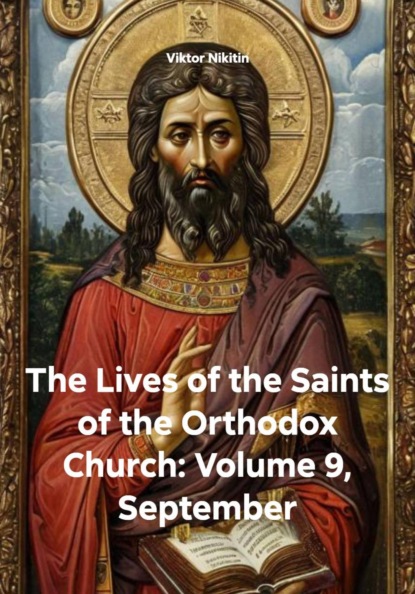
The Lives of the Saints of the Orthodox Church: Volume 9, September
- -
- 100%
- +

Lives of the Saints Celebrated on September 1
Righteous Joshua, the son of Nun (ca. 16th c. BC):
Righteous Joshua, the son of Nun, stands as one of the most formidable leaders of ancient Israel—a man who inherited the mantle of Moses and guided the people into the long-promised land with a combination of steady obedience, fearless courage, and unwavering reliance on God. As Moses’ longtime aide and disciple, Joshua learned to approach every situation not with self-confidence but with faith, having witnessed first-hand the miracles of the Exodus, the revelation on Sinai, and the chastening of the people in the wilderness. When the time came for Israel to cross the Jordan, God appointed Joshua as shepherd and commander of His people, calling him to lead them not by force but by fidelity to the divine Law. Under Joshua’s direction, the walls of Jericho fell, pagan strongholds collapsed, and the tribes received their inheritance, not through military prowess but by the manifest intervention of the Lord, Who fought for Israel as long as they remained faithful. Joshua’s leadership was deeply spiritual—he renewed the covenant at Shechem, called the people to choose between the living God and the idols of the nations, and himself bore witness with the words that echo through the centuries: “As for me and my house, we will serve the Lord.” He reposed full of days, leaving behind a legacy not of conquest alone but of steadfast, God-centered leadership and lifelong faithfulness to the promises revealed to Moses.
Martyrs Callista and her brothers Evodos and Hermogenes at Nicomedia (309):
Callista and her brothers Evodos and Hermogenes were Christians living in Nicomedia during the brutal persecutions of Diocletian, a time when professing Christ openly meant embracing the likelihood of torture or death. Their household was one of vibrant Christian faith, and the three siblings mutually strengthened one another, turning their family bond into a fortress of spiritual courage. When commanded to renounce Christ, they refused, unmoved by either persuasion or threat. The authorities subjected them to harsh torments—scourgings, racks, and burning instruments meant to intimidate or break them—but they endured everything with serene steadfastness, praying not for deliverance but for perseverance. Their unity under suffering was itself a testimony: where one faltered, another encouraged, and where one wavered, another prayed. Finally, still unyielding, they were cast into a cauldron of boiling oil, where they offered their spirits to God. Their memory remains a shining example of familial faith and the strength that arises when love for Christ binds siblings closer than blood alone can bind.
Holy 40 ascetic virgin-martyrs and their teacher the Hieromartyr Ammon the Deacon at Heraclea in Thrace (321–323):
These forty virgin-martyrs were devoted disciples of Ammon the Deacon, a spiritual father who taught them Scripture, prayer, and the life of purity during a time when Christianity was still persecuted intermittently under Licinius. They lived in a small community near Heraclea, dedicated to fasting, watchfulness, and charity, transforming their surroundings into a small monastic haven long before monasticism was fully established. When the decree came demanding sacrifice to idols, they refused. Soldiers dragged them before the governor, where they were threatened and humiliated for their commitment to chastity and their devotion to Christ. Ammon, their beloved teacher, stood with them, strengthening them with words of the Gospel and willingly accepting death before their eyes. The virgins endured torment with supernatural composure—burning irons, scourging, and confinement—yet their resolve only grew stronger. Finally they were executed together, sealing their lives of purity with a shared martyrdom. Their witness stands as a radiant sign of spiritual sisterhood, pastoral love, and the power of unity in faith.
Martyr Aeithalas the Deacon of Persia (380):
Aeithalas served as a deacon in the Persian Church during the reign of Shapur II, when Christians faced fierce persecution for refusing to honor the sun and fire gods of Zoroastrianism. Known for his humility, gentle speech, and steadfast service to the poor, Aeithalas became a beloved figure among believers. His diaconal ministry was not merely liturgical; he was a tireless servant who brought food to prisoners, comfort to widows, and the Gospel to those tempted to despair. Accused of converting others to Christianity, he was brought before the Persian authorities and ordered to worship the sun. Aeithalas quietly refused, declaring that he adored only the Creator Who made the sun and all things. He endured repeated beatings, imprisonment, and the threat of execution, all the while praying for his persecutors and strengthening his fellow prisoners. At last, he was beheaded for his confession of Christ. His martyrdom reveals the profound dignity of the diaconal calling—a life poured out in service, sealed by the supreme witness of blood.
Venerable Martha, the mother of St. Simeon Stylites (428):
Venerable Martha was a woman of uncommon faith, humility, and spiritual discernment, remembered chiefly as the mother of St. Simeon Stylites the Elder, the great ascetic who lived atop a pillar for decades. Yet her own life was one of quiet sanctity. Martha raised Simeon in the fear and love of God, planting in him the seeds of ascetic zeal through her example of prayer, fasting, and almsgiving. Widowed early, she embraced a life of simplicity, dedicating herself to the upbringing of her son and to works of mercy among the poor. She endured with patience the sorrow of separation when Simeon left home to pursue the monastic life, but she never ceased praying for him, supporting him spiritually even when unable to see him face to face. Her faith was rewarded by visions and consolations from God, and her repose was marked by peace and holiness. Her life reminds the Church that behind many great saints stands a parent whose hidden sacrifices play an essential role in their sanctity.
Saint Symeon the Stylite the Elder (459):
Saint Symeon the Stylite revolutionized Christian asceticism with a form of spiritual labor previously unseen: the stylite life, spent atop a pillar as a visible witness to total detachment from earthly distractions and complete dedication to God. Born into humble circumstances in Syria, he sought monastic life as a youth and soon surpassed his peers in fasting, vigils, and strict asceticism. Eventually, desiring even greater solitude, he climbed a stone pillar and made it his dwelling for over thirty years. From that lofty place, Symeon became a beacon of spiritual counsel. Crowds flocked from all corners of the empire to seek his prayers, guidance, and healing. Even emperors wrote to him, and many pagans turned to Christ through his witness. His endurance in harsh weather, his unbroken prayer, and his fearless preaching revealed a soul fully surrendered to God. When he finally reposed atop his pillar, the Church understood his life to be a radical testimony to the power of prayer and the limitless possibilities of holiness when one seeks God without reservation.
Venerable Evanthia:
Venerable Evanthia is remembered as a woman of deep spiritual insight and purity of heart, known primarily for her dedication to the monastic life and her unwavering pursuit of inner stillness. Her early years were marked by a desire to withdraw from worldly vanities and to devote herself wholly to God. Entering monastic life, she became an example of obedience, quiet labor, and ceaseless prayer. Though little survives of her life in written form, the memory preserved by the Church highlights her compassion for the suffering and her ability to offer consoling words to those in distress. She possessed spiritual discernment that allowed her to guide younger sisters in the struggle against temptations and to instill in them a love for humility. Her repose was peaceful, and many remembered her as a model of serene, steadfast devotion, a reminder that not only dramatic deeds but also a lifetime of quiet faithfulness can shine brightly before God.
Saint Symeon of Lesbos (ca. 845):
Saint Symeon of Lesbos was a monk and spiritual father whose holiness became renowned throughout the island and beyond. Born into a pious family, he entered monastic life at a young age and distinguished himself by strict asceticism, profound prayer, and gentleness of heart. Over time, he became known for the grace of spiritual counseling, offering clarity and healing to those tormented by despair, confusion, or sorrow. His reputation grew through accounts of miracles and prophetic insight. Symeon’s humility was so deep, however, that he often fled from public praise, retreating into greater silence and prayer. His cell became a place where people from all walks of life found consolation, and after his repose, many miracles occurred at his tomb. He remains a witness to the power of inner purity and the healing that flows from a heart attuned to the Holy Spirit.
Hieromartyr Priscus of Capua (ca. 66):
Hieromartyr Priscus was the first Bishop of Capua, sent by the Apostle Peter himself to shepherd the Christian community in that region during the first generation of the Church. He carried the faith fearlessly into a pagan world, preaching Christ openly despite the dangers posed by the Roman authorities under Nero. Priscus demonstrated pastoral zeal, baptizing converts, celebrating the mysteries, and strengthening believers facing the threat of denunciation or execution. His refusal to worship the gods of Rome eventually led to his arrest. He endured interrogations, beatings, and public humiliation, remaining steadfast in his confession of the risen Christ. Finally, he was beheaded for his witness. His life and death attest to the courage of the earliest bishops, who guided the infant Church not with worldly power but with the authority of those ready to die for the truth they proclaimed.
Hieromartyr Terentian, Bishop of Todi in Umbria (118):
Terentian became Bishop of Todi at a time when Christians were still regarded with suspicion and hostility by Roman society. Under Emperor Hadrian, he was accused of converting noble families and refusing to acknowledge the imperial cult. Arrested and interrogated, he persuasively defended the Christian faith, declaring Christ the only true Lord. His steadfastness enraged his persecutors, who subjected him to tortures meant to break his spirit. Legend recounts that his tongue was cut out so that he could no longer preach the Gospel—yet even then he continued to proclaim Christ through his endurance and serenity. At last, he was executed, sealing his episcopal ministry with the blood of martyrdom. His relics became a source of healing, and his memory a symbol of fearless evangelization.
Virgin-Martyr Vibiana (3rd c.):
Vibiana lived during a time of sporadic but severe persecutions in Rome. A young woman consecrated to Christ, she dedicated herself to chastity, prayer, and helping the poor. Her faith was discovered by officials who sought to force her either into apostasy or into marriage with a pagan nobleman. Vibiana refused both, declaring Christ to be her Bridegroom and the only King she would serve. She was arrested and subjected to harsh tortures, including scourging and starvation, yet she remained joyful, singing psalms in prison. Eventually she died of her wounds, and her relics were venerated by the faithful. Centuries later, they were rediscovered and brought to the United States, where she became the patron saint of Los Angeles—a remarkable journey for a humble Roman martyr whose quiet valor continues to inspire the faithful.
Saint Sixtus of Reims (ca. 300):
Saint Sixtus was the first Bishop of Reims, establishing the Christian faith in the region at a time when most inhabitants still practiced various forms of pagan religion. Known for his gentle character and strong pastoral sense, he converted many through his patient teaching and charitable works. His episcopate coincided with the final major Roman persecutions, and he faced constant threats from authorities who viewed Christianity as a subversive movement. Despite this, Sixtus continued preaching, baptizing, and tending to the poor. He reposed in peace, leaving behind a well-rooted Christian community and a legacy of pastoral compassion that shaped the faith of northeastern Gaul.
Hieromartyr Firminus of Amiens (ca. 303):
Firminus, the third Bishop of Amiens, shepherded his flock during a time of intense persecution under Diocletian. His zeal for evangelization had already drawn many pagans to Christ, raising the ire of civic officials who feared the decline of traditional cults. Arrested for refusing to offer incense to the gods, Firminus boldly proclaimed the Gospel before the tribunal. He was sentenced to torture, enduring chains, racks, and beatings with remarkable composure. Ultimately, he was beheaded, and the Christians of Amiens enshrined his relics with deep reverence. His witness strengthened the faith of the region, and his name remains honored among the heroic bishop-martyrs of Gaul.
The 12 Holy Brothers, Martyrs (ca. 303):
Donatus, Felix, Arontius, Honoratus, Fortunatus, Sabinian, Septimius, Januarius, a second Felix, Vitalis, Sator, and Repositus
These twelve martyrs suffered during the Diocletian persecutions in southern Italy. They were Christians belonging to different towns and communities, arrested separately but united in their steadfast refusal to perform sacrifices to the Roman gods. Their shared faith and courage forged among them a spiritual brotherhood stronger than familial bonds. They endured interrogation, imprisonment, and tortures of various kinds—scourging, stretching, burning—yet none faltered. Eventually, they were executed, some by the sword and others by fire. Centuries later their relics were gathered together and enshrined at Benevento, where they became a symbol of unity in martyrdom and a source of miracles for the faithful.
Saint Verena of Zurzach (ca. 350):
Verena was an Egyptian Christian who traveled to Switzerland, following the Theban Legion and seeking a life of prayer and service. Settling near Zurzach, she embraced a semi-eremitic life marked by fasting, almsgiving, and the care of the sick. Women and children especially found in her a protector and teacher. Verena’s sanctity attracted many to the Christian faith, not through preaching alone but through her purity of heart and compassion. She taught hygiene, modesty, industry, and virtue—qualities sorely needed in the communities she served. After her repose, her tomb became a site of healing, and to this day she is honored as one of the beloved saints of Switzerland.
Saint Victorius (Victurius), Bishop of Le Mans (ca. 490):
Victorius was a disciple of St. Martin of Tours, inheriting from him a spirit of pastoral zeal and deep humility. As Bishop of Le Mans, he worked tirelessly to eliminate lingering pagan practices, converting rural populations with gentleness rather than force. He founded churches, encouraged monastic life, and established charitable institutions for the poor and sick. His episcopal ministry was marked by simplicity, personal austerity, and an abiding spirit of prayer. After his peaceful repose, miracles at his tomb confirmed the deep veneration in which he was held.
Saint Constantius of Aquino (ca. 520):
Constantius served as Bishop of Aquino in central Italy during a time marked by political upheaval and ongoing conflicts between Ostrogoths and Byzantines. Despite the instability around him, he remained a steady shepherd who guided his flock through preaching, charity, and prayer. He confronted pagan remnants and heretical movements, defending orthodox teaching with clarity and patience. His life exemplified episcopal integrity, and after his repose he became known for miraculous intercessions, particularly in times of sickness and danger.
Saint Regulus (San Regolo) (545):
Regulus was a North African bishop forced into exile by the Arian Vandals. Carrying relics of saints with him, he traveled across the Mediterranean until he reached Tuscany, where he continued preaching Christ with apostolic zeal. There he attracted disciples and founded Christian communities. During the Gothic conflicts, he was seized by forces loyal to Totila and executed for his refusal to deny the orthodox faith. His relics became objects of deep veneration throughout Tuscany, and he remains honored as a missionary bishop and confessor of true doctrine.
Saint Lupus of Sens (623):
Lupus began as a monk of Lérins, where he embraced a life of silence, fasting, and manual labor. His humility and spiritual discernment were widely recognized, leading to his election as Bishop of Sens. As bishop, he encouraged monastic foundations, promoted liturgical life, and defended the poor from exploitation. His episcopate was peaceful, marked not by dramatic miracles but by quiet, consistent holiness. After his repose, Sens revered him as a model of pastoral wisdom.
Saint Nivard of Rheims (673):
Nivard served as Archbishop of Rheims and was known for strengthening both the moral and liturgical life of the diocese. He supported monasticism, rebuilt churches, and guided the clergy toward greater spiritual discipline. His humility was notable: although occupying a position of great prestige, he lived simply and treated all with kindness. His memory remains tied to the flourishing of Christianity in northern France during the early Middle Ages.
Saint Giles (Aegidius), founder along the Rhone (ca. 712):
Saint Giles was a hermit renowned for his humility, charity, and love of solitude. Fleeing worldly acclaim, he settled along the Rhone, where he lived in a cave sustained by prayer and the milk of a hind. His sanctity became known despite his efforts to remain hidden, and eventually a monastery was built around his hermitage. He became one of the most beloved saints of Western Europe, invoked especially for healing and protection.
Saint Lythan (Llythaothaw):
Saint Lythan, an early Welsh saint, is remembered through the churches dedicated in his honor and through the quiet legacy of sanctity attributed to him. Though few details of his life survive, he is honored as a holy man who lived a life of prayer, pastoral care, and service to his community. His memory reflects the early Celtic Christian tradition, in which holiness was often lived quietly, transmitted not through writings but through faithful local devotion.
Saints Giles (Aegidius) and Arcanus (1050):
These two saints founded a monastery that eventually developed into the town of Borgo San Sepolcro. Giles brought with him a relic of the Holy Sepulchre, inspiring the dedication of the site, while Arcanus joined him in establishing a community rooted in prayer, labor, and hospitality. Their monastery became a spiritual center for the region and eventually a place of pilgrimage. Their collaboration exemplifies how shared ascetic effort can shape entire communities.
Saint Meletius the Younger of Thebes (1105):
Saint Meletius was a monk and ascetic of deep humility, known for his prophetic insight and his ability to reconcile feuding families and communities. He lived in strict fasting, wore simple garments, and spent long hours in prayer. His miraculous gifts drew many to seek his blessing, though he constantly fled praise. After his repose, his relics became a source of healing, and his legacy endured in the monasteries he inspired throughout Greece.
Venerable Nicholas of Courtaliatis (1670):
Nicholas was a monk of Crete whose life was marked by simplicity, obedience, and deep inner prayer. Living under Ottoman rule, he provided quiet spiritual strength to oppressed Christians. He became known for his compassion and for the miracles that occurred through his prayers, particularly healings of those weighed down by spiritual afflictions. His repose in peace crowned a life of hidden holiness.
New-Martyr Angelis of Constantinople (1680):
Angelis was a pious young man from Constantinople who fell into the hands of authorities after false accusations brought by enemies of the faith. Pressured to convert to Islam, he refused steadfastly, declaring Christ as his God despite promises of wealth and threats of torture. Subjected to harsh beating and imprisonment, Angelis endured everything with courage beyond his years, strengthening his fellow prisoners by his witness. At last he was executed, sealing his confession with his blood and joining the ranks of the New Martyrs under Ottoman rule.
Venerable Anthony of Agyia:
Anthony lived as a monk dedicated to prayer, poverty, and obedience. His cell in Agyia was a source of spiritual counsel for those burdened by sorrow or confusion. He practiced ceaseless prayer and showed great gentleness toward the weak, teaching that humility is the foundation of every virtue. His repose in deep peace reveals the fruit of a life wholly surrendered to God.
Saint Haido of Stanos (1820–1821):
Haido was a young woman from Stanos in Macedonia who lived during turbulent times marked by oppression and war. Her life was characterized by purity, devotion, and steadfast courage. When threatened with forced marriage to a Muslim and with renouncing her Christian faith, she resisted bravely. Refusing to betray Christ, she was subjected to threats, coercion, and violence, yet she held firm. Finally, she suffered martyrdom, giving her life as a witness to the sanctity of Christian freedom and the dignity of conscience.
Virgin-martyrs Tatiana and Natalia (1937):
Tatiana and Natalia were two young Orthodox women martyred during the Soviet persecutions, a time when confession of faith was considered a crime against the state. Both lived quiet but devout lives, attending church secretly, helping the poor, and preserving Christian traditions in a society where doing so invited punishment. Arrested for their association with clergy and for refusing to renounce their faith, they were interrogated harshly and pressured to denounce Christ. They refused with quiet dignity. Eventually they were executed, joining the multitude of New Martyrs of Russia whose steadfastness in the face of ideological cruelty illumined the twentieth century with the light of faith and courage.
* * *
Lives of the Saints Celebrated on September 2
Martyr Mamas of Caesarea in Cappadocia, with his parents Martyrs Theodotus and Rufina:
Martyr Mamas stands among the most beloved early Christian witnesses, known both for his innocence and his unwavering courage. His parents, Theodotus and Rufina, were devout Christians imprisoned for their faith under Roman persecution. Mamas was born in prison, baptized in chains, and orphaned almost immediately when his parents accepted martyrdom with quiet courage. Raised by a Christian widow, he grew into a young man whose purity, gentleness, and unshakeable loyalty to Christ gave him a spiritual authority far beyond his years. When the persecution in Caesarea intensified, Mamas was arrested and ordered to renounce Christ and sacrifice to idols. Though barely more than a youth, he stood before governors and executioners with a fearless serenity that astonished all who heard him. He endured severe tortures—scourgings, burning irons, and brutal confinement—but he refused to waver, choosing truth over life itself. Tradition also remembers his bond with wild animals, which approached him with a harmonious gentleness that mirrored his own purity. In the end, after surviving torments that should have killed him, he was pierced with a trident and gave his soul peacefully to God. His parents’ steadfast faith lived on in him, and together they remain symbols of courage passed from one generation to the next, proving that holiness can shine even in the darkest trials.
Saint John the Faster, Patriarch of Constantinople:
Saint John the Faster was one of the most ascetical and spiritually discerning leaders ever to sit on the patriarchal throne of Constantinople. Renowned from his youth for strict fasting, deep prayer, and humility, he became a priest known for extraordinary compassion toward sinners and a rare gift of spiritual healing. Upon becoming Patriarch, he sought not power but purity—purity of the clergy, purity of worship, and purity of life in the great capital of the empire. His pastoral work was marked by an unusual combination of gentleness and firmness. He corrected sin without humiliating the sinner, insisted on repentance without crushing the weak, and called the entire city to a deeper life of prayer and restraint. His spiritual discernment was so refined that he could recognize the hidden wounds of the human soul and prescribe repentance like a physician prescribes medicine. He was the first to use the title “Ecumenical Patriarch,” not as a boast but as a description of his responsibility for the spiritual care of Christians both near and far. Though his life was strict, he was not harsh; though he fasted with severity, he embraced his flock with fatherly tenderness. At his repose, Constantinople mourned a shepherd who had carried their burdens with prayer and taught them that holiness begins not in grand gestures but in daily acts of discipline and mercy.