

Americanism Contrasted with Foreignism, Romanism, and Bogus Democracy in the Light of Reason, History, and Scripture;




- -
- 100%
- +
"Dear Sir: – … My opinion with respect to immigration is, that except of useful mechanics and some particular description of men or professions, there is no need of encouragement. I am, &c.,
"G. Washington."[Vol. XI., p. 1.]
TO J. Q. ADAMS, AMERICAN MINISTER AT BERLIN"Mount Vernon, Jan. 20, 1799.
"Sir: – … You know, my good sir, that it is not the policy of this country to employ aliens where it can well be avoided, either in the civil or military walks of life… There is a species of self-importance in all foreign officers that cannot be gratified without doing injustice to meritorious characters among our own countrymen, who conceive, and justly, where there is no great preponderancy of experience or merit, that they are entitled to the occupancy of all offices in the gift of their government.
"I am, &c.,"G. Washington."[Vol. XI., p. 392.]
SAME DATE, TO A FOREIGNER APPLYING FOR OFFICE"Dear Sir: – … It does not accord with the policy of this government to bestow offices, civil or military, upon foreigners, to the exclusion of our own citizens. Yours, &c.,
"G. Washington."[Vol. XI., p. 392.]
INSTRUCTIONS OF THE SECRETARY OF WAR TO THE INSPECTOR-GENERAL"War Department, Feb. 4, 1799.
"… For the cavalry, for the regulations restrict the recruiting officers to engage none except natives for this corps, and those only as from their known character and fidelity may be trusted."
[From the Knoxville Whig for March, 1856.]WHO IS MILLARD FILLMORE?
A Brief history of the American nominee for the Presidency is this: He was born in the year 1800, in Cayuga county, New York, and is now fifty-six years of age. His father was then, as he now is, a farmer, in moderate circumstances; and now lives in the county of Erie, a short distance from Buffalo. The limited means of the family prevented the old gentleman from giving his son Millard any other or better education than was obtained in the imperfect common schools of that age.
In his sixteenth year, Mr. Fillmore was placed with a merchant tailor near his home to learn that business. He remained four years in his apprenticeship, during which time he had access to a small library, improving the advantages it offered by perusing all the books therein contained. Judge Wood, of Cayuga county, pleased with his intellectual advancement, urged him to study the profession of the law; and as his poverty was the only obstacle in his way, Judge Wood advanced him the necessary means, relying upon his making a lawyer, and being able by the practice of the profession to refund the money again. With a portion of this money young Fillmore bought his unexpired time, which was for the winter, and he pursued his legal studies with energy and success, in the office of the noble Judge.
In 1822, he removed to Buffalo, where he was admitted to the bar. His object in removing to Buffalo was to complete his studies and to obtain a license. This accomplished, he removed to Aurora, not far from where his parents resided, and there commenced the practice of his profession. The confidence of his neighbors in his integrity and abilities was such that he found himself in the midst of a lucrative practice at once. In 1826, he was married to Miss Powers, the daughter of a clergyman in the village of Aurora, and this excellent woman lived to see him elected Vice-President of the United States.
In 1829, Mr. Fillmore was elected from the county in which he married and where his parents lived to the General Assembly of New York, and for three years continued a member of this body, distinguishing himself by his energy, tact, and wisdom in legislation. Through his energy and speeches, Imprisonment for Debt was abolished, and this so increased his popularity throughout the State, that it was apparent that he could be elected to any office in the gift of the people of that State.
In 1829, he was admitted a counsellor in the Supreme Court of New York, and in 1832 he removed to Buffalo, where he settled permanently and enlarged his practice as an attorney. In 1832, he was elected a representative in the 23d Congress, in which he served with industry and credit to himself and his district. At the end of his term he renewed the practice of the law, of choice, but, in 1836, was prevailed on to again serve his district in Congress; and in the celebrated New Jersey contested elections, distinguished himself. He was chosen to the next Congress by the largest majority ever given to any man in the district; and as Chairman of the Committee on Ways and Means, acquired a reputation that any man might be proud of.
At the close of the 27th Congress, his friends were anxious for his continuance in public life, but he declined. And in his address to his constituents, dated at Washington, July 11th, 1842, he says:
"Pardon the personal vanity, though it be a weakness, that induces me to recur for a moment to the cherished recollections of your early friendship and abiding confidence. I cannot give vent to the feelings of my heart without it. It is now nearly fourteen years since you did me the unsolicited honor to nominate me to represent you in the State Legislature. Seven times have I received renewed evidence of your confidence by as many elections, and, at the expiration of my present term, I shall have served you three years in the State and eight years in the National Councils. I cannot recall the thousand acts of generous devotion from so many friends, without feeling the deepest emotions of gratitude. I came among you a poor and friendless boy. You kindly took me by the hand and gave me your confidence and support. You have conferred upon me distinction and honors, for which I could make no adequate return, but by honest and untiring effort faithfully to discharge the high trust which you confided to my keeping. If my humble efforts have met your approbation, I freely admit, next to the approval of my own conscience, it is the highest reward which I could receive for days of unceasing toil and nights of sleepless anxiety. I profess not to be above or below the common frailties of our nature. I will therefore not disguise the fact, that I was highly gratified at my first election to Congress; yet I can truly say that my utmost ambition has been gratified. I aspire to nothing more, and shall retire from the exciting scenes of political strife to the quiet employments of my family and fireside, with still more satisfaction than I felt when first elevated to distinguished station."
During this same year he returned to the practice of his profession, and, in 1844, the Whig State Convention of New York put him in nomination for the office of Governor, in opposition to Silas Wright. This was the only conflict in which he ever suffered defeat, and the race was close. In 1847, without seeking or desiring the highly responsible office, he was elected Comptroller of the Finances of the State, and removed to Albany, where he discharged the duties of the office with great credit to himself and usefulness to the State, resigning the office in February, 1849, to enter upon the duties of the office of Vice-President, to which he had been called by the election in 1848. Gen. Taylor dying, he became President, and every patriot in the land remembers and admires the history of his administration. Gen. Cass and other distinguished Democrats said his career had been one of genuine patriotism, honor, and usefulness; and Gov. Wise, upon the stump in Virginia, characterized it as "Washington-like;" while the Democratic papers and orators, from Maine to California, declared that he ought to have been nominated in lieu of Gen. Scott, because he was one of the best men in America.
He is now in Europe, familiarizing himself with the workings of the despotic governments of that country. Before leaving, almost one year ago, he told his friends, in answer to questions relating to the presidency, not to start any newspapers for his benefit – not to publish any documents – not to make any speeches, or even electioneer – and added, that if the American people nominated him, of their own free will and accord, he would accept their nomination, and if elected, he would serve them to the best of his abilities. His nomination, therefore, under the circumstances, is a great honor, and shows the implicit confidence the real people have in the integrity, patriotism, and qualifications of the man. That he will go into the presidential chair almost by acclamation, we have not the shadow of doubt.
As to Mr. Fillmore's chances, we consider them excellent, and growing brighter every day. The indications are now very clear that he will obtain a plurality, if not a majority vote, in most of the Northern States; and under the most unfavorable circumstances, he will be sure to divide the electoral vote of the South, so as to carry more States than Mr. Buchanan. Virginia, South Carolina, Mississippi, and Alabama, are the only four States we concede to the Cincinnati nominee and one of these, we confidently expect to carry. Georgia and Arkansas we set down as doubtful, and we contend that Buchanan can't get either of them without a severe struggle.
We then make this estimate, and claim as certain for Fillmore and Donelson the following States, viz.:
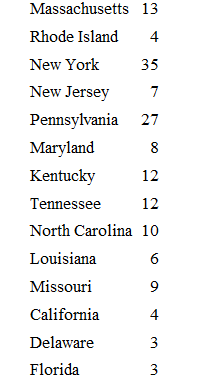
This makes a total of 157 —eleven, more than is necessary to an election. This is not an extravagant, but a very fair estimate. The friends of the American ticket have a right to feel encouraged. With proper exertions our ticket will carry. Let every American consider himself a sentinel upon the watch-tower – let every friend of the party do his duty, and the result will not be doubtful. And let all who believe that "Americans ought to rule America," take courage – "the skies are bright and brightening."
As it regards Mr. Fillmore's Americanism, that is settled – he has been a Protestant American fifteen years in advance of the party, as it now exists. The Hon. J. T. Headley, Secretary of State of New York, delivered a speech at the Capital of his State, March 7th, 1856, in which he spoke of Mr. Fillmore in the following language:
"Now, in the first place, he was an American years before those who denounce him ever thought of Americanism. The Police constable of Newburg elected last year on the American ticket, told me, that years ago, when that well-known conflict occurred between the citizens of Buffalo and the foreign population, that a combination was formed called the "American League." The members of this League entered into a solemn compact to stand together and fight together for the rights of Americans. This constable was at the time an humble mechanic in Buffalo, and he said that he constantly met Mr. Fillmore (who was a member of that League with him) at the Council Room. Thus you see that those who would arrogate to themselves the title of Americans, and yet carp at Mr. Fillmore as wanting in American sentiment, are really recent volunteers compared with him. Mr. Fillmore carried his American principles still farther and became (so an officer in the same order informs me) a member of the United Americans. He has always been a true American, he is now, and ever will be, and is worthy to move at the head of the glorious column over which floats the flag bearing the inscription, 'Americans shall rule America.'"
After the defeat of Mr. Clay, in 1844, Mr. Fillmore addressed him this noble American letter:
"Buffalo, Nov. 14, 1844.
"My Dear Sir: – I have thought for three or four days that I would write to you, but really I am unmanned. I have no courage or resolution. All is gone. The last hope, which hung first upon the city of New York, and then upon Virginia, is finally dissipated, and I see nothing but despair depicted upon every countenance.
"For myself, I have no regrets. I was nominated for Governor much against my will, and though not insensible to the pride of success, yet I feel a kind of relief at being defeated. But not so for you or the nation. Every consideration of justice, every feeling of gratitude conspired in the minds of honest men to insure your election, and though always doubtful of my own success, I could never doubt yours, till the painful conviction was forced upon me.
"The Abolitionists and Foreign Catholics have defeated us in this State. I will not trust myself to speak of the vile hypocrisy of the leading Abolitionists now. Doubtless many acted honestly and ignorantly in what they did. But it is clear that Birney and his associates sold themselves to Locofocoism, and they will doubtless receive their reward.
"Our opponents, by pointing to the Native Americans and to Mr. Frelinghuysen, drove the Foreign Catholics from us and defeated us in this State.
"But it is vain to look at the causes by which this infamous result has been produced. It is enough to say that all is gone. I must confess that nothing has happened to shake my confidence in our ability to sustain a free government so much as this.
"Millard Fillmore."But here is one other letter, written to Isaac Newton, just before Mr. Fillmore left the United States for Europe. A more patriotic letter, breathing more of the genuine American spirit, we have never met with:
"Buffalo, N. Y., Jan. 3, 1855.
"Respected Friend Isaac Newton: – It would give me great pleasure to accept your kind invitation to visit Philadelphia, if it were possible to make my visit private, and limit it to a few personal friends whom I should be most happy to see; but I know that this would be out of my power, and I am therefore reluctantly compelled to decline your invitation, as I have done others to New York and Boston, for the same reason.
"I return you many thanks for your information on the subject of politics. I am always happy to hear what is going forward, but, independent of the fact that I feel myself withdrawn from the political arena, I have been too much depressed in spirit to take an active part in the late elections. I contented myself with giving a silent vote for Mr. Ullman, for Governor.
"While, however, I am an inactive observer of public events, I am by no means an indifferent one, and I may say to you in the frankness of private friendship, that I have for a long time looked with dread and apprehension at the corrupting influence which the contest for the foreign vote is exerting upon our elections. This seems to result from its being banded together, and subject to the control of a few interested and selfish leaders. Hence it has been a subject of bargain and sale, and each of the great political parties of the country have been bidding to obtain it, and, as usual in all such contests, the party which is most corrupt is most successful. The consequence is, that it is fast demoralizing the whole country; corrupting the very fountains of political power; and converting the ballot-box – that great palladium of our liberty – into an unmeaning mockery, where the rights of native-born citizens are voted away by those who blindly follow their mercenary and selfish leaders. The evidence of this is found not merely in the shameless chaffering for the foreign vote at every election, but in the large disproportion of offices which are now held by foreigners at home and abroad, as compared with our native citizens. Where is the true-hearted American whose cheek does not tingle with shame and mortification to see our highest and most coveted foreign missions filled by men of foreign birth to the exclusion of native-born? Such appointments are a humiliating confession to the crowned heads of Europe that a Republican soil does not produce sufficient talent to represent a Republican nation at a monarchical court. I confess that it seems to me – with all due respect to others – that, as a general rule, our country should be governed by American-born citizens. Let us give to the oppressed of every country an asylum and a home in our happy land, give to all the benefits of equal laws, and equal protection; but let us at the same time cherish, as the apple of our eye, the great principles of constitutional liberty, which few who have not had the good fortune to be reared in a free country know how to appreciate and still less how to preserve.
"Washington, in that inestimable legacy which he left to his country – his farewell address – has wisely warned us to beware of foreign influence as the most baneful foe of a republican government. He saw it to be sure in a different light from that in which it now presents itself; but he knew it would approach us in all forms, and hence he cautioned us against the insidious wiles of its influence. Therefore, as well for our own sakes, to whom this invaluable inheritance of self-government has been left by our forefathers, as for the sake of unborn millions who are to inherit this land – foreign and native – let us take warning of the Father of his Country, and do what we can justly to preserve our institutions from corruption and our country from dishonor, but let this be done by the people themselves in their sovereign capacity by making a proper discrimination in the selection of officers, and not by depriving any individual – native or foreign-born – of any constitutional or legal right to which he is entitled.
"These are my sentiments in brief; and although I have sometimes almost despaired of my country when I have witnessed the rapid strides of corruption, yet I think I perceive a gleam of hope in the future, and I now feel confident, that when the great mass of intelligence in this enlightened country is once fully aroused, and the danger manifested, it will fearlessly apply the remedy, and bring back the government to the pure days of Washington's administration. Finally, let us adopt the old Roman motto, 'Never despair of the Republic.' Let us do our duty, and trust in that Providence which has so signally watched over and preserved us for the result. But I have said more than I intended, and much more than I should have said to any one but a trusted friend, as I have no desire to mingle in political strife.
"Remember me kindly to your family, and believe me truly your friend,
"Millard Fillmore."In March, 1851, Lewis Cass, than whom there is not a more devoted partisan in the Democratic ranks, delivered a speech on the floor of the United States Senate, in the course of which he paid the following just compliment to Mr. Fillmore's integrity, and to his efficiency in "pacifying the country," while he was President. We quote from the Congressional Globe, and hold it up as a withering rebuke to those "lesser lights" of Democracy, who are now defaming this pure and patriotic statesman:
"The Administration has placed itself high in the great work of pacifying the country, and they received the meed of approbation from political friends and political foes. I partake of the same sentiment. I do them justice. But I am a Democrat, and, God willing, I mean to die one. This is a Whig administration, but there is no reason I should not do them justice; and I do it with pleasure, in this great matter of the salvation of this country– if I may say so. I have done so; shall continue to do so, whatever sneers their papers may contain; for I do it not for their sake, but for the sake of their country."
The Democratic Review– the highest Democratic authority in the United States – for December, 1855, commenting upon the Compromise Measures of 1850, thus spoke of Mr. Fillmore, in a moment of candor, long before Mr. Fillmore was nominated by the American party for the Presidency:
"Momentous events were transpiring. The agitation of the question of slavery was paramount in the public mind. In this crisis, it was well that so reliable a man as Mr. Fillmore was found in the Presidential chair. The safety and perpetuity of the Union were threatened. Already had fanaticism raised its hydra-head. Schemes and 'isms' leaped from a thousand ambuscades. The enemies of the Union started forth on every side – Abolitionism here; secessionism there; acquisition and filibusterism elsewhere. These were the formidable elements of misrule with which the Executive had to cope. How well he met, and how entirely he for the time overcame these enemies of the peace of the republic, we leave the historian to relate; but our retrospect would be incomplete and disingenuous, did we not accord the meed of praise justly due to high moral excellence and intellectual and administrative honesty and talent, as developed in the administration of Mr. Fillmore."
Since the foregoing was prepared for the press, Mr. Fillmore's letter of acceptance has come to hand, greatly to the annoyance of the Democratic and anti-American fuglemen and politicians. We congratulate the country upon the patriotic, national, and truly American spirit which pervades this chaste and well-written document. It is just what we expected from one of the very first men in the Nation. His reference to his past course as a guaranty for the future is well-timed. Sectional legislation he is opposed to; and sectional agitation he will use his influence to suppress. We ask every man into whose hands this work shall fall, to read this admirable letter for himself: it is worthy of the man and the times; nay, it is the letter of a patriot and a statesman —
"Who for his country feels alone,And loves her weal, beyond his own."[COPY.]
Philadelphia, Feb. 26th, 1856.
To the Hon. Millard Fillmore:
Sir: – The National Convention of the American party, which has just closed its session in this city, has unanimously chosen you as the candidate for the Presidency of the United States in the election to be held in November next. It has associated with you Andrew Jackson Donelson, Esq., of Tennessee, as the candidate for the Vice-Presidency.
The Convention has charged the undersigned with the agreeable duty of communicating these proceedings to you, and of asking your acceptance of a nomination which will receive not only the cordial support of the great national party in whose name it is made, but the approbation also of large numbers of other enlightened friends of the Constitution and the Union, who will rejoice in the opportunity to testify their grateful appreciation of your faithful service in the past, and their confidence in your experience and integrity for the guidance of the future.
The undersigned take advantage of this occasion to tender to you the expression of their own gratification in the proceedings of the Convention, and to assure you of the high consideration with which they are yours, &c.
Alexander H. H. Stuart,Andrew Stewart,Erastus Brooks,E. B. Bartlett,Wm. J. Eames,Ephraim Marsh.Committee, &c.Paris, May 21st, 1856.
Gentlemen: – I have the honor to acknowledge the receipt of your letter informing me that the National Convention of the American party, which had just closed its session at Philadelphia, had unanimously presented my name for the Presidency of the United States, and associated with it that of Andrew Jackson Donelson for the Vice-Presidency. This unexpected communication met me at Venice on my return from Italy, and the duplicate, mailed thirteen days later, was received on my arrival in this city last evening. This must account for my apparent neglect in giving a more prompt reply.
You will pardon me for saying that when my administration closed in 1853, I considered my political life as a public man at an end, and thenceforth I was only anxious to discharge my duty as a private citizen. Hence I have taken no active part in politics. But I have by no means been an indifferent spectator of passing events; nor have I hesitated to express my opinion on all political subjects when asked; nor to give my vote and private influence for those men and measures I thought best calculated to promote the prosperity and glory of our common country. Beyond this I deemed it improper for me to interfere. But this unsolicited and unexpected nomination has imposed upon me a new duty, from which I cannot shrink; and therefore, approving, as I do, of the general objects of the party which has honored me with its confidence, I cheerfully accept its nomination, without waiting to inquire of its prospects of success or defeat. It is sufficient for me to know that by so doing I yield to the wishes of a large portion of my fellow-citizens in every part of the Union, who, like myself, are sincerely anxious to see the administration of our government restored to that original simplicity and purity which marked the first years of its existence; and, if possible, to quiet that alarming sectional agitation, which, while it delights the Monarchists of Europe, causes every true friend of our own country to mourn.