

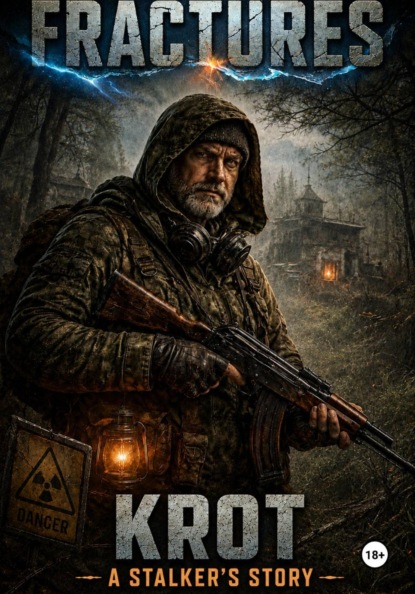
Krot. A Stalker's Story



- -
- 100%
- +
— What are you even looking for out there? — Rvany asked.
— There should be a "night star" here. I saw a distinctive mark on the ground — just need to search a three-hundred-meter radius around it.
— You've already gone around in circles twice and found nothing, — Kleshch said. — Like a mole, I swear. Digging and digging — no result.
Misha didn't answer. Went.
He found — not the "night star." Another rare first-category artifact. Good money. Not what he needed, but better than coming back empty.
At the base, Rvany greeted him with: "Oh, look, Krot's back."
By the end of the week, it had stuck.
Krot. He didn't object at first, then stopped noticing, then accepted it. Callsigns in the Zone are like skin: uncomfortable to wear until you get used to it. After that, you don't even think about it.
* * *
The fifth year brought the first serious talk with Irina.
Not a fight — Irina wasn't the type to make scenes. Just a conversation at the table, in the evening, while Masha slept. Irina poured tea, set it in front of him, sat across from him, and said:
— Misha, I want to understand. Are you still going out there because you believe you'll find something for Masha? Or is it a different reason now?
He didn't answer right away.
— I don't know, — he said finally. — Both, probably.
— That's honest. — She was quiet a moment. — Then one more question. If Masha got better tomorrow — on her own, no artifacts — would you stop going?
A long pause.
— I don't know, — he said again.
Irina nodded. Stood, cleared the cups. Before leaving the kitchen, she stopped.
— I thought you'd say "yes." Or at least "probably." — A pause. — Goodnight, Misha.
He sat at the empty table and looked at the cold tea.
It was the first time he understood something Irina had understood earlier.
Chapter 4. Deeper
After that talk with Irina, he went to Dead City.
Not alone — with a group of four. Two veterans: Slon and Prut — an odd pair. Slon was hulking and slow, living up to his callsign to a fault. Prut — thin and jittery, twitchy to look at, but in the Zone that vanished somewhere: he moved quietly, read the terrain well, reacted fast. The fourth — young, Vorobey, two years of experience, going into the western sector for the first time.
Krot was going for the first time too — but didn't say so.
Professional caution: don't announce your ignorance ahead of time. Better to listen and watch.
* * *
Dead City lived up to its name.
Not through beauty — no, "beautiful" wasn't the word. Through the sheer scale of its emptiness. They entered from the eastern outskirts — through an old industrial quarter, along concrete fences topped with rusted barbed wire that no one had bothered to cut, and which had long since stopped keeping anyone out. Beyond the fences — workshops. Collapsed roofs, broken window frames, machines still standing where they'd never been hauled away. Or never wanted to be. One of the shops was sealed — the doors welded shut, and on those doors someone had once painted a skull in white. The paint had flaked. The skull remained.
The residential blocks started half a kilometer on.
A housing district — or what was left of one. Five-story buildings, a few taller panel blocks that had held up decently — the concrete had lasted. But no living foot had clearly set in them for a long time — not just human, even mutants gave certain streets a wide berth. Why — unclear. The detector showed a moderate background, nothing critical. But something in the air pressed down — not radiation, not chemistry. The pressure of a space that had gotten used to being empty and wanted nothing else.
Slon called it "cursed patches."
— Every place in the Zone that's been empty a long time starts wanting to stay empty, — he said, as they walked down the central avenue, past rusted buses and leaning lampposts. — It's not mysticism. It's the fields. An anomalous field stabilizes around absence. Around emptiness. When you walk in — you disrupt the stabilization. The field pushes you back out.
— That's why it presses like this? — young Vorobey asked.
— That's why. You'll get used to it. Or you won't.
Krot walked and listened and thought: there it is. The very thing his father used to talk about — adaptive quasi-fields reacting to presence. Not hostile, not friendly — just reacting. The way a liquid reacts to a solid body. Simply trying to return to equilibrium.
He looked at windows with nothing behind them. At cars fused into the asphalt — one stood right in the middle of an intersection, door open, as if the driver had stepped out and would be right back. Coming back any decade now.
In Dead City, time had stopped. Not metaphorically — literally: he felt it through his feet, through that same nameless sense that had taken three years to develop. The field here was different — not active, not aggressive. Frozen. Like resin that had long since hardened and no longer flowed, but would never disappear either.
* * *
On the third hour of the route, Vorobey asked to stop.
— There, — he said, nodding to the side. — Detector's spiking. Might be something.
Slon looked where Vorobey had nodded. A five-story building, a side entrance, a breach in the first-floor wall — neat, as if cut out. Not an anomaly — an old explosion. Dark inside.
— No, — Slon said.
— Why? Good signal.
— Because dark rooms in Dead City — no. — Slon said it flat, just a fact. — There's "burners" in the corridors. Invisible. Lost a man in there three years back.
Vorobey looked at the breach.
— Understood, — he said. — Not going.
They moved on.
Krot remembered that moment — the way Vorobey nodded and looked away. Calmly. No resentment. A good sign. The young ones who get angry at being told no live shorter lives than the young ones who listen.
Then everything went wrong.
Prut found something — not an artifact, just an old military rucksack by a wall, right on the ground, barely decayed. Nothing valuable inside, but he pulled it out, looked it over. Vorobey came to look. They stood three meters from the wall, talking.
Krot, at that moment, was at the corner — checking the alley next over. Slon — across the street, back to them.
The wall came down without a sound.
Not an explosion. It just — settled. The top floor started sliding first, then the second, then the whole thing went down with that long low sound Krot would hear in his dreams afterward. Prut reacted — jumped clear, rolled, stood. Vorobey didn't make it.
Not because he was slow. Just — didn't make it. Half a second, maybe less.
The dust settled after a minute.
Slon stood at the edge of the rubble and looked. Didn't shout, didn't call out — just looked. Then turned.
— Let's go, — he said.
— Vorobey's in there, — Prut said.
— I know.
— We need to—
— Let's go, — Slon repeated. Same tone. — He's under the third slab. Can't reach him. Trying means bringing down the next one.
Prut said nothing.
Krot looked at the rubble. Thought about how Vorobey had been coming to Dead City for the first time. How he'd had two years of experience and the makings of a good stalker.
The Zone didn't consider that enough to survive.
— Let's go, — Krot said.
They walked.
* * *
They never found "Stardust."
They found something else: "shimmering dawn" — a rare artifact, neutral in effect, valuable to collectors. Found some "meat chunks" — a few, good quality. Krot took a couple for himself — good to sell, but the main thing was, in one specimen he made out a structure he hadn't seen before. Inside — something like a crystal lattice, regular, almost symmetrical. He held the artifact in his gloved hand and looked at it too long — until Slon called out.
— Krot. Time.
— Coming.
He looked another second and put it away.
It wasn't "Stardust." But something told him — the principle was the same. Same structure, only simpler, a lower degree of crystallization. Like he'd found ordinary salt where he'd been looking for a diamond, and realized: same geology, same process, just different conditions.
They walked back in silence.
Prut didn't say a word until the perimeter. Neither did Slon. Krot said nothing either — because there was nothing to say, and empty words in the Zone sound worse than silence.
Vorobey stayed in Dead City.
Dead City took him as its due — no mourning, no ceremony. Just took him. One more quiet place in a quiet city.
Krot went back four more times over the following six months. Every time, he walked past that rubble. Never stopped.
* * *
The sixth year brought a loss.
Not death — not yet. A different kind of loss: Irina said she was tired of waiting.
Not suddenly, not all at once. It built up slowly — every run, every "I'll be back in a week, Ira, this is important," every dinner where he stared at the table and thought about Dead City. She held out a long time — longer than anyone else in her place would have, Krot understood later. Irina was the kind of person who endures on principle: as long as there's any chance to change things, you give that chance a shot.
The chance never came.
— I'm not asking you to choose between me and the Zone, — she said. — You already chose, a long time ago. I'm just telling you I accept that choice. For you. And I'm making my own.
— Ira...
— Masha stays with me. Not because you're a bad father — you're a good one, when you're here. It's just that you're rarely here.
He didn't argue. There was nothing to argue with.
The divorce went through quietly, no court battle — Mikhail gave everything to Irina and their daughter, no scenes. Krot rented a room five minutes from the old apartment — to be close to Masha when he came around. Irina didn't stop him from seeing his daughter. That was the best that could have come out of all that bitterness.
Masha would ask: "Dad, why do you live there now?"
— That's just how it worked out, sweetheart.
— Will you still come?
— Of course.
— Every day?
A pause.
— When I can.
Masha nodded. A serious look. She was sixteen already — her illness had cost her so much of her youth.
— Fine, — she said. — Just come.
He came. Not every day — no. But he came.
Chapter 5. The Price of the Search
A year after the divorce, he became the man Borland would later see sitting at a table in the Barkeep's bar.
Good gear, well-worn — not the kind you go out in to make an impression, but the kind that works and that you trust. He'd replaced his detector three times before finding one he liked — the "Veles," expensive, but precise, calibrated for the anomalous fields of the western and northern sectors. He'd swapped his weapon after his very first run — an AKSU, then in his third year a plain AK with a proper stock, because sometimes the stock did the work too.
His biography had gathered details he never told anyone, but you could see them: the correct way his feet fell on unfamiliar ground. The habit of stopping before a turn — not out of fear, but to listen. The ability to read a map while moving, without slowing down.
He liked the Zone.
That was a truth he finally let himself say out loud — not to anyone else, to himself. Sitting alone by a fire in an abandoned house, eating canned food, thinking that in three days there'd be a checkpoint, an exit, a bus into the city, Masha — and realizing he didn't want to.
Not that he didn't want to see Masha. Not that he didn't want to leave.
Just — he wanted to stay here a little longer. In this silence, in this space that presses and lives and says not a single word, yet always lets you know it's there.
He was better off here than out there.
That was bad news.
* * *
He found "Stardust" at the end of the year he and Irina divorced.
Not in Dead City — in its outskirts, in a half-buried culvert he'd climbed into following someone's old map marked "check this." The mark was three years old; whoever made it had, by all appearances, died. Krot found the entrance, waded two hundred meters through knee-deep water, found a narrow tunnel, and in the tunnel — a crack in the wall, and in the crack — a blue glow.
Even. No pulse to it.
"Stardust." Exactly as Gorbaty had described.
He stood in front of it a long time. Three minutes, maybe five. The detector showed a strong anomalous effect, but not a dangerous one — more like a strong field that pressed but didn't burn. Krot looked at the blue light and thought about his father. About what his father used to call "crystallization points." About Masha.
He took it carefully — a fourth-class container, double walls, protective lining. Closed it. Climbed out of the culvert. Stood on the surface a minute in the wind.
Two days later he was home.
He took out the container. Sat at the table. Set it in front of him — just to look at it again, to check it hadn't been a hallucination. The blue light came through the container's lid — faint, even.
He picked up the phone. Called Irina.
— Ira. I found "Stardust."
A pause.
— And?
— It's the one. Matches every description. I want to give it to Masha — she'll get better.
A longer pause. Irina didn't answer right away. Then she did. Her voice was quiet — not the tired kind of quiet. Different.
— Masha died last night. A sudden decline. Her heart.
* * *
Krot sat with the phone in his hand after she hung up. The blue light came through the container. Steady. No pulse.
He didn't cry — not right away. Just sat, looking in the direction he'd come from. The Zone was out there, past the perimeter. Calm, as always. Guilty of nothing.
He thought back to his last conversation with Masha. Two weeks ago — she'd asked him not to go. Laughed at his stories. Her laugh had been good — light, unforced. Real.
Krot closed his eyes.
Then opened them.
* * *
He came to the funeral. Stood beside Irina, who stared at one point and held her hands folded in front of her. Irina never blamed him for anything. Not then, not later. She was smarter than that.
After the funeral they sat in the kitchen of the old apartment. He drank tea. Irina drank tea. The neighbors and relatives had gone home.
— I didn't make it in time, — he said.
Irina said nothing.
— I searched. Searched so long.
— I know.
— She died while I was out there.
— Yes. — A pause. — But you died before she did. She didn't have enough of you.
He looked at the mug. The tea was cold — he hadn't noticed while drinking it.
— Are you going back to the Zone? — Irina asked. Not with judgment. Just asking.
A long silence.
— Yes, — he said.
She nodded. Stood, cleared the mugs.
— I thought so. — A pause at the sink. — Not because you're a bad man, Misha. You're just someone else now.
* * *
He sold "Stardust" to the research center for good money — very good money. Gave part of it to Irina. The rest went into gear.
Three weeks later, he went back into the Zone.
Not because he needed to — he had enough money, no jobs lined up. Just because that was the only mode of existing left that still worked. In the city he walked his rented rooms from one to the next and ran into silence — too much of it, too dense, the kind with no room left in it for him.
In the Zone, the silence was different. It was alive. Something happened inside it — something moved, shifted, breathed. The Zone's silence didn't press on the ears. It spoke.
He walked, and the Zone talked to him through the rustle of leaves and the detector's beeping, through the smell of anomalous exhaust and the crunch of frozen ground underfoot. Not about Masha — about nothing in particular. Just about itself.
That was enough.
Chapter 6. Fine
Krot existed here. Now. In the Zone.
Other stalkers knew him. Not as a legend — as a reliable man you could bring into a group without worrying he'd wander off, panic, or do something reckless. He knew how to walk with scientists — that was his particular skill, a niche talent people valued. Nobody liked bringing scientists into the Zone: they asked questions, slowed the pace, reached for anomalies with measuring instruments when they should have been keeping their distance.
Krot knew how to talk to them in their own language. Explain the Zone through physics they understood. Keep them in line without offending them. It was a skill that had formed without him noticing — somewhere at the intersection of his father's legacy and his own experience.
That paid a little more. And jobs with research groups took priority.
* * *
— How are you holding up, Krot? — Slon asked once, when they sat by a fire.
Late already, the group asleep, only the two of them still awake — by some unspoken agreement that had formed on its own, because both knew: someone had to listen to the night, and it was easier to do that by a fire than from inside a sleeping bag.
— In what sense? — Krot asked.
— Well. — Slon shrugged. — Heard about your daughter. Sorry. You know how it is, the base is a village, everyone knows.
Krot was quiet for a while.
— Fine, — he said finally.
— No, it's not fine. — Slon said it without judgment, just stating it. — But you're managing. That's clear.
— Managing.
— You ever think about... going back? Getting out for good?
Krot looked at the fire.
— Nowhere to go, — he said.
— There's always somewhere.
— Not always.
Slon thought about it, then nodded.
— I get it, — he said. — I'm the same. Different reason, though.
They sat quietly. The fire burned.
— How long have you been walking? — Krot asked.
— Going on seventeen years.
That was a long time. Slon wasn't a legend — legends, as a rule, die young, dramatically, and for a reason. Slon just walked. Methodically, carefully, no heroics, no wasted moves. Seventeen years of that was, in itself, something serious.
— And it's fine? — Krot asked.
Slon smiled — not happily, more the way a man smiles when he knows something the other doesn't yet, and isn't sure whether it's worth telling.
— It's fine, — he said. — If you don't count that my normal life ended exactly seventeen years ago.
* * *
Krot thought about that for a long while, after Slon had curled up by the fire.
A normal life — that was what Mikhail Zemtsov had had. Engineer-physicist, model family man, an apartment overlooking a park. Tea on Sundays, Saturdays at the dacha, Masha with her serious look, asking about anomalies. That had been normal. That had been good.
That no longer existed.
Krot didn't have a normal life. He had a different one — complicated, dangerous, strange. But his own. Truly his own — not inherited from Mikhail Zemtsov, not built on someone else's blueprint. Earned. Suffered for. Here, every scuff on his boots was honest, every artifact in the container was deserved, every silence by the fire was real.
Maybe that's what "fine" meant.
Krot took the bundle of Irina's letters from the bottom of his rucksack. Put them in the fire, saying goodbye to his old self. Cutting off every road back for Mikhail.
* * *
A few months later, there was another night — also late, also by a fire, just a different group, a different place. Northern sector, grid eight, a cache by a stream that dried up in summer and flooded in spring.
A young walker — first year, name forgotten — asked:
— Krot. Why are you here? You're smart, educated. Could work in the city. Teach.
Krot looked at the fire.
— Because it's clear here, — he said.
— What's clear?
— Everything. — A pause. — Out there, there's a lot that isn't clear. A lot you don't control. Here — you don't control it either. But here, at least, you know where the threat's coming from.
The young man thought about it.
— That's strange logic, — he said.
— Maybe, — Krot agreed. — But it's honest.
He didn't add the main thing: that out there was the place where Masha died, and he hadn't been there. That out there was Irina, with her cold tea and her line about him being someone else now. That out there was an apartment with a view of a park that held nothing of his — no scent, no trace, no meaning.
The Zone was his.
That was enough — to stay.
* * *
Slon drifted out of Krot's life slowly — not physically, just less often crossing paths. Different routes, different jobs. Sometimes they met at the base — briefly, a nod, a couple of words. Sometimes they ate at the same table. Rarely — talked.
The last real conversation was in winter. Slon said he was thinking of leaving. For good. Buying something outside the city, somewhere quiet.
— That's the right call, — Krot said.
— Easy for you to say.
— Because it's true.
— And you?
— Nowhere for me to go.
Slon looked at him for a long time. Then said:
— "Nowhere" isn't an answer. "Nowhere" just means you haven't found it yet.
Krot didn't answer.
Slon left the following spring. Bought a plot of land — far from the perimeter, in another region. Wrote sometimes. Short: "alive, garden, quiet." Krot answered just as short: "alive, zone, fine."
That was their language. It suited them.
Chapter 7. The Day Before
The research center opened a new department for studying anomalous phenomena, with expanded funding. They were recruiting guides for long-term expeditions — two, three months, in the western and northern sectors. Good pay. Requirements: five years of experience, knowledge of topography, a medical license (a basic survival course counted).
Krot put in an application.
He went through the interview. Sat down across from a man in his mid-forties, a white coat thrown carelessly over his shoulders, with the tired eyes of a man asking the same question for the twentieth time that week.
— Seven years of experience. Zone — western, northern, central sectors. Western — good, central — adequate. — The man flipped through a printout. — Education — engineering physics. That explains the note, "knows the scientists' language." — He looked up. — Why do you want this assignment?
— Money.
The man was quiet.
— Don't lie to me, please, — he said. — I don't care what the real reason is. But lying at an interview is a sign of instability.
Krot looked at him.
— Habit, — he said. — I've got nothing to do out there. A long expedition beats short runs with gaps in between.
The man looked at him again — no judgment, just assessing.
— Fair enough, — he said finally. — You're in.
* * *
The first long expedition ran three months. Then a second. Then a third. The scientists rotated — Kolesnikov showed up somewhere around the fourth expedition, and Krot liked him right away: not stupid, no snobbery, listened to what he was told, didn't argue with the guide out on the route. The perfect client.
Krot had gone out with Kolesnikov five times by now.
He set money aside — mechanically, with no specific goal. Kept his gear in good shape. Collected artifacts, turned them in — it had become routine, like filing a work report. Sold a few rare specimens. Published three articles anonymously on the forum — on quasi-fields in the western sector, on carousel behavior at low temperatures, on emission precursors. The last one got reprinted in the center's internal journal — no name, just "your text was used."
He'd stopped looking for miracle artifacts.
Not out of disillusionment. Just — no reason to anymore. An artifact without a purpose is just a piece of crystallized field. Pretty, and pointless.
Masha was gone. Irina was living her own life — met someone, Krot had heard in passing, hadn't asked for details. That was right. Irina deserved a normal life. That wasn't his story anymore.
His story happened here.
* * *
The Barkeep's bar was a place Krot had known for a long time.
Not the coziest place — a barrack hastily converted, with wooden benches that creaked under any weight, a single lamp on a post outside, swaying in the draft from the front door so the shadows on the floor never sat still. But reliable. The Barkeep was one of those men who lived neither in the Zone nor outside it, but in that in-between space people called the base — territorially beyond the perimeter, but still an antechamber, not the Zone itself. He knew everyone. Informed on no one. Kept his own counsel, could get information for a fee, and the price was always fair.