

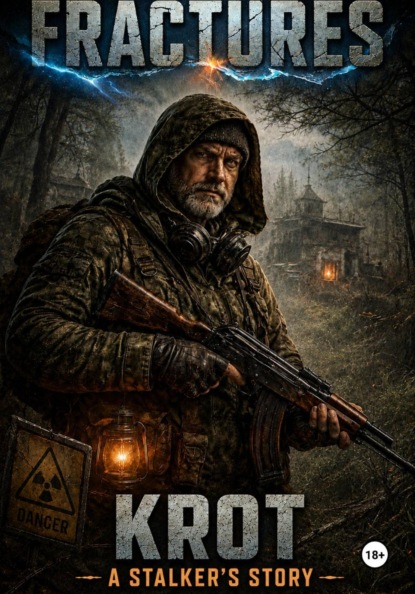
Krot. A Stalker's Story



- -
- 100%
- +
Either the man had a habit he couldn't switch off. Or — he was watching someone. Or expected to be watched himself.
Interesting question. No answer yet.
The flask made another round. Krot took it — the last time for today.
The village stayed silent.
Chapter 10. The Trap
He woke before Leshy.
Almost before. When he opened his eyes, Leshy was already sitting by the stairs, looking at the ceiling. Or thinking. Hard to tell with him.
Krot rubbed his face. His head felt clear — not from rest, not from the flask. Something in the cellar's air had changed overnight. Not a smell, not a sound — that same nameless feeling built up over years. Something had grown. Denser.
— Is this me, — he said quietly, — or...
— Not you, — Leshy said.
Silence.
— Bad.
Leshy nodded. Added nothing — there was no need to.
* * *
They ate breakfast in silence.
That in itself was telling. Kolesnikov ate mechanically — he always talked while eating, that was his norm, unbreakable. Now — he stayed quiet. Stared into his mug. The second scientist didn't argue — with anyone, about anything. The assistant held her mug with both hands and stared at the wall.
Krot watched this and thought: bad sign. When walkers feel the unease, it's a working situation. When scientists feel it — people who'd been in the Zone two days and hadn't developed any instinct yet — that meant the signal was loud. Very loud. Loud enough that even an unprepared person picked it up — the way you catch infrasound, not with your ears but with your skin.
That wasn't good.
Leshy stood first — no words, up the stairs, into the house. Wasn't gone long. Came back down. Sat on the step.
The group watched him. All of them.
— Leshy, — Krot said carefully. — What's out there?
— Anomalies, — Leshy said. — Everywhere.
— Meaning — everywhere?
— Meaning — the whole village. — A pause. — After the rain. Grew like mushrooms. Where it was clean yesterday.
Silence.
The second scientist opened his mouth: — That's not possible. Anomalies don't form that fast. Forming an anomalous structure requires—
— I know what it requires, — Leshy said. — And yet.
Krot stood, climbed two steps, looked through the doorway.
The village outside looked like a village. Morning light, wet grass, dark log walls. Nothing visible.
But he felt it. Where yesterday there'd been ordinary space, now there was a field. Not local, not a single point — continuous, like fog after a night. It had come with the rain, or behind the rain, or used it as cover. Anomalies didn't form this fast — that was true. It contradicted everything he knew about how the Zone worked.
But the detector was silent. And the field was there.
Krot went back. Sat on the crate.
— Detector's silent, — he said.
— Silent.
— Then how do you—
— I feel it.
Krot looked at Leshy. He looked back — even, no explanation. Just a fact.
Krot nodded. Slowly, accepting it. Instinct wasn't mysticism — it was accumulated experience, processed faster than the conscious mind could put it into words. Leshy felt the field, and that was that. Arguing with it made about as much sense as arguing with the fact that the ground was wet after rain.
Kolesnikov raised a hand — the gesture of a man used to meetings.
— What does this mean practically? Are we trapped?
— For now — yes.
— And how long?
Leshy didn't answer right away. He was thinking. Krot watched him and tried to guess what exactly he was calculating. Escape routes? The field's behavior? Time to discharge?
— Krot, — Leshy said finally. — You ever hear of an anomalous field that moves?
Krot turned toward him slowly.
He'd heard of it. Of course he had. Zonnikov's theory — a working name, the author already dead. Mobile fields, not tied to a fixed point in space, moving by some logic of their own. His father had mentioned it in passing — as a hypothesis he found interesting but unconfirmed.
— Heard of it, — Krot said. — A theory. Considered unconfirmed.
— Considered, — Leshy said.
Krot looked at him for a second.
A mobile field. That was what he'd felt all of yesterday. Not a mutant, not some random observer's presence — the field itself, moving alongside them, and at night it had rolled over the village while they slept.
That explained everything. And it made the situation considerably worse than just "a lot of anomalies."
— Well I'll be, — Krot said quietly.
Not from fear. From the kind of surprise you get when something you always considered a theory turns out to be standing right in front of you — real, tangible.
His father would have been thrilled.
Krot himself — not thrilled. But that was a separate matter.
Beyond the cellar walls, the village stayed silent. The field sat outside — dense, invisible, patient.
Not just a field. Something else could be felt inside it.
Krot didn't say that out loud. Too soon for that.
They needed to get out. The only question was how.
Chapter 11. Field of Wonders
— Krot. Vint. With me.
Krot got up at once. Leshy spread the map on the crate — no question, no explanation of why, just spread it out and started talking.
— I need an exact layout of the village. Every house, every gap, the distances between buildings. As best you remember.
Krot took a pencil and started drawing — confidently, from memory. He knew the terrain. The space sat clear in his head: there was the main street, there the leaning house by the well, there the distance from porch to corner — ten paces, no more.
Leshy watched, corrected where he saw more precisely.
Then Vint took the pencil.
Krot watched him work. The mercenary added detail without a word, without hesitation — the fence at the north house, three sections, the middle one collapsed. The well further right than it seemed. The gate at the outermost cabin — open, unlocked; in the rain, in the dark, in passing, he'd still surveyed the whole perimeter.
A serious man.
The map came out dense. It took an hour.
— Wait here, — Leshy said, gathering the sheets.
— I'll go with you, — Krot said.
— No. I need you here. — A pause. — If I'm not back in four hours, you try to get the group out yourself. If both of us die in there, the outcome for the group is bad.
Krot didn't argue. The logic was sound. He nodded.
Leshy took the map and went out.
* * *
Four hours was a lot and a little at the same time.
A lot — because sitting in the cellar waiting while one man dealt with whatever had covered the whole village was a nerve-racking way to spend the time. A little — because Krot couldn't imagine how what Leshy had taken on could possibly be done in four hours at all.
Walk the whole village by hand. Find a route through an anomalous field the detector couldn't see. No instruments, just instinct.
Krot sat and thought about that.
He could feel a field himself. He'd developed that over seven years — slowly, unevenly, without ever quite noticing when it started. Just, at some point, he'd stopped fully trusting the detector and started trusting instinct more. But what Leshy was doing out there now was a different level. Not just a stalker's sense. More like reading the field the way you'd read a map.
Where a twenty-year-old kid got that from — unclear.
The scientists talked quietly by the wall. The soldiers stayed silent — one asleep, the other watching the stairs. The assistant was writing something down. Vint sat in his usual spot — back to the wall, face to the cellar.
Krot caught his eye.
Vint wasn't looking at him — at the stairs. With the expression people get when there's a separate conversation running in their head, unconnected to what's happening around them.
Then he stood, climbed the stairs without a word, and went out.
Krot watched him go for a second.
Went out after Leshy. Unnoticed — so quietly that no one below seemed to register it.
Interesting.
* * *
Leshy came back three and a half hours later; Vint not long before him.
Krot heard the footsteps before he saw him — heavier than usual, fatigue in every step, but even, unhurried. He came into the cellar. Sat on the crate. Spread out the map.
The sheet was a web of lines, crosses, arrows. Anomalies — marked with crosses. The route — a straight line between them, with notes: stop, fast, left, three steps. Timing marked in some spots — pencil numbers.
Krot looked at the map and understood: this was three and a half hours of solo work, no instruments, in a space the detector couldn't see. It was a map he himself could never have drawn — not from lack of skill, but because he didn't have this particular skill.
The assistant leaned over the sheet — and went still. Then took out her notebook and started copying it. Fast, barely glancing at her pencil.
Leshy looked at her. Said nothing.
Krot caught that look. There was no irritation in it — more something like: let her. Doesn't matter either way.
An interesting reaction from a man who'd just spent three hours making this map and who knew exactly what information like this was worth in the Zone.
— Listen carefully, — Leshy said, and the talking died down. — I walked the route. Forty minutes, maybe more. My pace. Where I say stand, you stand. Where I say run, you run without questions and don't stop. — He swept his eyes over the group. — Anomalies are unstable after discharge. The window's small. Whoever hesitates puts everyone at risk.
Silence. Nods.
— Krot, soldiers up front. Not as canaries. — A look at Krot — quick, direct. — I'll be at the back, I'll see the whole route. If something shifts, I'll correct it.
— Understood, — Krot said.
He'd put himself at the back. Which meant — ready to react to anyone. Meant he didn't consider anyone expendable, scientists included.
— Moving out.
* * *
The first twenty minutes went well.
Leshy led by voice — short, no explanations. Step left. Stop. Three steps forward. Right. Fast. Krot walked first in the group and passed the commands on with his body — not words, movement: a stop meant stop, a turn meant turn. People picked it up.
The village around them looked like a village.
That was the worst part. No visible anomalies, no glow — just wet grass, dark logs, gray sky. An ordinary abandoned place. And at the same time Krot could feel the field on every side — dense, jittery after the rain. He walked through the invisible corridor Leshy had cut through that field, and tried not to think about what would happen if the corridor shifted.
The soldiers kept pace well. The scientists — worse, but held on. The assistant walked steady, watching her feet.
Ten meters left to the exit.
* * *
Krot felt it before he saw it.
Not the impact itself — a change in the air. The pressure swayed sideways. Behind him — a pop, light, like a cork, and then a rising hum.
He turned.
The second scientist's rucksack — the overloaded one, the one he'd meant to lighten and never had — had clipped a funnel at the edge. The soldiers reacted instantly, yanked him free. The scientist stayed on his feet.
The funnel started spinning up.
— Stop! — Leshy shouted.
And immediately, a second later:
— Krot! Run! Everyone — run! Not far to the exit!
Krot bolted.
He'd memorized the map, but checked it on the move anyway — one glance, a second — and took the route confidently, without hesitation. Exit straight ahead, a little left of the last house, don't stop. The soldiers followed, step for step — good, correct. The scientists behind them — slower, but holding the line.
At the edge of his sight — the assistant.
Standing still.
In the middle of the corridor, staring at the funnel. Her legs weren't holding her — he could see it in how she sagged, as if her knees had decided that was enough.
Krot thought about turning back — and stopped.
Leshy was closer.
Three strides and he was beside her, grabbed her, dragged her down the corridor. Krot saw it out of the corner of his eye, already running — how Leshy hauled her along, how the ground behind them was starting to really roar now, a chain, one after another.
He ran the last stretch. Broke out of the field.
Stood, caught his breath. Turned. Started counting everyone.
Chapter 12. The Run Through the "Minefield"
The soldiers — here. Both. The scientists — here. Kolesnikov gasping, doubled over, hands on his knees. The second scientist stood straight, staring at the field with the look of a man whose head didn't have enough words for what he was seeing.
Two were missing.
Leshy. And Vint — he'd vanished somewhere between the cellar and the exit. Krot hadn't noticed when. He'd been in the cellar, then he wasn't. Quiet, the way only he could manage.
The field was detonating. Anomalies layering over each other, space losing its shape — pops, flashes, a pressure on the ears that wasn't sound, that the word "sound" didn't quite fit. Looking that way was like looking at several realities at once.
Then something whistled through the air — sharp, in an arc — and the assistant dropped onto the grass some twenty meters off.
She landed decently. Covered her head, took the impact on her shoulder, rolled. Krot was already running.
— Alive?
She lifted her head. Looked at him.
— Alive, — she said.
And burst into tears.
* * *
They sat on the grass some fifty meters from the edge of the field.
The detonations were dying down — slowly, with pauses. The village was sinking into a silence still tangled with overlaps that hadn't yet unraveled.
No one spoke.
The soldiers watched the field with the professional anger people get when a situation slips out of control and someone's left inside. They didn't fuss, didn't shout — just stood and watched. Kolesnikov stared at the ground. The second scientist lit a cigarette.
Krot lit one too. Stood a little apart from the others, looking at the field.
The second scientist's rucksack. He'd meant to lighten it back on the route — saw it was overloaded, decided: later. Later never happened. If he'd lightened it, the rucksack wouldn't have clipped the funnel. The funnel wouldn't have spun up. There'd have been no chain.
He didn't say that out loud. Not out of fear — just no reason to. The past couldn't be fixed, and the group didn't need his confession right now.
The assistant talked — fast, disjointed, the way people talk when something needs to come out. She described how she'd frozen. How Leshy had appeared and dragged her through a corridor she couldn't see. How he'd thrown her into an anomaly — she'd thought it was the end. How, mid-flight, she'd understood she needed to tuck in.
— He saved me and cut off his own way out, — she said. — Because of me, he's dead.
No one answered.
Krot took a drag, watching the field.
He was angry at Leshy — that was honest, he didn't try to hide it from himself. Sent him ahead, said go, I'm behind you. And then stayed behind. And Vint too. Two professionals inside, six outside. An unfair ratio.
But the anger wasn't sticking.
Because he'd seen it. Seen how Leshy walked at the back so he could see everyone. Seen how he'd covered the distance to the assistant in three strides — before Krot himself had even managed to react. Seen him dragging her through a corridor that was already falling apart.
That wasn't a mistake. That was a choice.
Krot knew people like that. He'd seen them rarely — not many in the Zone have it in their blood, walk it like their own backyard. Borland was one of them. Young — and only now, sitting on the wet grass, did Krot truly register how young. Twenty. Maybe less. And he walked as if he'd known the Zone since birth.
Maybe he had.
He dropped his cigarette butt.
— Time to move.
Everyone looked at him.
— Leshy and Vint aren't coming out. — He said it evenly, no inflection. — Not from here, not now. — A pause. — If by some miracle they made it, we'll meet them at the endpoint. Leshy knew this route better than any of us. If there's a way out, he'll find it.
He wasn't sure of that. But that wasn't for himself — it was for them.
— On your feet. Moving out.
Kolesnikov stood first. The soldiers followed. The assistant wiped her face, put away her notebook, got up.
Krot took one last look at the field.
Live, Leshy. You still owe me an explanation of what a mobile anomalous field is. In plain terms, without all your "I feel it."
He turned and walked.
Конец ознакомительного фрагмента.
Текст предоставлен ООО «Литрес».
Прочитайте эту книгу целиком, купив полную легальную версию на Литрес.
Безопасно оплатить книгу можно банковской картой Visa, MasterCard, Maestro, со счета мобильного телефона, с платежного терминала, в салоне МТС или Связной, через PayPal, WebMoney, Яндекс.Деньги, QIWI Кошелек, бонусными картами или другим удобным Вам способом.