

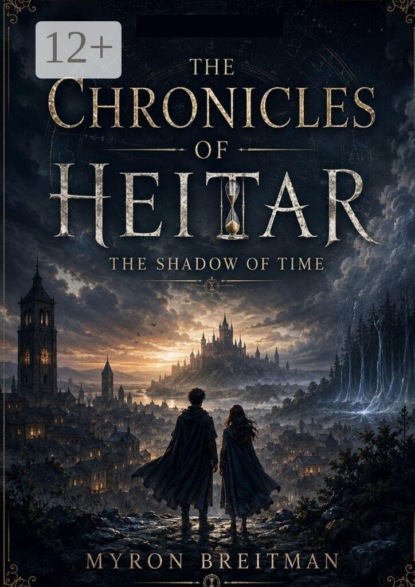
The Chronicles Of Heitar — The Shadow Of Time



- -
- 100%
- +
They had known what their children were. And they had chosen not to say.
He sat with this until Merissa opened her eyes.
She woke absolutely. No gradual emergence, no confusion about where she was. She opened her eyes and the gray light of the domed room was in them and she looked at him across the embers and said nothing for a long moment.
Then: “How long did I sleep?”
“A few hours.”
She sat up, reached for a piece of wood from the small supply left beside the hearth, and fed it in with the competence of someone who has done this enough times to do it without thinking.
“The things are gone,” she said. “They’ll come back.”
“Yes. Both.”
The wood caught. The embers began to breathe again.
“You read all night,” she said. “And?”
He handed her the book.
She took it with both hands, with the sensitivity in her fingertips that was part of how illusion-mages related to objects. She opened it and looked at the text that should have been illegible to both of them and was not.
She read for several minutes. He watched the fire.
“This is about us,” she said. “Specifically. I can feel it — writing doesn’t usually carry magical resonance, but this does. It’s addressed. Like a letter written before we were born.”
“Written before there was a way to know we would be born.”
She closed the book and held it in her lap. “I dreamed about the Forest. I understood that the things that came last night weren’t sent to harm us — they were sent to find us. To verify we exist and are what the prophecy says we are.”
“And now that they’ve confirmed it, the actual summons will come.”
“Unless we go first.”
She was quiet. The fire had achieved something sustainable — not large, but steady.
“We need to understand more. The book describes something, but doesn’t explain it.” She looked up. “Where did it come from? Who put it here?”
“Someone who wanted it found at the right time.”
“Our parents?”
The question hung in the air above the fire. Needing to be addressed.
“I don’t know,” he said. “The book predates them. But they may have known it was here. May have arranged for it to be accessible when it needed to be.”
“They prepared for us,” she said finally. “They knew we would need this. They made sure that when we reached this point, we would have what we needed.”
“We’re going to go into the Forest,” she said.
She had said it before she decided to say it. That was how she knew it was true — not the kind of thing you arrive at through argument, but the kind that is simply already there when you open your mouth, waiting to be spoken.
She looked at the fire. Twelve years she had looked at the horizon instead of the Forest. Twelve years of peripheral vision, deliberate and practiced. And last night something had come out of it and walked through her walls and looked for her specifically.
There was no version of this in which they didn’t go.
It was not a brave thought. It was just a true one.
“Yes. But not today. We need to prepare.” He paused. “We start today. But first — we eat something. We find out what happened to the city last night. Then we plan.”
Outside, very distantly, he could hear the first sounds of the city waking. A cart on wet cobblestones. The sound of a door.
The world was choosing, with reluctant pragmatism, to continue.
The city, they discovered, was largely unaware.
The market was operating by mid-morning. The stalls were open, the people selling their things with ordinary focused attention. Children had emerged, the dogs had reclaimed their corners, the smell of bread from the communal ovens had reasserted itself. No one spoke about the night. Not at the market, not at the well, not among the clusters of neighbors exchanging the ordinary social currency of a small community.
As if it had not happened.
“They didn’t experience it,” Merissa said to Kaen, when they found a quiet corner behind the herb seller’s stall. “Only us.”
“Only us,” he confirmed. “That’s intentional. Whatever came last night was precise — it targeted us. The silence, the stillness, was a stage. A demonstration of capabilities.”
They watched the ordinary morning of the market. Everything as if last night had simply not occurred.
“After,” she said, when he mentioned the house. “First I want to know what Marten knows. About the temple. About why that book was there.”
“He doesn’t speak.”
“I know. But he communicates. He left us food and a fire and a room and said nothing about it, which suggests he was expecting us. A man who expects people doesn’t expect them without reason.”
Marten was in the lower part of the temple when they returned, mending cloth, working with the concentration of hands that know a task well and are permitted to let the mind go elsewhere.
He looked up when they entered. His one eye — the left — was extraordinary in the way eyes are sometimes extraordinary in very old people, as if years of seeing have deposited something in the iris. Dark gray, very clear. The other socket was covered by a patch of worn leather so old it had become part of his face.
He set down his mending with the movement of someone who understands that some conversations take precedence, and he waited.
“We found the dark green book in the library,” Kaen said carefully. “Last night.”
Marten’s hands rested perfectly still on his knees — the stillness of someone for whom this information is not new. He produced his notebook and pencil, wrote, held the paper out.
I have been its keeper for forty years. It arrived before I did. I was told what it was, and that the right people would find it when the time came.
“Who told you?”
A woman. She came once, thirty years ago, and said: you will know the moment when the book chooses to be read. Keep it safe until then. She did not give her name.
Merissa looked at Kaen. Thirty years ago — the timeline was close to right for their mother. Or someone who knew their mother.
“The creatures that came last night,” Merissa said. “What are they?”
Marten wrote carefully. I have heard them called the Breathless. They are not alive the way animals are alive — they are what remains of something that chose to un-live, that gave up the things which bind a creature to the world in order to become unbound. They are instruments.
The Forest sent them.
The three words sat on the paper with the directness of a fact long understood.
“Yes,” Kaen said. “We believe so.”
Marten stood and went to a small chest in the corner, opened it, and held something out to Merissa.
A key. Old brass, darkened almost to black, with a handle in the shape of a knotwork Kaen recognized from the book — cousin symbols, drawn from the same original vocabulary.
Merissa took it without asking why. When a very old man who has spent forty years keeping a thing for the right people finally recognizes them, you do not ask for credentials.
He wrote one final note and returned to his mending in the manner of someone who has completed work that has been waiting long enough.
The lower library. Third door on the right from the bottom of the stairs. What is inside has been waiting for your family.
The lower library existed at a depth that had not seen daylight in longer than anyone living could know, the stairs cut into bedrock rather than built of it. They descended by lantern light, the flame making the walls look wet, the grain of the cut stone look like something living.
Three doors on the right. The first two were unlocked, opening onto rooms that smelled of deep storage. The third was different — not in the visible age of the wood but in some quality of the space around it, a pressure suggesting it had opinions about who it would open for.
Merissa put the key in the lock. It turned with the ease of something that has been waiting to be turned.
Inside: a room smaller than the others, the walls lined with shelves from floor to ceiling, the shelves occupied not by many books but by few — each one isolated from its neighbors, each one resting in a purpose-built bracket. The care of the arrangement was striking. Not the careless accumulation of the library above, but something curated. Selected. Each item chosen and placed with intention.
Seven books.
And between two of them, on the middle shelf, at eye level — a box.
Small, made of the same dark metal as Kaen’s amulet, with a quality of seeming to absorb rather than reflect the light. On the lid, symbols — the same language as the book, immediately comprehensible to both of them without their being able to say why.
For those who carry the Hours and the Mist.
Merissa reached past the books and took the box down. She held it with both hands for a moment. Then she looked at Kaen.
“I think here is where we’re meant to open it,” he said.
She pressed the latch. It released without resistance.
Inside, resting on what had once been velvet — the ghost of a texture, the memory of a color — were two objects.
The first resembled a watch in its dimensions and disposition toward circularity, but revealed itself on examination to be something other. The face had no numbers. The case was dark metal, warm to the touch the way the amulet was warm, and when Kaen picked it up he felt time moving through it — some channel opening between his gift and whatever this object was. The hands moved not in correspondence to duration but in response to something else he could not yet name.
It was their mother’s. He knew this the moment his skin touched the metal. Not from a label, but from the imprint of years of a specific person’s handling.
She had left this here. For him.
The second was a pendant — small, oval, made of something suggesting both glass and stone, clear enough to see through but with depth. Inside it, something moved slowly, continuously, without any visible mechanism. Something that looked like mist but was more deliberate — put inside this pendant and told to stay.
Merissa picked it up. The thing inside moved toward her touch without hesitation.
“Hers,” she said.
“Yes.”
On the back of the watchcase, an inscription. He read it and the reading took a moment, because what it said was not simple. Then he looked up.
“‘The time you carry is not a weapon. It is a river. Walk with it, not against it. And when the river floods — breathe, and remember that water returns to water.’”
She was quiet.
“And mine?” she said. She turned the pendant herself and read it, and he watched her face.
“‘The mist you make is not a lie. It is the truth seen from an angle. The mist that hides is a mist that has forgotten its purpose. Make it so it shows instead.’”
A long silence in that small stone room. The lantern between them. Seven books on their shelves.
“They knew this day would come,” he said.
“They prepared for it. They couldn’t tell us — if we’d grown up knowing what we were, knowing this was coming, we would have prepared ourselves according to our own understanding, and our own understanding would have been insufficient. They needed us to arrive at this moment as we are, not as we would have tried to be.”
“That is either wisdom or a very convenient explanation for secrecy,” he said.
“Both,” she said. “Things can be both.”
The house, or what had been the house.
He had tried to prepare himself and found that preparation of this kind was not possible. There is a category of experience that can be understood in advance without being felt in advance.
The foundation remained. The oldest part, intact — though the stones were disturbed in a way that suggested not demolition but removal from within, as if the structure above had been lifted away. No rubble. No scattered timber, no shattered glass. Everything that had stood above the foundation was simply absent.
Taken.
The garden was untouched. The low shrubs in their self-determined shapes. The stones of the path leading to where the door had been, now leading to nothing. The iron gate, lacking its latch, standing open to emptiness where a house had been.
Merissa stood at the edge of the foundation and did not speak for a long time. He stood beside her and also did not speak, and the wind moved between them, and the clear blue sky above was very blue, and somewhere in the distance the Forgotten Forest was a dark line that was too dark to be merely shadow, too present to be merely weather.
“Everything that was ours,” she said finally.
“Yes.”
“The books in the study. Father’s notes. The pressed flowers Mother kept in that box by the window. The mechanical bird I was building, with the moving wings. Since last spring.”
“I know.”
“Everything.”
The wind between them. The open gate. The foundation stones that had once held a life.
“We still have what we carried out,” he said. “And what the temple gave us.”
She looked down. The pendant was around her neck — she had put it on in the room below the library, instinctively, as if it had always belonged there. The watchcase was warm against his ribs in his coat pocket.
“And each other,” she said.
“Yes. And each other.”
She crouched and picked up a piece of stone from the foundation — small, loose, displaced in whatever had happened here. She held it for a moment. Then she put it in her pocket.
He understood without asking. A piece of the place where they had been children, where they had learned to be themselves. Not enough to rebuild anything. Enough to carry.
She stood.
She looked north.
“We have one day,” she said. “One more day in the city. We read what’s left in the library, we find what we can purchase with what money we have, we prepare for the journey.” She turned from the north and looked at him. “Tomorrow morning we go to Sylva. And after Sylva — we go to the Forest. And we finish what our parents started.”
He looked at his sister. She had their mother’s jaw, he realized suddenly — that particular set of it, the quality of determination made physical. He saw it now because he had rarely seen it at full expression.
“Yes,” he said. “We finish what they started.”
She nodded.
The day continued around them — blue sky and the bare foundation of a life and a horizon with a dark line on it that was the most important place in the world and the most dangerous and the only possible destination.
That evening, they sat at the window of the domed room — the narrow window that looked north, not designed for looking out of but permitting it. The sky had deepened from blue to the particular shade that precedes dark, the blue of a world that has used up its light for the day and is weighing the decision to begin again tomorrow.
On the northern horizon: the dark line.
More visible in this light than in the full brightness of day. In full brightness, the Forest was simply a darkness at the edge of the visible world, a shadow that could almost be rationalized as weather. At dusk, it was undeniable. It sat on the horizon with a settled certainty that no trick of failing light could account for. It was there in the way that only real things are there — thoroughly, without equivocation, without any interest in whether you believed in it.
“I’ve been looking at it my whole life,” Merissa said.
“Yes.”
“I never looked at it directly. I always looked at the edge of it. At the line between ordinary and that.”
“I did the same.”
“It knew we were doing that. It was patient about it.”
He considered this. “I think it needed circumstances more than it needed us to be ready. The prophecy is not about us being ready. It’s about us being present at the right time.”
“Which is now.”
“Which appears to be now.”
She was quiet for a while. Then: “Do you think they’re aware? Our parents. Inside it. Do you think they can experience being inside it?”
“I don’t know,” he said honestly. “But I think they’re not gone. I think there’s enough of them still themselves that when we reach them, they’ll know us.”
She absorbed this. “That’s the most important thing. Everything else — the Forest, the darkness, whatever needs to be done with the prophecy — all of it matters less than that.”
“Yes. I know.”
“I need you to know that. In the Forest, things might suggest otherwise. Things might suggest that everything else comes first and our parents are secondary. And I need you to know that for me they are not secondary.”
He turned to look at her directly. She was looking at the horizon, at the dark line, at the thing she had been looking at obliquely her whole life and was now, for the first time, choosing to look at straight.
“They’re not secondary for me either,” he said. “Whatever the prophecy needs from us — the prophecy can have. But I am also going in there to bring them home.”
She exhaled. Very slightly. The release of something held.
“Good. Then we’re agreed.”
Outside, the dark deepened. The line of the Forest became invisible — merged with the approaching night, present but unseen the way it was most of the time. The city of Heitar made its small evening sounds. The clock below marked the hour.
Tomorrow: the Boundary Hills. Sylva. The beginning of becoming what they needed to become.
And after: the Forest itself.
But tonight: the fire, and food, and the particular warmth of two people who have decided on a dangerous thing together and found, in the deciding-together, something that fear alone could not provide.
The night came in, as nights do.
And in the lower library below them, the seven books sat on their shelves in the dark, patient as only very old things can be patient, waiting for the morning that would begin the next part of everything they had been prepared to explain.
Chapter Three — The First Steps
Morning did not announce itself in the Temple of Hours. It arrived the way old truths arrive — not with drama, not with the warm ceremony of sunrise over open country, but quietly, through the single crack in the domed ceiling that let in a thread of sky. The thread turned from black to gray to something approaching silver, and that was all. That was morning here.
Kaen had not slept.
He had kept watch the way you keep watch over something you cannot protect by watching it but cannot stop watching anyway — sitting by the dying fire with the dark green book in his lap, not reading, only holding it, letting the warmth of its strange living pages move through his palms like a second pulse. Outside the temple walls, the city of Heitar had been very still. Not the imposed stillness of the night before, the silence that had felt placed, deliberate, the silence of something listening — but a different kind of quiet. The exhausted quiet of a place that has recently been frightened and is now, carefully, beginning to be ordinary again.
He was not ordinary. He understood that now in a way he hadn’t when the sun had last been up.
The book had told him things he could not unknow. The prophecy was precise in the way of things written by someone who had seen what they were describing, not imagined it — precise in the wrong places, in the details that mattered and should not have been guessable, while vague in the places where vagueness served as a kind of mercy. It named them without naming them. It described what they were. What they carried. What they were expected to walk into.
He set the book aside and looked at Merissa sleeping.
Her face in sleep had the quality it always had — motion arrested, all the expressiveness of it held still for the moment, and what remained was the structure beneath: the particular architecture of her that was their mother’s jaw and their father’s brow and something else entirely that was simply and specifically her. He had looked at that sleeping face his entire life. In the first years of it he had been afraid of the dark and would sometimes leave his room and sit beside her bed until the fear passed, and she had never woken but her breathing had always seemed to him to change slightly, as if some part of her acknowledged him even in sleep. Steadied him.
He was going to put her in danger.
The thought was not new. It had arrived the moment he read the prophecy and had been sitting in him since, solid and quietly terrible. He was going to put her in danger because there was no version of this that did not. Because the prophecy did not leave space for one of them to be safe while the other proceeded. Because the lock and the key did not work separately.
He thought about the words. The Clock and the Illusion. Through them — the Last Path. Through them — the Return of the Primordial Dark or its Final Ash.
Both options led through them. Not around. Not instead. Through.
He fed the last of the wood into the fire and watched it catch.
She woke absolutely, as she always did — no gradual emergence, no confusion about where she was or what had happened. Her eyes opened and the gray morning was in them and she looked at him for a moment without speaking. Then she sat up and reached for the piece of bread from the night before that the old caretaker had left and ate it with the focused attention of someone who understands that the body’s requirements are not suspended by extraordinary circumstances.
“You read all night,” she said.
“Yes.”
“And you’ve already decided something.”
It was not a question. He had forgotten, over the comfortable years of their shared life in the northern house, how well she read him. Or perhaps he had not forgotten — perhaps he had simply grown accustomed to living in the presence of someone who read him well, the way you grow accustomed to a good light.
“We need to go to Sylva,” he said.
She was quiet for a moment, processing this. Sylva — the name was known in Heitar the way that names of certain places and people become known in border towns, through accumulation rather than any particular event. Not famous, not notorious. Simply known, in the way a reef is known to sailors: consistently present, consistently relevant, consistently something you didn’t approach without purpose.
Sylva lived in the Boundary Hills, three hours north and east of the city, in a house that was allegedly not quite a house. She had lived there as long as anyone could remember and rather longer than that, judging by the age of the stories. Most people in Heitar did not discuss her directly. She existed in their conversations as a peripheral reference, mentioned sideways, as a last resort — you could go to Sylva, someone might say, meaning: if everything else has failed and you are desperate and you are not afraid of what you might find.
“The book mentions her?” Merissa asked.
“Not by name. But the lineage of the Guardians — the people who understood what the Forest was and what it required — her description is there. What she is. What she knows.” He paused. “She was one of them. One of the ones who chose to remain outside rather than go in.”
“She chose not to enter.”
“She chose to be the preparation for those who would.” He looked at the book. “There’s a difference.”
Merissa absorbed this. She finished the bread. She looked at the crack in the dome, where the morning’s thread of light had widened slightly, the silver of it warming toward something that was almost white.
“How long will it take?” she asked.