

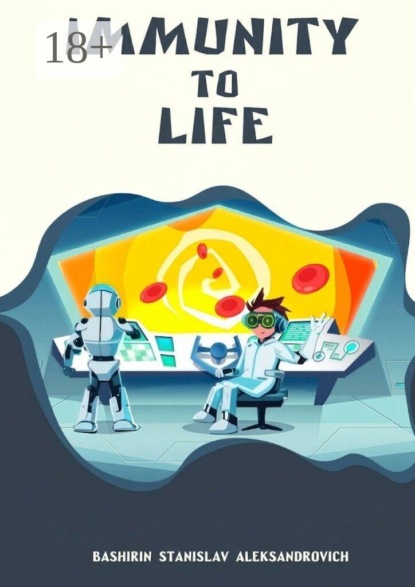




- -
- 100%
- +

© Stanislav A. Bashirin, 2026
ISBN 978-5-0071-3184-1
Created with Ridero smart publishing system
Preface
The human body is a strange, messy, wonderful thing.
When I was a kid, I devoured sci-fi novels about space — about distant stars, alien oceans, ships that sailed between galaxies. But there was always another world that pulled me in harder. Not the one out there. The one right here. Under my skin. Inside us.
We’re made of atoms that were born in exploding stars. Those stars probably never imagined that their particles would one day wake up, start asking questions, and begin exploring themselves — through us.
Our story started with supernovae, and it ended with something incredible: life. Messy. Complex. Beautiful. Our bodies built an entire army of cells that protect us, fight for us, die for us, and keep going. And I thought: why not tell their story as an adventure?
Let me tell you something about medical school.
Medicine is important — no doubt. But sometimes it’s painfully, soul-crushingly dull. Professors and the whole system manage to turn it into a pile of dry facts, like tasteless porridge without salt. Immunology is often taught as a checklist of allergies and diseases — not as the incredible, bloody, non-stop battle happening inside you every second.
Between the first lecture about ‘innate’ and ‘acquired’ immunity, and the later lectures about ‘what goes wrong,’ there’s a huge, dark gap. And students fall into it.
But immune cells aren’t mindless soldiers. They’re scouts, strategists, messengers. They talk to each other, coordinate, adapt. If you’ve ever played strategy games, you know: each unit has a role. You command, you plan, you attack.
But immune cells do all of that on their own. No commander needed. They just know.
That’s what I wanted to capture. Not the dry facts, but the story behind them. To give each cell a personality, a purpose, a voice. Because when you care about something — when you feel it — you remember it.
I won’t drown you in biochemistry. I’ll only touch on what you need to understand the story. Just enough to make you feel like you’re inside that world — the one that lives under your skin, right now, without you even noticing.
Because it’s there. Always. Fighting. Breathing. Waiting.
And that, my friend, is worth a story.
Chapter One
‘Do you realise how risky this is?’ Anna’s voice was tight, but she already knew the answer. He’d do it anyway. ‘Are you sure you can pull this off?’
Cody didn’t answer. He just sat there, still.
Her hands — steady from years of practice — slid the needle into the patient’s vein. The IV drip started its quiet work, carrying nutrients straight into his blood. She adjusted the flow, calm and precise.
Her dark-blonde hair fell over her white coat, almost blending with her pale skin. Her brown eyes — sharp, alive — showed worry. Not for the patient. For him. She was already calculating the next move. She hadn’t slept in two days. Not because she was preparing the room, but because she knew she’d spend the next hours — maybe days — watching over two people: a dying man and a reckless doctor. Both unconscious.
‘Don’t just sit there in silence,’ she said, turning to face him. Her voice cracked just a little.
Cody’s private office — once just an examination room — was now flooded with harsh light. At first glance, it still looked like a doctor’s space, but now it was crammed with resuscitation gear, two hospital beds, and a machine designed to transfer human consciousness. It looked like a futuristic hospital chamber.
‘Chaos’ — that’s what Anna would’ve called it. Despite the scattered books and notebooks on the windowsill and desk, Cody somehow kept the place sterile. When there were no patients, the UV lamp would burn for hours, killing bacteria, viruses, fungi. Now, with the patient here, he couldn’t use it. Instead, a bacterial recirculator hummed in the corner — safe for people, but useless against the microscopic world crawling over every surface.
That was the problem. Those invisible enemies were normally nothing to worry about — but not in this case. Not in this story.
Cody was a doctor and a self-taught physicist. He was about to transfer his own consciousness into a tiny exoskeleton the size of a human cell. He was going to travel inside his patient’s body — for one reason: to save him.
And in that world, the invisible enemies wouldn’t be small. They’d be giants.
Cody’s body swayed gently in the chair, rocking with the rhythm of his heartbeat. Years of practice had taught him coldness, control — but he’d never learned to shut out his patients’ suffering. Compassion was his engine. It was what drove him to steal months, years, sometimes decades from death’s hands.
Coldness and optimism — they were just masks. He wore them so others wouldn’t panic. So they’d trust him. But Anna saw right through him.
‘Did you see the female prototype?’ Cody said, forcing a faint smile, his eyes locked on hers. A weak joke. ‘It’s got the same cute face as you.’
Anna didn’t smile. She just stared, waiting. Her patience was gone.
‘Don’t be mad,’ he said quietly. ‘I have to do this. If I don’t, I’ll never forgive myself.’
He paused, searching her face for any sign of understanding.
‘He’s an adult. Grown. Human,’ she said, her gaze fixed on him. ‘You’re not responsible for saving everyone. You offered help. He chose to take it. You can’t carry every person you’ve ever tried to help. What do you say to that?’
‘I understand what you’re saying,’ Cody said. ‘But right now, the only thing standing between him and death is me and my invention.’
‘An untested invention,’ she shot back.
‘Isn’t that the perfect time to test it?’ he said, barely holding back a laugh.
‘When you get back, I swear I’ll kill you,’ she muttered, turning away and pulling ampoules from her bag.
‘I love it when you’re angry. You look even cuter,’ he said, grinning.
She cracked a smile. She couldn’t help it.
The vacuum of silence stretched for several minutes before her gentle voice broke it again.
‘Explain to me,’ she said, ‘how exactly your consciousness is supposed to transfer into that tiny robot?’
Cody opened his mouth, but she kept going, not waiting for the answer.
‘I get how the body works. I get the brain. But I don’t understand how your consciousness can exist in two places at once!’
‘Quantum entanglement,’ Cody said flatly, taking a slow sip of tea. He liked drinking tea during serious conversations. It annoyed people. But if the tea got cold, he got annoyed.
‘Thanks for the detailed explanation,’ she said, rolling her eyes with a theatrical sigh.
‘Let me explain,’ he said, setting the cup down. ‘Two particles collide and interact. They become linked.’
His hands started moving, performing the old familiar dance — touching, parting, drawing shapes in the air. When Cody talked about something he cared about, his hands became part of the story. His eyes burned. He locked onto her.
‘So. The neurons in the brain generate electromagnetic impulses at a certain frequency. Inside the robot’s ‘head’ — he pointed to the container with the exoskeleton — there’s a chip. Inside that chip are particles entangled with the ones generated by my brain. Particles that mirror my consciousness. Make sense?’
‘No,’ she said bluntly. ‘No one’s ever pinpointed what part of the brain creates consciousness. And what makes you think your consciousness inside the robot can’t be damaged? And if the robot’s consciousness gets damaged, does the real you get hurt?’
‘You’re already a little off. I mean a different kind of ‘broken’, ’ she added.
‘Fine. Listen,’ he sighed dramatically. ‘The chip is sealed inside a container that should — theoretically — block external electromagnetic fields. The entangled particles interact in isolation, even when they’re far apart. In theory, changing the state of one particle changes the other.’ His hands started doing the particle dance again, pulling apart, snapping together.
‘I still don’t understand why they’re connected like that,’ she said with a shrug.
‘I don’t either, honestly,’ he admitted. ‘The point is it works.’
‘And what about the damage?’
He said the thing he’d been avoiding.
‘I don’t know.’
He bit his lip. They both knew the risks. Anna’s scepticism had always been his shield — she was the one who kept him from chasing every crazy idea. But this time, she saw the look in his eyes. She knew he was already gone.
Cody’s actions always seemed illogical at first — reckless, even. But slowly, piece by piece, they’d form a clear picture.
Anna genuinely admired him.
The first time they met — back when ‘Cody’ was still just a pseudonym — he’d told her everything: his wildest ideas, his strangest theories. She listened, even when she didn’t understand.
The human brain is incredibly complex. When part of it dies — from a stroke, for example — other neurons take over. Neuroplasticity. And despite the old myth, we use all of it, not ten per cent. Every time we learn, new synapses form. The more you build, the faster the signals travel. The sharper your thinking.
Cody felt the limits of his brain. He was born smart, but he never stopped feeding it. He consumed knowledge. Sometimes he used nootropics to speed things up. But it wasn’t enough. There was always a wall.
Living matter is limited.
That thought became his starting point.
What if you could expand the number of ‘cores’ in your brain using external modules? It turned out you could. But he didn’t stop there. Once he increased his processing power, he brought in a partner — an AI. Cold, unconscious, just a set of algorithms. No creativity. No spark. Just data.
But something unexpected happened.
The living mind and the dead algorithm started something new — a way to bring impossible ideas to life.
That’s how consciousness transfer was born.
The key was the bridge between human reason and terabytes of encrypted data — an AI that gave Cody instant access to information without the burden of memorisation. No risk of forgetting.
It’s no surprise he chose that pseudonym.
It wasn’t planned. But one day, he tried to create a digital copy of his own consciousness — a matrix. He fed it into the AI he’d built. He named it Vivian. From the Latin vivus — alive.
But Vivian never woke up. No personality. No emotion. No dreams. No will to live.
Still, Cody kept the name.
Chapter Two
‘Time to start,’ Cody said calmly, lying on the couch, his body covered with electrodes, his head wrapped in a strange cap of wires and sensors. ‘After I inject the Vascularius, I’ll have about twelve seconds — just enough to take control and stop before I end up in a vessel the size of a thread.’
Anna smiled, but there was a hint of mockery in her voice.
‘‘Vascularius’ — that’s an interesting name for your ride. Why not ‘Nautilus’?’
Cody sighed; a flicker of regret passed through his eyes.
‘I really wanted to. But I can’t steal everything from my favourite books.’
‘Are you taking Vivian with you? Can he actually control the exoskeleton?’ she asked, carefully filling the syringe with a tranquiliser and sedative. The doctor’s pulse suddenly jumped to a hundred and twenty, and his hands started trembling — betraying him. He breathed in deeply.
‘Yes, I’m sure he’ll handle it. Tie my arms and legs to the couch, please. I don’t know what’ll happen to me during the transfer. Unfortunately, lab rats can’t tell you how it feels.’
He raised his hands, clenched them into fists a couple of times, then thoughtfully scratched his nose.
‘I wonder — what if my nose starts itching? Or something else?’
‘Hmph! You said you were calm, but your heart’s pounding like crazy, and you’re asking stupid questions. Actually, no — you always ask stupid questions,’ Anna shot back.
‘How could it not pound when I’ve got such a beautiful girl in front of me?’ he replied with a grin.
‘I’ll be the one needing sedatives soon. Why are you like this?’ she said, barely hiding a smile.
‘If I weren’t like this, you probably wouldn’t be sitting here right now, worrying about me,’ he admitted.
‘So explain this to me: why won’t your immune cells try to destroy you like some foreign microorganism?’ Anna asked, her eyes fixed on him.
‘I have a plan for that. Didn’t you read it?’ Cody said, with a hint of reproach.
‘Your notes are chaos — you never write anything in order,’ Anna said, her patience wearing thin.
‘Alright, don’t be mad,’ he said, smiling, though he knew that phrase usually made her even angrier. ‘I’ll get a protein from a healthy cell…’
‘Yeah, right! If you can find one — just look at him!’ she interrupted. ‘He’s got such a list of pathologies that it’s a miracle he’s still alive!’
‘That’s exactly why I’m going in — to find out what’s shutting down his immune system. And the fact that he’s still breathing — that’s all your doing.’
‘Protein,’ her voice cut in, firmly bringing him back on track.
‘Right! So, I’ll get the protein, and when I find an immune cell, I’ll present it for inspection — like a citizen’s passport.’
Cody had equipped the exoskeleton with a special double ‘hand’ that, like a tray, carefully holds out the protein structure to any immune cell — a macrophage1, a natural killer2, or any other. After a thorough check, he’d be free to go about his business.
The protein is synthesised inside the cell, and all the information about it is encoded in DNA3. If the genetic machinery is damaged — for example, by a viral infection or a mutation, like in cancer cells — the protein structure presented for inspection changes. That’s why it’s crucial to find a healthy cell with intact DNA and, consequently, a correctly synthesised protein.
The patient’s immunity was suppressed for an unknown reason, and Cody was counting on having enough time. Besides, Vivian was supposed to find a suitable ‘victim’. At this scale, the doctor’s consciousness is closely tied to his software assistant — only through Vivian can he distinguish between different cell types.
In reality, cells are stained with special dyes for microscopic examination. If you’ve ever seen colourful images of immune cells, those were always the result of stains. Vivian, however, digitises the images from Cody’s visual sensors and converts them into colour — familiar and comfortable for human perception.
‘After the transfer, a special window will appear on the laptop screen where we’ll communicate.’ His face suddenly became deadly serious.
‘You know how much I hate all this tech,’ she protested. ‘I can barely work with it…’
‘Don’t worry. You’ll manage.’
Anna noticed he was looking at her intently, almost demanding, but also with hope. She was the only person in his life he trusted completely, and that was no secret to either of them. She wanted to look away — her natural shyness told her to — but her heart wanted the opposite.
‘And don’t think it’s only because of that look that I’m ready to do anything for you,’ she said, holding his gaze.
‘Isn’t it?’ The room filled with laughter, and a moment later his left shoulder felt a gentle shove, which only made him laugh harder.
‘Alright, that’s enough! You’re blushing already! Go on, or you’ll forget something important again,’ she said, still smiling.
‘If I find anything important, I’ll report back immediately — the transmitter is on the Vascularius.’
‘So you’ll only report when you’re back on your ship?’
‘Yeah. Unfortunately, it can’t travel in the intercellular space — it’s only designed for vessels — veins and arteries. Can’t even squeeze through capillaries4.’ Cody’s brows furrowed. That limitation had always irked him.
Anna yawned so wide that a tear ran down her cheek.
‘Why didn’t you make it like a red blood cell5?’ she asked, stretching in her chair.
‘Get some rest when we start, okay? You mean how a red blood cell is larger than a capillary but still squeezes through?’
‘Yes.’
‘First of all, I don’t even know how to do that, and second…’ Cody paused. ‘Actually, why does it work?… Either way, red blood cells deform every time they pass through a vessel smaller than themselves. And I’d rather not cause a thrombosis6 — even at the level of a tiny capillary.’
‘You’re worried about one capillary?… Let’s just start: the sooner we begin, the sooner we’re done. Why aren’t you asleep yet?’
‘In the grand scheme of things, one capillary is a minor loss,’ Cody said. ‘But what could become of me, stuck in that one?’
The room filled with laughter again — this time it was Anna’s. She remembered how, one winter, Cody had tried to take off his anorak, but the zip jammed treacherously, and he ended up literally trapped, waiting for her to rescue him. She couldn’t help laughing at the memory.
A minute later, Anna broke the silence.
‘Anything else you want to say?’
‘Yeah,’ came the reply, without a trace of emotion.
A few seconds passed. Anna prompted him.
‘Well? Spit it out! Why are you frozen?’
‘Scratch my nose, please,’ Cody said, equally deadpan. His eyelids were already starting to droop.
‘Right. That’s it. Sleep!’ Anna said decisively. ‘The sedative finally kicked in.’
‘What would I do without…’
She spent another minute watching him sleep, drinking him in. Then she sat down at the laptop…
Chapter Three
‘How?!’ Cody yelled as he fell. ‘How do you fly this thing?!’
Vivian approached slowly, silently, stopping beside Cody’s motionless body on the floor of the Vascularius. He leaned in and froze, staring through two glowing lenses. Inside them, smaller lenses spun, emitting a faint blue neon glow.
‘First of all, that’s creepy. Don’t look at me like that. And second — I didn’t design my visual apparatus this way. Do I have to turn my head like an owl?!’
‘Doctor, you need to focus on me. I’ve made some adjustments to the lenses — creating servos small enough for their movement was impossible.’ Vivian didn’t look away until he saw movement in Cody’s “eyes.”
‘Is the image clear?’
‘Yeah… Almost. But I can’t move. Take control yourself and activate the sensors — you need to simulate the movements. And don’t forget the sensors — I can’t feel my body… I think something’s wrong, Vivian… Vivian!’ Cody was straining every fibre of his composure.
In reality, a person always knows where their hand, leg, or any other limb is. This is thanks to proprioception. Though I prefer the term “kinesthesia” — it includes not just “body position awareness” but also the information gathered by the senses.
Muscles are equipped with special nerve endings — receptors, which in this case are proprioceptors. They receive information about body position, about how other objects affect it — like clothing — and send that information to the brain. The brain collects these signals from the entire body and creates a complete picture.
Cody’s condition could be called sensory ataxia — he couldn’t feel his mechanical arms, his legs, or even the white coat he was wearing — a set of elastic plates that mimicked a doctor’s attire. The coat recreated the authentic look and also served as a protective suit. At least, its creator wanted to be safe.
Vivian knelt down and placed his three-fingered hands on Cody’s head. Surprisingly, the doctor vaguely resembled his real self — especially the tousled “hair” on his head, which doubled as antennas and receptors.
Cody felt every part of his new body come to life in response to Vivian’s touch. He felt an unfamiliar warmth and lightness, as if his own skin had absorbed new sensations, and the world around him was opening up in a completely new way.
Exactly like after a limb falls asleep — he felt a tingling, like sparks of electricity shooting through his limbs. His arms began to move, then his legs. A tremor ran down his “spine,” and he tried to take a deep breath — the kind you take after falling flat on your back, painful but necessary. But apart from the panic, nothing happened. No matter how hard he tried, he couldn’t breathe. The two bright flames inspired no calm.
“Doctor, you’re in the exoskeleton… Consciousness successfully transferred… Doctor, are you alright?” — the two glowing eyes stared relentlessly at the trembling mechanical body. First his head stopped moving, then the rest of him. The joints of this invention looked like intertwined cables — they coiled, uncoiled, and returned to their original position, moving the body parts like levers.
‘That’s better. I can manage on my own now,’ Cody said, his voice shaking as he struggled to stay upright after standing up; his head turned twice on its axis. ‘How wonderful! Now I just need to fix the focus.’
‘I’m calibrating it now. Just a little more and it’ll be ready.’
Cody fumbled for the chair and dropped into it. The body bounced slightly. The fear of death still hadn’t left him.
‘Funny! Feels like a video game,’ he tried to calm himself.
‘Can you simulate emotions?’ the doctor asked the motionless Vivian.
‘Why?’
‘It’s easier for me to perceive you as alive. Real people… feel things. I’d like you to… you know, at least pretend to be worried about me.’
‘Doctor, that never bothered you before.’
‘Right now, you’re a humanoid. I think you understand that as a human, I’m used to human company.’ If Anna could see Cody under a microscope, she would immediately recognise from his habit of gesturing that he was talking. She could even gauge his emotional state from the amplitude and intensity of those movements.
‘You don’t like society,’ Vivian stated.
‘But I like people. You can’t be a doctor and not like people.’
‘Then why don’t you like society?’ Vivian asked with complete indifference.
‘Because individually — people are interesting! Stupid, smart, decent or not — they’re fascinating. But when they form groups, their differences create a chaos that’s only controlled for so long.’
‘For so long,’ Vivian repeated, as if to himself, followed by silence.
‘And don’t think I don’t fit in,’ the doctor continued with annoyance. ‘I’ve given society a lot — you know that. But it’s not always appreciated, and it doesn’t always turn out well.’
‘Doctor, there’s no need to justify yourself to a machine. You felt fear, even though people with more composure are hard to find. It bothers you that I don’t feel emotions — including fear. Don’t think you’ve shown weakness — I was created to help you, not to judge your abilities. I also know you start arguments every time you try to distract yourself. And Anna is waiting for your signal.’
‘Hang on, I haven’t even seen my spaceship yet — only sketches,’ Cody looked away from his companion. ‘You could at least play along in the argument, you pedant.’
‘This vessel is not designed for space travel,’ Vivian corrected him, equally monotonously. But the objection was ignored — the yellow glow in his eyes, like an incandescent lamp, grew brighter. They greedily examined the interior of the “spaceship.” If the doctor’s eyes radiated the warmth of the human soul, Vivian’s were cold as ice — and their blue colour only emphasised that coldness.