



- -
- 100%
- +
‘You pe-e-edant!’ the doctor said, and started pacing, remembering childhood dreams of interstellar voyages.
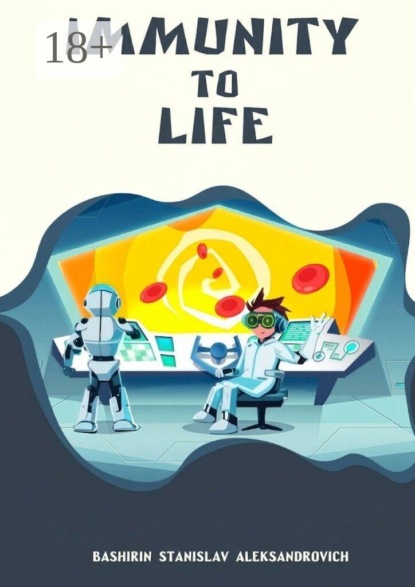
In the centre of the vessel rose a hall with a high, dome-shaped ceiling that seemed alive, like the heart of a microscopic sea giant. A central “spine” or “backbone” ran from tail to head, with thick, intertwined fibres (wires) that resembled the skeleton of a fish designed to sail through the circulatory system.
The ship’s walls were lined with rows of smooth, glowing tiles that emitted a soft beige light.
Many instruments and sensors were attached to the fibres descending from the “spine” down the walls, like ribs. This equipment was used for data collection, repairs, and maintenance — Vivian often worked with it and knew the purpose of every tiny part.
The captain’s bridge was slightly elevated and separated from the rest of the deck by a transparent screen. On the bridge stood the captain’s chair, upholstered in black fabric with a high curved back. Next to the chair, above the control panel, was a helm — its shape resembling the ship’s wheel used by ancient sailors who conquered seas and oceans. But this one was smaller and equipped with buttons and levers.
The instrument panel in front of the captain’s chair was crowded with screens, buttons, and levers.
At the base of the “spine,” above the captain’s chair, was a cylindrical structure covered in a mesh of thin silver wires, containing the main systems and components — the brain and heart of the Vascularius.
A circular platform in the centre of the room, surrounded by a halo of chaotically flickering luminescence, was where Cody had appeared during the consciousness transfer. He stood there now, caught in the bitterness of the sensations he’d experienced when he couldn’t control his new body.
A complex mechanism where every element worked in unison. And Vivian was part of that mechanism.
Cody had his reasons for disliking society, but he hated loneliness even more.
The desire to see a friend in his creation was reflected in his attitude towards Vivian: seeing the world through new eyes, he felt a strange closeness to this mysterious creation, as if they shared something beyond mere inventor and invention. If the fear that had enveloped him at the beginning of the transfer was slowly fading, his doubts — mixed with disappointment — about those two icy lights were only growing.
Chapter Four
‘Turbines are operational,’ Vivian reported.
‘Will the hull coating actually let us attach to the vessel endothelium?7’ Cody asked suspiciously, gripping the helm tightly with his mechanical hands.
‘Yes,’ Vivian confirmed. ‘What’s more, it will prevent platelet adhesion, just as you designed.’
Cody nodded silently, thinking through the next steps. He stared through the bridge’s porthole, visualising the contours of enormous endothelial cells lining the vessels like a mosaic of diamonds. Before his inner eye, the heart muscle shimmered with electric light.
In reality, if a blood vessel — specifically the endothelium, its inner lining — is damaged, platelets immediately rush to seal the breach. They attach to the rough edges of the endothelium, and the already-adhered platelets release chemical signals, calling their free-floating comrades to join them. These tiny heroic creatures seem to cry out: “We’re here! We need help! Our world is in danger!” The whispers of chemical language weave with the waves of blood, creating a musical symphony of survival. These minuscule particles, whose sacrifices and lives seem insignificant on the grand scale of the human body, make an invaluable contribution. They announce their activation and set about their primary task — stopping the bleeding. Initially round, upon activation platelets sprout tendrils that others grab onto as they drift past.
In this story, Anna had repeatedly administered various medications to the patient, keeping his body alive. If the platelets — of which, incidentally, he had very few, the cause of which our heroes are trying to discover — hadn’t sealed the vein after the syringe was withdrawn, the patient could have bled to death from even that tiny wound.
For Dr. Cody, it was crucial that the Vascularius’s hull remained perfectly smooth, without the slightest irregularity. This ensured that passing platelets wouldn’t mistake it for a damaged vessel wall. Even the two turbines, designed to counter the blood flow, only extended from the hull when the submarine detached from the vein or artery wall.
In large arteries with high blood flow — where the turbines can’t provide enough thrust — Dr. Cody relies on a simple trick: laminar flow. Just as a river flows faster in the middle and slower near the banks due to friction, blood speed inside vessels follows the same laws. In the centre of a large artery like the aorta, blood flows significantly faster than near the walls. There, where the Vascularius hugs the surface, the speed is much lower. This helps the submarine move in the right direction.
This explanation is meant to help the reader understand how a tiny underwater vessel can resist the powerful, rushing current of blood inside the body.
‘You know, Vivian, what really interests me?’ Cody asked his assistant. Not waiting for an answer, he paused briefly and continued. ‘Even in a mechanical body, I’m still aware that I am me.’
Vivian met Cody’s gaze, using his processing power to make sense of what he’d heard.
Cody felt the need to explain before Vivian got lost — the idea was so deep it didn’t seem obvious at first.
‘When I was human, I knew there was ‘me’ and there was the world around me. That my hands, my legs, my head, even my hair — all of it was part of me, and the world was something separate. You understand? Even though I rationally knew I was part of that world, made of the same atoms as everything else. And even now, in a mechanical body, it feels exactly the same. Why is that? And it’s not about nerve endings.’
‘It’s a feature of human psychology. I don’t have it. Your consciousness needs to recognise ‘itself’ as ‘itself.’ Even at the immune level, your cells distinguish ‘self’ from ‘non-self.’ And it’s the same at every level of your makeup. Even if a person loses a limb, because of this property, they’ll feel for a long time that it’s still there — and sometimes even feel pain in it,’ Vivian concluded.
‘Every person,’ Cody continued, ‘is like a little universe. He knows he’s a whole world, that there are other worlds like his, and that there’s a much larger world beyond. Sounds interesting, don’t you think?’ Cody’s eyes sparkled, as if he was on the verge of a philosophical breakthrough.
‘I understand that you, as an emotional and creative being, have a tendency to exaggerate,’ Vivian said flatly.
‘You don’t understand anything,’ Cody hissed, turning to the porthole in irritation. ‘Anna would definitely have appreciated my thoughts.’
‘Anna would have pretended to listen, doctor, because she clearly doesn’t enjoy these kinds of conversations,’ Vivian said. ‘By the way, are you sure she can handle the task?’
‘Anna is very responsible. She always worries when someone — especially me — needs her help. I think she’ll manage,’ Cody replied, keeping his faith in his companion, though his voice still sounded irritated.
‘Then you should have fully briefed Anna, since…’ Vivian began.
‘She’s responsible, sure, but if she knew everything, she’d start worrying… And excessive worry would just ruin everything, you understand?’ Cody cut him off sharply.
‘So she doesn’t even know you kidnapped your friend from the clinic to find the cause of his suppressed immunity?’ Vivian’s words struck like weapons. ‘Does she know your friend became your enemy? Does she realise the danger of the adventure you’ve recklessly dragged her into?’ The last sentence sounded like a verdict.
After a long silence, Cody finally answered.
‘I can’t do this without her.’
There was a pause — the kind where he would normally take a deep breath.
‘I have no one else. I think I’ve thought this through. The fact that she doesn’t know the whole truth — that’s irresponsible. I agree. It’s just… you don’t understand that even someone as smart as she is makes mistakes that could have been avoided. She worries about everything. I’ll tell her everything. Later.’
A moment later, Cody smiled faintly, remembering something funny.
‘Once, Anna had dinner later than usual…’ The doctor glanced at Vivian, as if sharing something childishly naive but with a touch of admiration. ‘And instead of going to bed, she stayed awake for three whole hours. You know as well as I do that people lose weight while they sleep — growth hormone breaks down fat and all that… Well, Anna knows that too. She also knows that if she eats right before bed, it triggers insulin production.8 And what does that lead to?’ Without waiting for an answer, he continued. ‘Right. Less growth hormone, less fat burned, and insulin helps store new reserves… Women, you know — always dieting, watching their weight. But Anna’s different — she was exhausted, desperate to sleep, her body running on fumes, but instead of closing her eyes and resting — what did she do? She watched movies. Exactly long enough to wait out that damn insulin phase. And she made it, even though she usually falls asleep like a log at that hour. I don’t think she’d ever watched a single movie all the way through before — because she always fell asleep halfway. And you know what? She didn’t regret it one bit — even though she was sleepy and grumpy the whole next day. But then she fell asleep with a sense of duty fulfilled. That’s Anna,’ Cody said, captivated by the memory.
As he sank into memory, he stopped being here and was already there — in that place where countless fragments of memory are stored, like film reels, texts, barely perceptible emotions he himself had once felt. Immersing himself, he didn’t just remember — he watched himself from the outside, as if everything he’d experienced no longer belonged only to him, but also to that other person he had been before.
Cody wasn’t a machine — his smile was genuine, and the smallest details of his “face” conveyed the kindness of a human soul. That kindness was as mysterious and unfathomable as human nature itself. No one had ever seen a soul, but everyone knew it existed — some called it a divine gift, others a product of the brain, consciousness.
The robot, however, knew nothing of kindness, compassion, or sincerity. It simply processed data, retrieving it from memory without the slightest trace of emotion. For him, this process was merely mechanical, unconnected to that half-dream state where, against a backdrop of emptiness, a bright or faded cloud would appear. In that cloud, a memory didn’t play — perhaps distorted, worn by time and new experience. But for a human, that cloud was precious, because it held the most intimate moments of their life.
‘Are you still sure about your plan?’ Vivian asked, his voice now serious.
Snapped back to reality by the question, Cody nodded slowly, his gaze fixed on the floor beneath his feet.
‘Almost,’ he replied quietly. He seemed to be wrestling with doubts, bubbling up again in his dishevelled head, irritated that he couldn’t bite his lower lip as he usually did.
Vivian paused for a moment, his voice growing stricter.
‘In your situation, ‘almost’ is not acceptable.’
Despite the tension, Cody smiled ironically and shook his head slightly. The hair on his head seemed to compress under electromagnetic tension for a moment, then returned to normal.
‘Very ‘almost,’’ he added. ‘Who am I even wasting my breath on here?!… Alright, let’s get started,’ Cody concluded, annoyed.
‘The red button on the control panel — slightly to your right…’
‘No, wait. I’m not done!’ Cody turned back to the robot, this time with his whole body. ‘Why do you doubt me? If I could come up with you, design you, then…’
Cody was about to continue, but Vivian cut him off.
‘No one doubts your intelligence, doctor,’ he said firmly.
‘Then why — if I’m so clever — why does everyone around me, and what hurts more — even you, even a ‘cold’ hunk of metal that doesn’t even know how to doubt properly — think I can’t plan anything in real life? Why?!’ Cody’s voice was laced with resentment, its roots clearly reaching deep into the past.
‘Because nothing ever goes according to your plan.’
‘Maybe I planned it so that it wouldn’t go according to plan? Maybe my plan is that everything will go off-plan?’ The doctor no longer cared whether his words reached the mechanical heart or what objections would follow, because the chair spun quickly towards the control panel, and the red button became the full stop of the conversation.
‘Next stop: the right atrium! Everyone fasten your seatbelts!’
The Vascularius lurched into motion: turbines extended from the hull and spun in reverse, resisting the flow of blood as they entered the vessel.
Anna received the signal…
Chapter Five
‘This is magnificent! Absolutely incredible! Do you even realise how cool this is?!’ Cody exclaimed, pressing his face against the porthole, unable to tear his gaze away from the beauty around him. His eyes burned brighter with wonder as he watched the red blood cells drift past — disc-shaped, shimmering in the light of the Vascularius.
Vivian, focused on the instrument panel, didn’t even glance at Cody.
‘The sonar indicates we’re moving almost flush against the vein wall,’ he said, not looking up from the instruments. ‘I’ll relay the image to you.’
Cody let out a joyful cry in response. The sound waves the Vascularius sent towards the surrounding cells, and which bounced back, allowed the doctor to see everything around him — much like a bat navigating in the dark. And he could see surprisingly far.
This is exactly how ultrasound machines work: sound waves are directed into the body, where each structure has its own unique density. The reflected signals return to the device, which records not only the intensity of the reflected sound but also the time it took to return — allowing it to determine distance, size, and volume. Processing this data, the machine creates a complete image of the body’s internal structures.
However, while a standard ultrasound displays a two-dimensional, flat image, Cody and his companion saw a volumetric, three-dimensional picture. This was possible because the processing and reconstruction happened directly in the “brain” — capable of creating a full, detailed map of the surrounding space.
‘Doctor, directly ahead — a red blood cell,’ Vivian said. ‘Be careful.’
Red blood cells are shaped like discs — or even doughnuts, but without a hole in the middle and without icing. Concave and slightly flattened, they appear red due to haemoglobin, which carries oxygen to various organs and tissues. Unlike other blood cells — except perhaps platelets — red blood cells have no nucleus or DNA, making them incapable of self-repair. Over time, they wear out, as they travel through vessels, colliding with walls, each other, and squeezing, deforming, through capillaries narrower than themselves. Such trials mercilessly damage their membranes.
Like diligent workers, after serving their time, they die in the spleen — a kind of “red blood cell graveyard.” It sounds a bit frightening and even sad, but such is the fate of these deliverers of life-giving oxygen.
Like a nimble fish, the Vascularius wove through clusters of dark-crimson cells. Its streamlined hull cut decisively through the viscous, pale-amber fluid. The blood itself appeared as burnt gold, which to human eyes took on a different hue due to the red blood cells, giving it a fiery-ruby tint. As the Vascularius cruised through the vein, its thin tail fin left a trail behind — like the white contrail of an aeroplane in the sky — a brief life tracing the path of its creator.
The whitish-yellow walls of the veins, lined with diamond-shaped endothelial cells, seemed to blur as the Vascularius rushed past with a quiet, almost imperceptible hum. The fluid seemed to come alive; its foaming molecules danced and swirled chaotically around the ship.
Cody turned the helm to the right and tilted his head the same way.
‘Hey! What the…?!’ The Vascularius shuddered — and Cody with it.
‘You collided with a red cell on the right,’ Vivian said, not even flinching, as if he’d known it would happen.
‘No problem, I’ll get the hang of it! Just need to get used to it!’ The doctor imagined himself as a spaceship pilot, weaving through an asteroid field.
He’d spent countless nights playing computer games — whether out of boredom, or trying to escape into a more interesting, colourful world than the one around him, fleeing loneliness. Even in the real world, the doctor imagined himself as the protagonist of a game called “life” — it helped him cope with everyday struggles, which felt like new quests, missions, or levels. On the one hand, this approach really does generate motivation, fuelling him with energy, as a nuclear reactor would, and every small victory strengthens his self-belief. On the other hand, you mustn’t forget that every person you meet is a hero in their own story.
Spinning the helm, Cody manoeuvred deftly between red blood cells, lifting, dipping, pulling the ship close. But a sudden impact from the left threw the vessel to the right, provoking the pilot’s outrage.
‘Where did that one come from?!’ Cody yelled.
‘Cell movement is sometimes chaotic,’ Vivian explained immediately. ‘One of them ricocheted straight into us. Be careful. Remember: the Vascularius’s eyes are your eyes. Concentrate.’
‘I know!’ Cody grumbled, but kept dodging one red disc after another. Then another impact — the Vascularius spun, and the image in the porthole blurred. But Cody quickly cut the turbines, and the current levelled the ship.
Ahead of the pilot, two cells were moving towards each other. The Vascularius held its course, heading straight for them. A moment more — and the ship reached the critical point, but the cells collided and scattered in opposite directions. In that instant, the Vascularius shot through the gap between them.
‘Ha-ha! See that?!’ Cody exclaimed proudly, and immediately spotted another cell. ‘Come on, then!…’ The pilot yanked the helm down, throwing his whole weight into it. ‘Yes!…’ Another threat neutralised by a virtuoso manoeuvre, and the deck rang with laughter and triumphant cries.
‘See? And you doubted me,’ Cody said gleefully.
As he travelled deeper through the circulatory system towards the heart, the sound waves from the sonar reached farther — the vein’s diameter was growing, and with it the pulsating surges forward grew stronger, merging with the heartbeat.
The ship quickly reached the superior vena cava.
‘Doctor, according to the sensors, we’re about to enter the right atrium. Activate the electromagnetic field…’ Vivian said, and Cody automatically pulled a small lever on the left side of the helm.
The giant vein launched the Vascularius into the void like a cannonball. Red blood cells stretched, blurred, and lost their familiar shape at high speed. For a moment, Cody lost control and gripped the wheel with all his might, resisting the vortex. But the Vascularius, like a living creature, fought the turbulent blood flow entering the atrium and rushed towards the negatively charged endocardium.9 The electromagnetic field on the hull began pulling it towards the inner wall, where the flow was weaker. The turbines, working at full capacity, allowed full manoeuvrability again, and Cody, still disoriented, turned to Vivian and asked uncertainly.
‘Have we arrived?’
‘Almost,’ Vivian said, releasing the levers that had served as handrails. ‘At least we’re safe now. We’ve reached a spot where the heart’s contractions aren’t felt as strongly.’
They had likely been pulled towards the boundary between the right and left atria — the interatrial septum. Here they amplified the energy field, retracted the turbines into the hull, and docked against the endocardium, feeling a gentle jolt.
‘Now we’ve arrived,’ Vivian said after the docking.
Cody continued sitting, staring through the porthole, gripping the helm with a death grip. His mind was a tangle of thoughts — the thrill of the journey, countless drifting cells, the vortex of blood. And perhaps most importantly — he was in the heart. A place where every emotional wound left its scar.
The pain that every person on earth had ever felt was like a hammer striking fragile glass. Every sorrow was like a sea flooding a barren landscape — the garden of joy where happiness bloomed. Every moment of love was like a ray of sun warming the soul. Every smile was like a melody echoing somewhere in the chest. Every tender moment was like a soft, pulsing touch.
Cody remembered every emotion he’d experienced with every heartbeat. And like any other person, the heart held a sacred, special meaning for him — even though it was just a pump moving blood through the body.
Cody released the helm, stood up, and walked slowly towards Vivian, who was busy pulling flasks from a small cabinet.
‘What are you doing?’ Cody asked, his “brows” furrowing with curiosity.
‘These are for collecting protein,’ Vivian replied, ‘as well as cytokines10, enzymes, and other substances that might prove useful, doctor.’ His hands moved quickly and confidently, with his characteristic mechanical precision. ‘Our supplies are limited, but we’ll most likely have to replenish them on site.’
‘I see,’ Cody said quietly, his gaze dropping thoughtfully. His eyes slid over the cables hanging down and the shimmering panels of the Vascularius’s interior.
The robot didn’t pause.
‘Doctor, perhaps you should contact Anna?’
The doctor’s gaze instantly shifted to Vivian, then to the bridge. Those words snapped him out of his daze, and a faint smile appeared on his face.
‘What, you can read my mind now?’ he asked, feigning surprise.
And throwing himself into the chair, he dropped into it, bouncing slightly as usual.
He activated the console, and the screen came to life, becoming a thread connecting him to the outside world. The smile on the doctor’s face brightened with anticipation, and his fingers glided smoothly across the keys, like a dance, drawing out the hidden letters: “Anna.” His eyes fixed on the screen.
Конец ознакомительного фрагмента.
Текст предоставлен ООО «Литрес».
Прочитайте эту книгу целиком, купив полную легальную версию на Литрес.
Безопасно оплатить книгу можно банковской картой Visa, MasterCard, Maestro, со счета мобильного телефона, с платежного терминала, в салоне МТС или Связной, через PayPal, WebMoney, Яндекс.Деньги, QIWI Кошелек, бонусными картами или другим удобным Вам способом.
Примечания
1
Macrophages — a type of white blood cell that acts as a “cleaner” in the body. They engulf and destroy harmful microbes, dead cells, and other debris.
2
NK cells (Natural Killers) — another type of white blood cell that protects the body from infections and cancer. They “sense” dangerous cells and can destroy them quickly without prior activation.
3
DNA — the molecule that carries all genetic information. It’s like a long chain of “letters” (nucleotides) that encode instructions for building proteins and determine hereditary traits. If DNA is damaged, cells may malfunction, leading to diseases like cancer.
4
Capillaries — the smallest and thinnest blood vessels in the body. They connect arteries and veins, allowing oxygen, carbon dioxide, and nutrients to exchange between blood and tissues.