

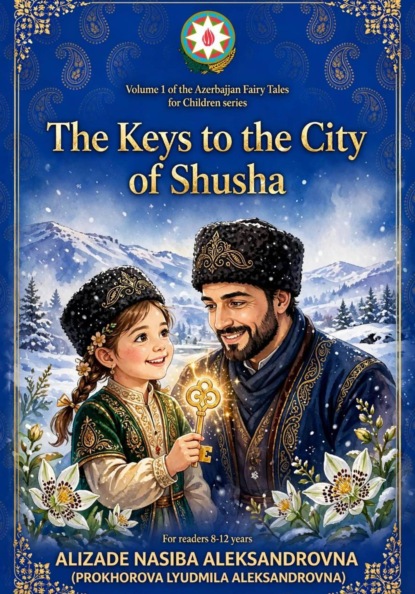
The Keys of the City of Shusha


- -
- 100%
- +

Глава
Chapter 1. The Tale of January: The Magic Key of Icherisheher
When the first lights of the new year are lit in Baku, and the streets smell of tangerines and pomegranates, the ancient Maiden Tower awakens in the very heart of Icherisheher.
The winter wind wandered along the fortress walls, climbed into the cracks between the old stones, and told them stories a thousand years old. That evening it was especially restless. From the sea came the scent of salt and fuel oil, from the teahouse drifted the aroma of saffron and fresh churek, and somewhere in the distance, children’s laughter mixed with music pouring from open windows.
Little Nasiba loved to walk with Uncle Sasha, her mother’s younger brother, through the narrow stone streets of the Old City. Her red boots clattered brightly on the cobblestones, and the warm scarf knitted by her grandmother smelled of home and cinnamon. This evening, Uncle, who usually loved strolls along the embankment, suddenly turned toward the tower itself.
“Today is a special night,” he said, and his eyes gleamed in the lantern light like two beads. “They say once a year, on the first night of January, the tower chooses the keeper of the magic key. Not just anyone — only the one whose heart holds kindness.”
Nasiba raised her head. The Maiden Tower stood before her, tall and mysterious. By day it looked simply ancient, covered in wrinkle-cracks. But now, in the blue twilight, its golden outline lighting shone brighter than usual. The light ran over the stones like living gold, tracing every ledge, every loophole. It seemed the tower was breathing.
Suddenly the air grew warm, despite January. The heavy wooden door, bound with iron, creaked open. On the threshold appeared an old woman. She was small, but stood as straight as a young girl. Her dress was the color of the night sky, embroidered with golden pomegranates and wheat stalks. In her hair, silver as moonlight, bloomed tiny khari-bulbul flowers.
“I am Khari-bulbul, the spirit of these lands,” she smiled. Her voice sounded like rustling leaves and a distant mugham song at once. “Our fairy-tale calendar begins here, by the walls that remember everything. To travel the path from Icherisheher to Shusha and gather all 12 festive stories, you need a key.”
The old woman took a step, and not a single pebble crunched under her feet. She held out a small golden key to Leyla. It was warm and light, and its bit was carved in the shape of a buta — the ancient drop-shaped pattern that means life, fire, and eternity.
“But remember, child,” Khari-bulbul touched Nasiba’s chest, “the key opens not doors, but hearts. January is the month of new beginnings. The first holiday of the year is a time when people make wishes. But true magic begins not with a wish for yourself, but with a good deed for another. What good deed will you do today?”
Nasiba clutched the key tightly. It answered at once, warming in her palm like a chick. The girl closed her eyes and thought. The face of Auntie Milena from the second floor surfaced before her. Auntie Milena baked the tastiest shekerbura, but since her son had left, she hardly ever went out. Her windows in winter were always dark.
“I… I’ll bring her a piece of Grandma’s gogal!” Nasiba suddenly said loudly. “And I’ll draw her a card. A big one, with the Maiden Tower and a pomegranate. So she won’t be lonely in the New Year!”
The moment she said it, the key in her palm flared with soft light. It grew so warm that Nasiba almost let go. The tower’s golden illumination ran upward to the very top, and there, on the ancient stone, fiery letters appeared. They formed the first page of an enormous calendar:
“January. The Holiday of New Beginnings”
And just below, in ornate script, more words appeared: “Kindness, done from the heart, opens any road.”
Uncle Sasha watched in silence. When the letters faded, he dropped to one knee and hugged his niece. His coat smelled of tobacco and old books.
“So you’ve turned the first key, Nasiba,” he said, and there was pride in his voice. “Ahead lie 11 more fairy tales, 11 holidays, and a long road to Shusha. Each month — a new story, a new trial, and a new lesson. But now you are the keeper of the calendar. The key chose you.”
Khari-bulbul nodded and began to melt into the air, like smoke from fragrant tea. The last thing Nasiba saw was the flower in her hair. It detached and floated down onto the girl’s palm, turning into a golden badge shaped like a buta.
“When it gets hard, squeeze it,” came a voice from nowhere. “And remember why you’re walking.”
The tower door closed silently.
They walked back with Uncle in silence. Nasiba held the key and the badge to her chest. It seemed to her that all of Icherisheher was looking at her differently. Lanterns winked, cats warming themselves by the walls watched her intently, and in the windows of houses she thought she saw silhouettes of people from past centuries.
At home, Grandma was already waiting for them with hot tea and gogal. Without a word, Leyla took the two most golden ones, wrapped them in a napkin, took out her paints, and sat down to draw a card. She painted the Maiden Tower, golden and shining, and next to it — a small door with a kind old woman peeking out.
Half an hour later, she threw her coat on right over her house dress and ran to Auntie Milena. The door was opened by a surprised old woman with tear-stained eyes.
“Happy New Year, Auntie Milena!” Nasiba blurted out and held out the gogal and the card. “This is for you. So your year will be sweet!”
Auntie Milena took the gift. Her hands trembled. She looked at the card for a long time, then at Nasiba, and suddenly hugged the girl tightly.
“Thank you, sunshine,” she whispered. “You have no idea how timely this is…”
At that moment, the key in Nasiba’s pocket grew completely hot. And when she returned home and looked out the window, she saw snowflakes slowly circling over Icherisheher. They didn’t melt when they reached the ground — they turned into tiny sparks of light.
The Maiden Tower smiled quietly into the night. Its golden outline glowed softly in the darkness, as if winking at everyone who believes in miracles and is ready to open their heart to a good deed.
The first page of the fairy-tale calendar had been turned. February awaited.
End of the first tale
The Tale of February: The Lost Letters
February in Baku smells of damp wind from the Caspian and the first, still timid hints of spring. The snow no longer sparkled, but melted on the cobblestones of Icherisheher, turning into little mirrors that reflected the gray sky.
After the January night with the magic key, Nasiba carried the golden buta-badge in her pocket every day. Sometimes it warmed, as if reminding her: the fairy-tale calendar is waiting.
On one such day, February 21, Grandpa took Leyla to the Old City library.
“Today is Mother Language Day,” he said. “It’s a holiday for all the words we use to think, dream, and love.”
In the quiet hall of the library it smelled of old books and thyme tea. The librarian, Auntie Nigyar, showed Nasiba the oldest book. Its leather cover was cracked with age, and on the spine a buta was embossed in gold.
“This is ‘The Book of Native Speech,’” Auntie Nigyar whispered. “They say the soul of our language lives in it.”
As soon as Nasiba touched the cover, the book shuddered. The lock clicked, the pages flew open on their own — and suddenly, with a loud rustle, hundreds of golden letters fluttered out of it like fireflies! They circled the hall, flew out the window, and scattered over Icherisheher.
“Oh!” Auntie Nigyar gasped. “Without letters the book will go mute. And if the language goes mute, then the heart of the people will fall silent…”
At that same moment, the buta-badge in Nasiba’s pocket grew hot. Before her, woven from a sunbeam, Khari-bulbul appeared. Today her dress was the color of ink and paper, and golden letters shimmered in her hair.
“The key did not choose you for nothing, keeper,” she said. “The letters have scattered through the city. They got frightened that people were starting to forget their native words, replacing them with foreign ones. By sunset we must gather them, or the holiday will not come.”
Nasiba nodded and ran out into the street. The first letter — the ringing “Ç” — was trembling on an almond petal that was about to bloom by the fortress wall.
“Don’t be afraid,” Nasiba said to it in Azerbaijani. “‘Ç’ is for ‘çıçək’ — flower. Without you we can’t say how beautiful spring is.”
The letter trustingly lowered itself onto her palm and turned into a warm spark.
By the Maiden Tower, Nasiba found “Ş.” The letter was hiding in the shadows, frightened by the noise of cars.
“‘Ş’ is for ‘şəhər’ — city,” Nasiba smiled. “This is our Baku, our Icherisheher. We need you.”
So, word by word, she walked the streets. She took “A” from the dome of the mosque — it’s “ana,” mother. “V” was found in the cooing of pigeons — “vətən,” homeland. “M” was warming itself by the samovar in the teahouse — “musiqi,” music.
The hardest was the letter “Ə.” The most tender and melodious, it had hidden in the darkest corner and was crying.
“Everyone forgets me,” it sobbed. “I’m hard to pronounce. They replace me with ‘E’.”
Nasiba sat down beside it on the cold stone.
“‘Ə’ is for ‘əl,’ hand. It’s ‘ər,’ husband, ‘ailə,’ family, ‘Əlifba,’ alphabet book. Without you there is no ‘Azərbaycan.’ You are the most ours. Come to me.”
And “Ə” flew to her, the brightest of all.
When the sun touched the sea, Nasiba returned to the library. A whole swarm of golden letters glowed in her palms. She opened The Book of Native Speech, and the letters poured onto the pages, becoming words, poems, fairy tales. The book sighed, and the hall filled with the scent of pomegranate and fresh bread.
Khari-bulbul touched Nasiba’s shoulder.
“You returned not just letters. You returned pride. Today every child who speaks their native language will light one of them in their heart.”
On the last page of the book, a new entry appeared in the calendar, in gold:
“February. The Holiday of the Native Language. Who guards the word — guards the soul of the people.”
That evening, Auntie Nigyar read fairy tales in Azerbaijani to the children in the library. And Nasiba, walking home, heard how all of Icherisheher sounded: in laughter, in a mugham song from a window, in a mother calling her son to dinner.
The buta-badge in her pocket was warm. The second key had been turned. March awaited.
End of the second tale
Chapter 3. The Tale of March: Novruz Bayram
March in Baku always comes with wind. It tears winter’s silence from the roofs, rattles the windows of Icherisheher, and brings the smell of earth, rain, and the first buds. And March also brings Novruz — the holiday of spring, fire, and renewal.
On one of those windy days, the buta-badge in Nasiba’s pocket grew warm. The girl understood: the calendar was calling. She threw on her coat and ran outside.
The Old City was already preparing for the holiday. On the squares they were piling khonchas with semeni, shekerbura, and pakhlava. Boys were flying paper kites, and the air hung heavy with the scent of sumac and roasted chestnuts. But today Nasiba was not going to the square. Her feet carried her to the ancient fortress walls, where among the stones the first, stubborn wheat sprout was breaking through.
“You’re on time, keeper,” Khari-bulbul’s voice came with a gust of wind. Today her dress was the color of flame: scarlet, orange, gold. Sparks glimmered in her hair, and in her hands she held a small clay bowl in which there was no fire.
“This is the Novruz bowl,” said Khari-bulbul. “But its fire has gone out. People have started to forget that Novruz is not just bonfires and sweets. It is a holiday of a pure heart, of forgiveness and good beginnings. Without true fire, spring will not come to Icherisheher. And without spring, we will not reach Shusha.”
Nasiba looked into the bowl. At the bottom lay only cold ash.
“How do I light it?” she asked. “I have no matches.”
“Novruz fire is not lit with matches,” Khari-bulbul smiled. “It is lit with four sparks: The Spark of Courage, the Spark of Generosity, the Spark of Memory, and the Spark of Hope. Gather them by sunset, and the bowl will blaze.”
And Khari-bulbul dissolved into the air, leaving behind the scent of smoke and blooming almond.
Nasiba squeezed the key tighter and ran to find the first spark.
The Spark of Courage was waiting for her at the Maiden Tower. There, a boy named Rufat was afraid to jump over a small holiday bonfire. His friends were laughing, but he stood pale.
“What if I fall?” he whispered.
Nasiba remembered how she herself had been afraid last year. She walked over and took Rufat’s hand.
“I’ll jump with you. On three. Novruz is when fear burns up in the fire! One, two… three!”
They jumped together. The flame licked their boots but did not burn. At that moment, a scarlet spark flew from the bonfire and landed in the bowl. The bowl grew a little warmer.
Nasiba found the Spark of Generosity on the street. Old master Uncle Ali was sitting by his shop, trying to mend a kelaghayi that had torn for a little girl. The girl had no money and was about to cry.
“Take this,” Nasiba took the buta-badge from her pocket. It was golden and beautiful. “Sell it and buy her a new one.”
Uncle Ali shook his head and laughed.
“Your heart is gold, daughter. Look.” He made a few stitches, and the kelaghayi was as good as new. “I don’t take money for kindness.”
And then, from the golden thread in the master’s hands, a second spark flew out — orange. It, too, fell into the bowl.
Конец ознакомительного фрагмента.
Текст предоставлен ООО «Литрес».
Прочитайте эту книгу целиком, купив полную легальную версию на Литрес.
Безопасно оплатить книгу можно банковской картой Visa, MasterCard, Maestro, со счета мобильного телефона, с платежного терминала, в салоне МТС или Связной, через PayPal, WebMoney, Яндекс.Деньги, QIWI Кошелек, бонусными картами или другим удобным Вам способом.